 MailerLite
 ActiveCampaign
 Omnisend
 Klaviyo
 SE Ranking
 Mangools
 Semrush
 Ahrefs
 Pipedrive
 Zoho CRM
 Salesforce
 HubSpot
 Systeme.io
 GoHighLevel
 ClickFunnels
 Vendasta
CRM for landscapers
The one feature that actually pays for itself in this business is route optimisation — and every vendor puts it four to five tiers above the entry plan you were looking at. Here is what routing really costs, what recovered drive time is worth in your own numbers, and the seasonality maths that decides monthly against annual billing.
RealCostLabs is independent and reader-supported. We may earn a commission on purchases made through our links, at no extra cost to you, and our scores are never for sale.
Disclosure: the tool we recommend for most landscaping businesses on this page — Jobber — is one we earn nothing from. We are recommending it because it is the cheapest route to the feature that matters. The two links we do earn from are marked, and neither is the main recommendation.
Correction, 30 August 2026. An earlier version of this page said Jobber Grow included ten users for $105 a month, and that Grow cost only $72 a year more than Connect. Both were wrong. Jobber prices by team-size band, and its advertised annual rate is introductory for twelve months. At two crews the real figures are Connect $161 and Grow $210 a month in year one, rising to $229 and $299. Every Jobber number here is now corrected and shown for both years. We also had LMN marked as lacking route optimisation; its comparison table shows routing included on every tier, and that is corrected too. Full detail in our Jobber pricing breakdown.
Landscaping is a route-density business, and the software should be bought that way
A landscaping company’s margin is not really set by what it charges. It is set by how much of the crew’s paid day is spent working rather than driving.
Fifty properties clustered across three neighbourhoods and fifty properties scattered over thirty miles produce the same revenue and completely different profit. The industry measures this as revenue per crew hour, and drive time is the single largest thing eating it.
That is the lens for this purchase. Not features. Not seats. How many minutes a day does this get back, and what is a minute worth to you?
Work out what your drive time is worth before you shop
Do this on paper first. It takes two minutes and it changes which plan you buy.
The formula
Crews × minutes saved per crew per day × working days per year ÷ 60 × your revenue per crew hour.
Here is one worked example. Your numbers will differ — that is the point of doing it yourself.
| Input | Example |
|---|---|
| Crews | 2 |
| Stops per crew per day | 12 |
| Average drive between stops | 8 minutes → about 88 minutes a day |
| Reduction from tighter routing | 25% → 22 minutes per crew per day |
| Working days | 5 a week × 40 weeks = 200 |
| Hours recovered a year | 2 × 22 × 200 ÷ 60 = 147 hours |
| At $75 revenue per crew hour | $11,000 |
The caveat vendors leave out: recovered drive time is only worth revenue if you fill it with billable work. If your route is already full and you have a waiting list, those 147 hours become real income. If you are not turning work away, they become a shorter day — which is worth something to your crew and your fuel bill, but it is not $11,000.
Ask yourself which of those two you are before you buy the expensive plan. Then compare the answer against the numbers below, where the whole software decision is between about $600 and $3,600 a year.
Route optimisation is behind a paywall on every platform
This is the finding that should decide your plan, and no comparison chart shows it: routing is not an entry-level feature anywhere.
| Platform | Entry plan | Routing first appears on | Price for routing | Jump |
|---|---|---|---|---|
| Jobber | Connect $161/mo (6–10 band, 10 users) | Grow (same band, GPS too) | $210/mo then $299 | +30% |
| Service Autopilot | Startup $49/mo (1 user, 1 mobile) | Pro (1 business user, 2 mobile) | $199/mo | 4× |
| LMN | — (no cheaper tier) | Starter — the entry plan | $297/mo | none |
| Housecall Pro | Basic $59/mo (1 user) | Max (8 users, GPS too) | $299/mo | 5× |
Annual billing where offered. Jobber and Housecall Pro figures are annual-billed monthly rates; Service Autopilot publishes one rate plus an unspecified sign-up fee.
So the $21 and $49 plans that look affordable are precisely the plans missing the thing that returns money. If routing is why you are buying software — and in this industry it should be — your real entry price is the routing tier, not the advertised one.
But the size of the step varies enormously, and that is the real finding. On Jobber, moving from Connect to Grow inside the same team-size band is a 30% increase — $161 to $210 a month at two crews. On Service Autopilot it is four times the entry price, and on Housecall Pro five times.
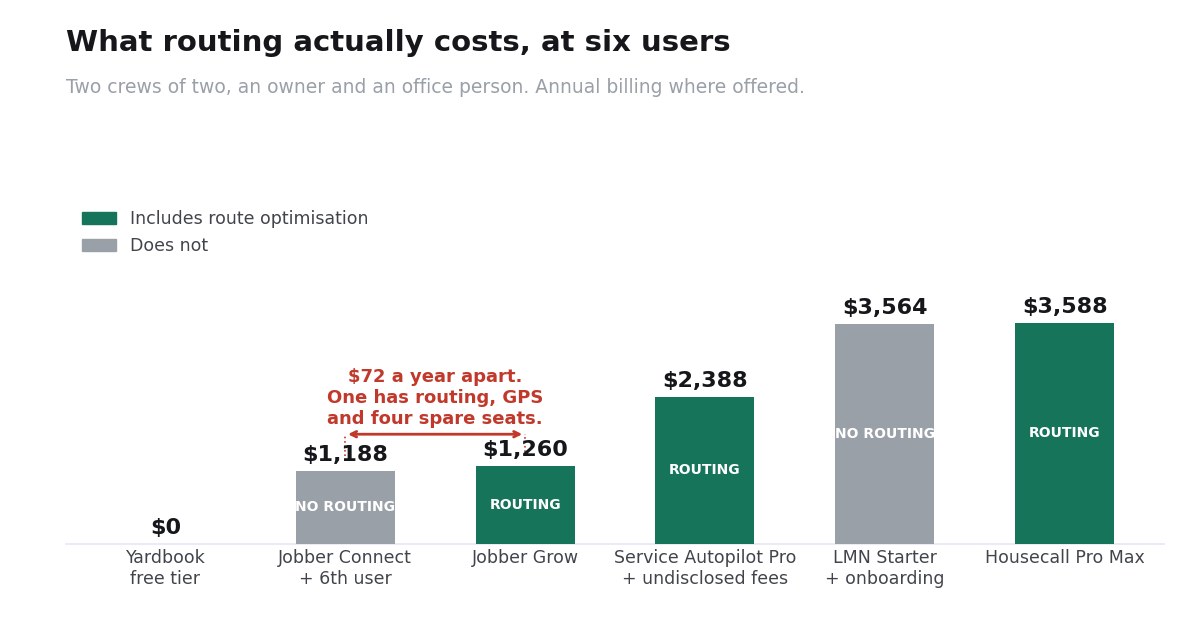
At two crews the comparison is still not close. Jobber Grow is $210 a month for ten users; Service Autopilot Pro is $199 for one business user and two mobile licences, plus a sign-up fee and extra-user pricing that are not published. You can compare Jobber’s bill in advance. You cannot compare Service Autopilot’s.
Three costs Service Autopilot does not put a number on
We do not think this makes it a bad product. We do think you should get all three in writing before you sign, because on a $199-a-month plan they are the difference between a fair price and a surprise.
- The sign-up fee. Every tier is listed as “plus sign-up fee” with no amount anywhere on the pricing page.
- Extra users. Pro includes one business user and two mobile licences. A two-crew operation with an owner and an office manager needs more than that, and the page says to contact customer success for the price.
- Payment processing. No card or ACH rate is published, and as our HVAC analysis shows, processing typically costs several times the subscription in field service.
Three numbers. Ask for them in one email before the demo, not after it.
What it costs at a realistic size
Two crews of two, plus an owner and someone in the office — six people.
| Platform | Plan | Users included | Per year | Routing? |
|---|---|---|---|---|
| Jobber | Grow | 10 | $2,520 then $3,588 | Yes |
| Jobber | Connect | 10 | $1,932 then $2,748 | No |
| Service Autopilot | Pro | 1 + 2 mobile (extras not published) | $2,388 + fees | Yes |
| LMN | Starter | 1 office + 5 crew | $3,564 | Yes (on the entry plan) |
| Housecall Pro | Max | 8 | $3,588 | Yes |
| Yardbook | Free tier | No published limit | $0 (ad-supported) | No |
Jobber and Housecall Pro at annual billing. LMN Starter is $297/mo plus a one-time onboarding fee it does not publish; Professional is $648/mo. Yardbook’s pricing page is not publicly accessible — third-party reviews report paid tiers around $35 and $50 a month, which we have not been able to verify at source.
Note the two Jobber rows. At two crews, Connect is $1,932 a year and gives you no routing. Grow is $2,520 — $588 more — and adds routing and GPS. From year two the gap widens to $840.
Set that against the drive-time arithmetic above. Two crews recovering 22 minutes a day across a 200-day season is roughly $11,000 of capacity at $75 a crew hour. Routing costs $588 to $840 a year. If you fill the recovered time with billable work, it returns thirteen to nineteen times its cost. If you do not, it returns a shorter day and nothing else — which is the question to settle before you upgrade.
The seasonality maths nobody publishes
Landscaping shuts down. In northern markets that is three or four months with no revenue, and the obvious instinct is to pay monthly so you can cancel over winter.
Run the numbers and the instinct is usually wrong.
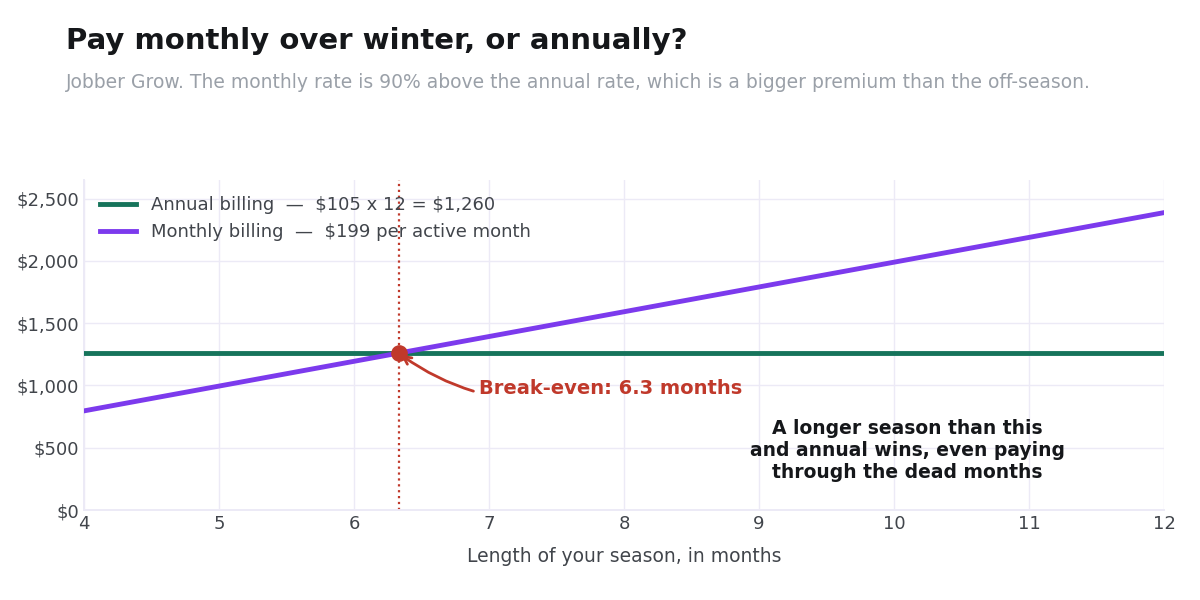
| Season length | Annual, year 1 | Annual, year 2 | Monthly ($399 × season) | Cheaper |
|---|---|---|---|---|
| 5 months | $2,520 | $3,588 | $1,995 | Monthly, both years |
| 6.3 months | $2,520 | $3,588 | $2,514 | Year-one break-even |
| 8 months | $2,520 | $3,588 | $3,192 | Annual in year one, monthly in year two |
| 9 months | $2,520 | $3,588 | $3,591 | Year-two break-even |
| 12 months (south, or snow work) | $2,520 | $3,588 | $4,788 | Annual, both years |
The break-even moves, and that is the point. In year one Jobber’s annual rate is introductory, so annual billing wins above 6.3 months. In year two the annual rate rises 42% while the monthly rate does not, and the break-even moves out to 9.0 months.
For a northern landscaper running an eight-month season, that means annual billing is right in year one and wrong in year two. Revisit the decision at renewal rather than letting it roll — on this example that is $396 a year.
Two things change this: if you run snow removal or holiday lighting through the winter, your season is twelve months and annual wins outright; and if a vendor lets you suspend an annual plan off-season, ask for that in the contract rather than assuming it.
The other place money leaks: the estimate
Routing protects the margin on work you have. Estimating decides whether there was a margin to protect.
Landscaping has a structural trap that most trades do not:
- An underbid installation loses money once. You quote a patio at $8,000, it costs $9,000, you lose $1,000 and you learn.
- An underbid maintenance contract loses money every week, all season, for as long as the contract runs. Price a weekly mow $8 low and that is $8 × 30 visits × however many years the client stays. The same mistake, compounded.
This is why the green industry teaches pricing from a cost per crew hour that includes overhead recovery — your trucks, insurance, office, equipment replacement — rather than from what the last contractor charged. Price the second way and you discover in November that a busy season produced no profit, without being able to say which contracts caused it.
That is the case for LMN, and it is a real one. LMN includes route optimisation on its entry plan, which none of the others do — but it is budgeting-and-estimating-led rather than scheduling-led: it exists to make you calculate your true hourly cost before you quote, and to job-cost against it afterwards. At $297 a month plus an unpublished onboarding fee it is expensive against Jobber, and it is aimed at a different problem.
Buy LMN if you cannot currently say which contracts are profitable. Buy Jobber if you know your numbers and the problem is executing the work efficiently. Those are different companies at different stages, and paying $3,564 to solve a problem you do not have is the overspend to avoid in this category.
What to buy
| Your situation | Buy | Per year |
|---|---|---|
| Solo operator, one truck, tight route | Yardbook free, or Jobber Core | $0–252 |
| One crew, routes still manageable by hand | Jobber Connect | $840 |
| Two or more crews — the routing threshold | Jobber Grow | $2,520, then $3,588 |
| You cannot say which contracts are profitable | LMN Starter | $3,564 + onboarding |
| You want deep automation and will pay for it | Service Autopilot Pro Plus | $5,988 + fees |
| Commercial maintenance bids and design-build | Pipedrive alongside the field tool | $468/seat |
For most landscaping businesses the answer is Jobber Grow at $2,520 in year one, $3,588 after. It is the cheapest route to route optimisation by a wide margin, it includes ten users where the nearest competitor includes one, and at two crews the recovered drive time is worth several times the price.
The spring problem, which is a different problem
Field software schedules work. It does not win it, and landscaping has a brutally compressed buying season: the phone rings in March and April, capacity for the whole year is effectively set in six weeks, and a call that goes to voicemail is a job a competitor can quote the same afternoon.
Missed-call text-back is the feature that matters in a six-week window, and unlimited users suits seasonal headcount. It is not a dispatch system and should not replace one. See GoHighLevel pricing.
Commercial maintenance contracts and design-build genuinely are a pipeline: a specification, competing bids, a decision date months out. A field service tool handles that poorly. See Pipedrive pricing.
The verdict
Buy for route density. It is the number that decides whether a landscaping business makes money, and it is the number the entry-level plans cannot help you with.
Jobber Grow, $2,520 in year one and $3,588 after, is the answer for most operations with two or more crews — routing and GPS included, ten users included, and $588 a year more than the Connect plan that has neither.
Pay annually unless your season is under about six and a half months, because the monthly premium is bigger than the winter you are trying to avoid paying for.
And if you cannot currently name your least profitable contract, fix that before you optimise anything — a tighter route on an underpriced maintenance agreement just loses money more efficiently.
We earn no commission from Jobber, Service Autopilot, LMN, Housecall Pro or Yardbook.
Common questions
What is the best CRM for a landscaping business?
For most, Jobber Grow at $210 a month in the 6-10 band — it is the cheapest plan on any platform that includes route optimisation, and it covers ten users. General CRMs do not dispatch crews or optimise routes, so they are the wrong category for maintenance work.
Which plan includes route optimisation?
Jobber Grow, Service Autopilot Pro and Housecall Pro Max. On every platform routing sits four to five times above the entry plan, so the cheap tier you were pricing does not include the feature that pays for the software.
How much does landscaping software cost?
Around $1,932 to $2,520 a year for a two-crew business on Jobber, rising to $2,748 to $3,588 from year two, $2,388 plus fees on Service Autopilot Pro, $3,564 plus onboarding on LMN Starter, and $3,588 on Housecall Pro Max. Yardbook has a free ad-supported tier.
Is LMN worth $297 a month?
If you cannot say which of your contracts are profitable, yes — it is built around costing and estimating rather than scheduling, and an underpriced maintenance contract loses money every week for its whole life. If you already know your cost per crew hour, you are paying $2,300 a year more than Jobber to solve a problem you have solved.
Should I pay monthly or annually if my season is short?
It depends on the year. Jobber’s annual rate is introductory, so in year one annual wins above 6.3 months; in year two the break-even moves to 9.0 months. An eight-month season should be annual in year one and monthly in year two. Run the same comparison on whichever platform you choose.
What is route density and why does it matter?
It is how tightly your jobs cluster geographically. Fifty properties in three neighbourhoods and fifty spread over thirty miles produce identical revenue and very different profit, because drive time is paid and unbillable. It is the main lever on revenue per crew hour.
Does route optimisation actually save money?
Only if you fill the recovered time with billable work. Two crews saving 22 minutes a day across a 200-day season recover about 147 hours; at $75 per crew hour that is $11,000 — but if you are not turning work away, it is a shorter day rather than more income. Decide which you are before buying the expensive tier.
What about estimating software specifically?
LMN is the estimating-led option and is built around overhead recovery. Jobber and Service Autopilot both quote from the field, which is enough if your pricing method is already sound. The tool does not fix a pricing method — it just applies whichever one you have faster.
Do I need separate software for snow removal?
Usually not — the same platforms schedule and invoice winter work, and running twelve months makes annual billing clearly the cheaper option. Confirm your platform handles per-event and seasonal-contract billing, which are different from a mowing schedule.
KEEP EXPLORING