 MailerLite
 ActiveCampaign
 Omnisend
 Klaviyo
 SE Ranking
 Mangools
 Semrush
 Ahrefs
 Pipedrive
 Zoho CRM
 Salesforce
 HubSpot
 Systeme.io
 GoHighLevel
 ClickFunnels
 Vendasta
ClickFunnels review
The most polished funnel builder in the category, priced like a premium tool and now capped by contact count, so the real bill climbs faster than the sticker.
Ratings from G2 (413 reviews), Capterra (666) and Trustpilot (~4.0, ~2,324 reviews), pricing verified October 11, 2026.
The verdict
ClickFunnels is the tool that taught a generation of marketers what a sales funnel is, and the 2.0 platform is still the most refined version of that idea you can buy. The editor is the best in the category, the template library is the largest, and the checkout engine (order bumps, one-click upsells, downsells, failed-payment retries) is genuinely strong revenue infrastructure. If your business lives or dies on a multi-step funnel that turns a cold click into a $497 order with two upsells stacked behind it, very few tools convert as cleanly out of the box. Plan-by-plan numbers, add-ons and real team bills are in our ClickFunnels pricing 2026 breakdown.
The problem is the math. ClickFunnels starts at $97 per month, or about $81 per month if you pay for a year up front, and that is before the part nobody mentions on the homepage. In June 2025 the company restructured pricing and put contact caps on every new plan. The entry Launch plan holds 10,000 contacts. Cross that line and there is no graceful overage on the pricing page: you contact sales, and in practice you upgrade to the next tier, which roughly doubles the annual rate from about $81 to $164 a month. The independent ratings tell the same story. G2 sits at 4.6 across 413 reviews and Capterra at 4.5 across 666, both strong, but Capterra’s lowest sub-score by a clear margin is Value for Money at 4.1, and Trustpilot, which skews more critical, lands near 4.0 across roughly 2,324 reviews with reliability and bugs as the dominant complaint.
So the Lab Score is 7.9. That is a good tool, not a cheap one, and our scoring rewards value for what you get. ClickFunnels loses points where it should: price, the new caps that force upgrades as your list grows, deliverability that trails dedicated email tools, and an LMS that is thin next to course-first platforms. It keeps points where it earns them: a category-leading editor, the deepest checkout toolkit here, and an all-in-one bundle that can genuinely replace four or five subscriptions if you actually use all of it. If you do not need the upsell-and-checkout machinery, a cheaper capable tool will leave you more satisfied, and the satisfaction data backs that up.
What ClickFunnels really costs at scale
The short version is below. For the plan-by-plan detail, the full add-on table and the ways to pay less, see our dedicated ClickFunnels pricing breakdown.
Every ClickFunnels plan bills the same core product. Unlimited funnels, unlimited landing pages, unlimited visitors, A/B testing, checkout, email, and courses are included on all four tiers. The only thing that changes as you move up is the contact cap, the monthly email-send allowance, and the number of workspaces and team seats. That is unusual, and it matters: you are not paying more for better funnels, you are paying more to hold a bigger list.
Here is the real picture across the tiers, with annual billing (the cheaper way to pay) shown alongside the monthly rate.
| Plan | Monthly | Annual (per mo) | Annual total | Contacts | Emails/mo |
|---|---|---|---|---|---|
| Launch | $97 | $81 | $970 | 10,000 | 50,000 |
| Scale | $197 | $164 | $1,970 | 75,000 | ~200K to 300K |
| Optimize | $297 | $248 | $2,970 | 150,000 | ~700K to 750K |
| Dominate | annual only | ~$500 | $5,997 | 400,000 | 1.2M |
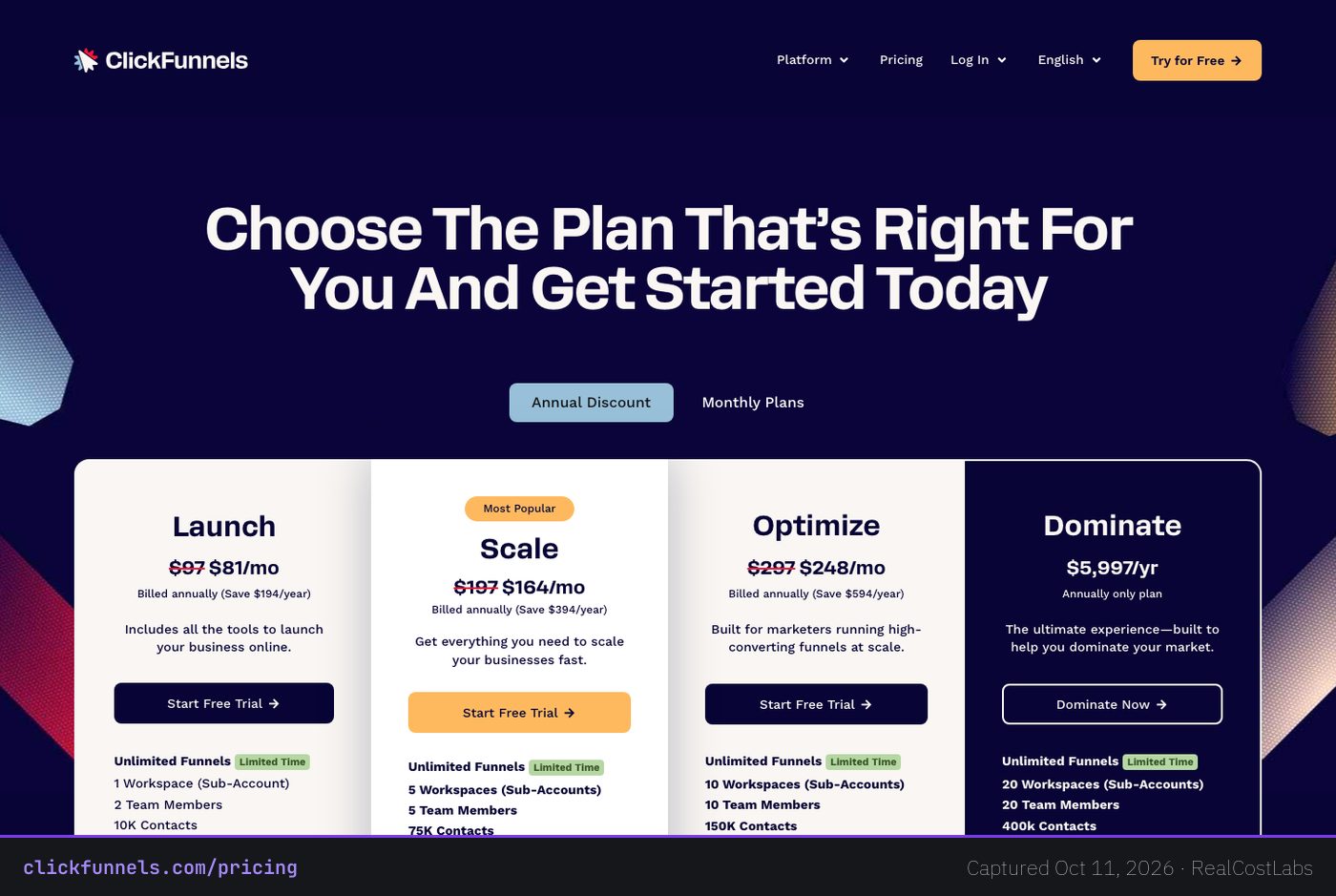
Read the email column carefully, because the published sources do not fully agree. On Scale, Leadpages lists 300,000 sends a month while Ruzuku lists 200,000, so treat that band as approximate until you confirm it with sales for your account. Optimize lands somewhere around 700,000 to 750,000. The figures we are most confident about are the prices and the contact caps, which are consistent across sources.
Now the part that decides your actual annual cost. A solo seller or small business on Launch pays $970 for the year, which is fair for what the platform does. But the 10,000-contact ceiling arrives quickly if you run any real lead generation, because contacts accumulate: every opt-in, every buyer, every abandoned-cart address counts against the cap. The moment you cross 10,000 you are pushed to Scale at $1,970 a year. That single step, a list growing from 9,900 to 10,100, roughly doubles your bill. There is no documented pay-as-you-go overage to soften it, which is the genuine cost-escalation trap in 2026 and the reason Value for Money is the weakest dimension in the ratings.
One thing ClickFunnels does not do is mark up your payments. Checkout runs on Stripe and PayPal, so the processing fee (about 2.9% plus $0.30 per transaction) is the processor’s own rate, not a platform surcharge on top. That is worth saying plainly, because some all-in-one tools take a cut of sales, and ClickFunnels does not.
Conversion toolkit and deliverability: the performance that matters
For a funnel builder, the core performance question is not “can it send a newsletter,” it is “how much revenue does the funnel capture per visitor.” That is where ClickFunnels is strongest. The checkout stack is the most complete in this category: pre-purchase order bumps, true one-click upsells and downsells after the initial sale, and smart retries on failed payments so you recover charges that would otherwise vanish. A/B split testing is built in, and the analytics tie results to conversion and per-campaign revenue rather than just clicks, so you can see which variant actually made money. Paired with the editor and template library, that is the reason ClickFunnels keeps winning head-to-head funnel comparisons in 2026.
Email deliverability is the weak spot. ClickFunnels is a funnel platform with email attached, not a dedicated email service, and there is no independently audited inbox-placement test for it the way EmailToolTester runs seed tests on standalone email tools. ClickFunnels’ own guidance frames success around bounce-rate targets instead of inbox placement: roughly 2% bounce at 500 contacts, about 1.6% at 1,000, and around 1.2% once you are above 1,000. Those are reasonable internal benchmarks, but they measure bounces, not whether your campaign reached the inbox or the promotions tab. In practice, deliverability here trails purpose-built email tools, and competitors lean on that gap. GoHighLevel openly markets stronger deliverability as a reason to switch.
The practical takeaway: run your funnels, checkout, and transactional and behavioral emails on ClickFunnels, and if you send high-volume broadcast campaigns to a large list, consider keeping a dedicated email tool for those sends. The funnel is the asset you are paying for. Treat the email as good enough for lifecycle messaging rather than as a replacement for a serious email service.
Features, in depth
ClickFunnels 2.0 is marketed as an all-in-one platform, and the bundle is real. Under one login you get more than a dozen tools, and the value of the package depends entirely on how many of them you would otherwise pay for separately.
- Funnel and page editor. A drag-and-drop builder that is the most praised in the category, backed by the largest template library here. This is the headline reason to choose ClickFunnels.
- Smart checkout. Order bumps, one-click upsells, downsells, and failed-payment retries. The revenue engine, and the feature set rivals struggle to match at this depth.
- Email and automation. Broadcast and sequence email with behavioral triggers, so actions inside a funnel can fire follow-up automations.
- Courses, memberships, and community. Host paid courses, gate member content, and run a community space. Useful, though the course features are basic next to dedicated platforms.
- Store and CRM. A lightweight ecommerce store plus CRM pipelines to track contacts and deals.
- Booking, surveys, and countdowns. Appointment scheduling, surveys and quizzes for lead capture, and countdown funnels for time-limited offers.
- Affiliate center. A built-in affiliate management system so you can run your own affiliate program for your offers.
- 2026 AI and developer tools. AI-assisted funnel and copy creation, an AI chatbot, a REST API V2, and an official MCP server that lets Claude and other AI agents connect to your account directly.
The official MCP server is a notable 2026 addition. It means you can point an AI agent at your ClickFunnels data through a standard protocol, which is ahead of where most competitors are on AI integration. Whether you need it is another question, but it is there.
Ease of use
The editor itself is approachable. Dragging blocks onto a page, swapping a template, and wiring up a checkout step are all things a non-developer can do in an afternoon, and the template library means you rarely start from a blank canvas. That is the approachable part.
The learning curve comes from the breadth. ClickFunnels bundles a dozen-plus apps, and learning how funnels, email automation, courses, the CRM, and the store fit together takes real time. The platform is easy to start and harder to master across everything it does. Two other friction points stand out. Deep template customization is difficult without touching code, so pixel-precise design work can fight you, and the funnel architecture is proprietary, which means workflows you build here do not move cleanly to another platform. That lock-in is partly by design, and it is the cost of the all-in-one convenience.
Who it is for
ClickFunnels is built for sellers whose business is the funnel. If you run paid traffic into a multi-step offer with order bumps and upsells, sell courses or coaching with a real checkout sequence, or launch products where the post-purchase upsell flow is where the margin lives, this is a tool that pays for itself when the funnel performs. It also suits operators who genuinely want one login for funnels, email, courses, a store, and an affiliate program, and who will use enough of that bundle to justify the price.
It is the wrong tool if you mainly need landing pages and lead capture without a checkout, if you are price-sensitive and your list is growing fast (the caps will catch you), if course delivery is your core product and you need quizzes and gradebooks, or if high-volume email is central and deliverability is your priority. In those cases a cheaper or more specialized tool will serve you better, and you will likely be happier, which is exactly what the satisfaction scores suggest.
Three real-world scenarios
The course creator launching a $497 program with upsells
This is ClickFunnels at its best. You build the sales funnel, add an order bump and a one-click upsell, host the course, and run the affiliate program for your launch partners, all in one place. On Launch at $970 a year you are fine until your contact list crosses 10,000. If your launch list grows past that, budget for Scale at $1,970. The checkout and upsell engine is the reason the funnel earns more per buyer, and that usually covers the cost.
The agency managing funnels for ten clients
Here the caps bite. Ten clients means ten growing contact lists sharing your workspace allowance, and you will climb the tiers fast. This is precisely the profile that outgrows ClickFunnels and looks at GoHighLevel, which offers unlimited contacts and white-label client accounts. If you are running client work at volume, price out the alternative before you commit a year to ClickFunnels.
The solo seller who just needs a landing page and an email capture
This is the overpay case. If you do not need a multi-step checkout with upsells, $970 a year for ClickFunnels is more tool than the job requires. A landing-page specialist or a cheaper all-in-one will cover lead capture for a fraction of the cost, and you will not be paying for a checkout engine you never switch on.
ClickFunnels vs the alternatives
ClickFunnels is the polished incumbent, but three tools take real bites out of it depending on what you need. Here is how they line up.
| Tool | Best for | Contacts | Starting price | Edge over ClickFunnels |
|---|---|---|---|---|
| ClickFunnels | Funnels with upsells | 10K cap (Launch) | $81/mo | Best editor, deepest checkout |
| GoHighLevel | Agencies, services | Unlimited | from $97/mo | No caps, CRM, SMS, white-label |
| Kartra | Coaches, creators | tiered | from $52/mo | Deeper all-in-one integration |
| Leadpages | Landing pages | tiered | from $10/mo | Cheaper, stronger pure landing pages |
GoHighLevel is the natural destination for users outgrowing ClickFunnels’ caps. It gives you unlimited contacts with no per-funnel or per-contact ceiling, a full CRM, SMS, appointment scheduling, white-label client accounts, and the stronger marketed email deliverability mentioned earlier. For agencies and service businesses managing many clients, it removes the exact constraint that makes ClickFunnels expensive at scale.
Kartra is the closest like-for-like all-in-one for coaches and course creators. It packs funnels, email, memberships, a helpdesk, video hosting, and affiliate management into a stack that is more tightly integrated than ClickFunnels, so the pieces feel like one product rather than a dozen apps under a shared login. If the bundle is the point and you want it to feel cohesive, Kartra is the comparison to run.
Leadpages is the cheaper specialist, and the caveat is that it is not a full funnel builder. It excels at landing pages and lead capture with strong conversion tooling, but it has no native multi-step checkout or upsell funnels. If your real need is pages and opt-ins rather than a sales sequence, Leadpages does that job for less. If you need the checkout machinery, it cannot replace ClickFunnels.
Pros and cons
- Pro: The best drag-and-drop funnel editor and the largest template library in the category.
- Pro: The deepest checkout toolkit here: order bumps, one-click upsells, downsells, and failed-payment retries.
- Pro: A genuine all-in-one bundle (12-plus tools) that can replace several subscriptions if you use it fully.
- Pro: A/B testing with per-campaign revenue tracking, so you optimize for money, not just clicks.
- Pro: Strong independent ratings (G2 4.6, Capterra 4.5) and no markup on payment processing.
- Pro: 2026 AI features plus a REST API V2 and an official MCP server for AI-agent access.
- Con: Premium price, and Value for Money is the lowest-rated dimension (Capterra 4.1).
- Con: June 2025 contact caps with no documented overage, so crossing a cap forces a costly upgrade.
- Con: Email deliverability trails dedicated email tools, and there is no audited inbox-placement figure.
- Con: Thin LMS (no quizzes, assignments, or gradebooks) and no native mobile app for students.
- Con: High learning curve across the bundle, hard template customization without code, and proprietary lock-in.
- Con: Reliability and bugs are the dominant complaint on Trustpilot and Reddit.
FAQ
How much does ClickFunnels cost in 2026?
The Launch plan is $97 per month, or about $81 per month ($970 per year) on annual billing. Scale is $197 per month (about $164 annually, $1,970 per year), Optimize is $297 per month (about $248 annually, $2,970 per year), and Dominate is annual-only at $5,997 per year. All plans include a 14-day free trial and a 30-day money-back guarantee.
Does ClickFunnels have a free plan?
No. There is no permanent free plan. You get a 14-day free trial and a 30-day money-back guarantee, but after that every tier is paid, starting at $97 per month.
What are the new contact caps and why do they matter?
In June 2025 ClickFunnels added contact caps to all plans. Launch holds 10,000 contacts, Scale 75,000, Optimize 150,000, and Dominate 400,000. They matter because there is no published pay-as-you-go overage. When you exceed a cap you contact sales and effectively upgrade to the next tier, so crossing 10,000 contacts roughly doubles your annual cost from about $81 to $164 a month.
Is ClickFunnels worth the price?
It is worth it if your revenue depends on a multi-step funnel with upsells and checkout, where the conversion toolkit pays for itself. If you mainly need landing pages or low-volume email, it is more expensive than the job requires, and Capterra’s Value for Money score of 4.1 (its lowest dimension) reflects that price tension.
How is ClickFunnels’ email deliverability?
It is a relative weakness. ClickFunnels is a funnel platform, not a dedicated email service, and there is no independently audited inbox-placement figure for it. Its own guidance targets bounce rates (around 1.2% above 1,000 contacts) rather than inbox placement. For high-volume broadcasts, a dedicated email tool will usually deliver better.
What is the best ClickFunnels alternative?
It depends on why you are leaving. For agencies and anyone hitting the contact caps, GoHighLevel offers unlimited contacts and white-label accounts. For a more integrated all-in-one for coaches, look at Kartra. If you only need landing pages and not a checkout funnel, Leadpages is cheaper.
Does ClickFunnels charge extra fees on sales?
No. Checkout runs through Stripe and PayPal, so you pay their standard processing fee (about 2.9% plus $0.30 per transaction). ClickFunnels does not add its own percentage on top of your sales.
Can ClickFunnels replace a course platform like Teachable?
Partly. It can host and sell courses and memberships, which is enough if the course is a side product. But its LMS is basic: no quizzes, assignments, or gradebooks, and no native mobile app for students. If course delivery is your core product, a dedicated platform will go deeper.
KEEP EXPLORING
Ready to try ClickFunnels?
Start with the 14-day free trial and a 30-day money-back guarantee, then watch your contact count before it pushes you to the next tier.
Try ClickFunnels →RealCostLabs is independent and reader-supported. We may earn a commission on purchases made through our links, at no extra cost to you, and our scores are never for sale.