 MailerLite
 ActiveCampaign
 Omnisend
 Klaviyo
 SE Ranking
 Mangools
 Semrush
 Ahrefs
 Pipedrive
 Zoho CRM
 Salesforce
 HubSpot
 Systeme.io
 GoHighLevel
 ClickFunnels
 Vendasta
GoHighLevel review
The agency platform that replaces ten tools, if you survive the learning curve and read the usage meter.
Ratings from G2 (~600 reviews), Capterra (89) and Trustpilot (~4.9 from ~13,750 reviews), pricing verified October 11, 2026.
The verdict
GoHighLevel (the company calls itself HighLevel) is the strongest all-in-one platform for marketing agencies that will genuinely use white-label resale to build recurring client revenue. That is the whole thesis, and it is worth saying plainly because most reviews bury it. If you run an agency, put the platform on the Agency Pro plan at $497 per month, rebrand it as your own software, and resell it to your clients with a markup, the math works and the consolidation pays for itself fast. If you are a solo operator or a small business that wants one polished tool to send some email and book some calls, GoHighLevel is the wrong shape: you will hit the learning curve, the deliverability friction, and a usage meter that quietly adds to your bill every month. Plan-by-plan numbers, add-ons and real team bills are in our GoHighLevel pricing 2026 breakdown.
Our Lab Score of 8.1 reflects that split. The capability is real and broad. The independent satisfaction data is mixed once you strip out the inflated Trustpilot number. The headline price understates the true cost by a meaningful margin. And the one performance dimension that matters most for a tool that sends email at volume, deliverability, has no neutral lab score behind it. Capable, yes. The cheapest capable option for most people, no. Below we show the actual numbers and where they came from.
What GoHighLevel really costs, at scale
The short version is below. For the plan-by-plan detail, the full add-on table and the ways to pay less, see our dedicated GoHighLevel pricing breakdown.
The plan price is the part everyone quotes and the part that matters least. GoHighLevel sells three public tiers plus a custom Enterprise plan. Annual billing is priced at ten times the monthly rate, so you pay for ten months and get twelve, which is roughly two months free. Here are the verified numbers from the official pricing page.
| Plan | Monthly | Annual | What you get |
|---|---|---|---|
| Starter | $97 | $970 | 3 sub-accounts (locations), unlimited contacts, unlimited users. No white-label, no API, no SaaS mode. |
| Unlimited | $297 | $2,970 | Unlimited sub-accounts, basic API access. No white-label, no SaaS mode. |
| Agency Pro / SaaS Pro | $497 | $4,970 | Unlimited sub-accounts, advanced API, white-label, SaaS Mode (rebill and resell with markup), white-label mobile app. |
| Enterprise | Custom quote | Custom quote | Contact sales. |
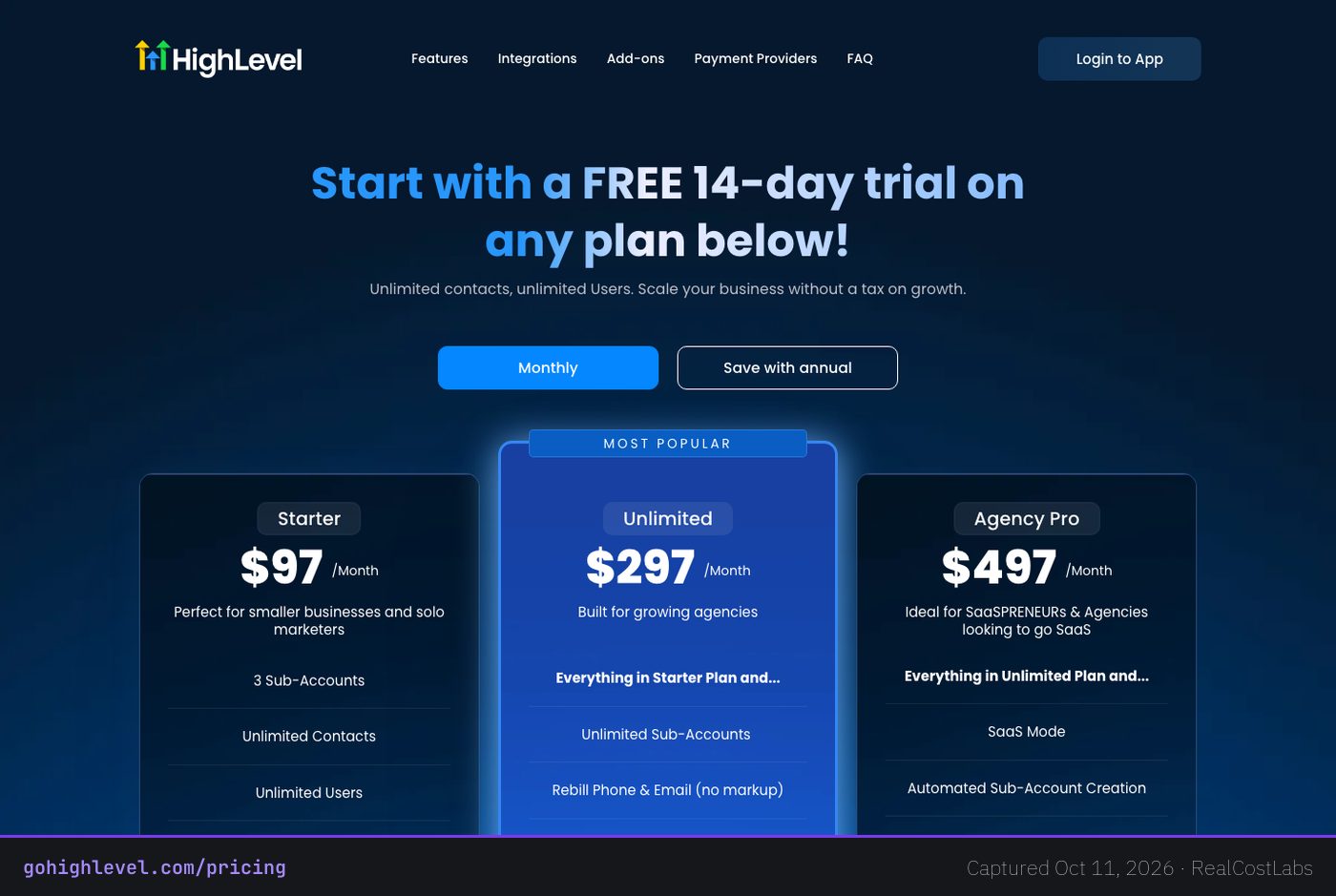
Now the part the pricing page does not show. The plan does not include the messages you send. Email, SMS, voice, and the AI features run on usage billing through a prepaid wallet, charged at live rates through Twilio (telephony and SMS) and Mailgun (email, branded inside the product as LC Email). The rates are small per unit and add up quickly at agency volume:
- US SMS runs about $0.0079 per segment, and a single long text message is several segments, so a real campaign costs more per recipient than the per-segment number suggests. MMS runs about $0.02 to $0.03.
- Email runs about $0.675 per 1,000 sends. Voice calls run about $0.014 per minute. A local phone number is about $1 to $2 per month, with a separate monthly fee for a toll-free number.
- The AI Employee add-on is about $97 per month for the core AI suite (Conversation AI, Voice AI, Content AI, Workflow AI) under a fair-use policy, billed on top of your plan. The Voice AI runs on GPT-5 Mini with sub-600ms latency in 2026.
- Premium Support is a paid add-on. Standard support is included; faster response, a dedicated Technical Account Manager, a private Slack channel, and Quarterly Business Reviews cost extra.
So what does a realistic month actually cost? By our estimate, a solo user or small agency on the Unlimited plan ($297) running modest email plus SMS plus a few AI features lands around $330 to $450 all-in, and an agency on Agency Pro ($497) reselling to clients with active AI and voice usage runs $600 to $800 or more before any reselling revenue comes back. In plain terms, the plan price understates your true monthly cost by $50 to $300 or more, depending on volume. The way to budget GoHighLevel is plan price, plus wallet (SMS, email, voice), plus the optional $97 AI Employee, plus optional Premium Support. Quote yourself that full number before you commit, not the $97 on the homepage.
Email deliverability: the number that matters, and the number nobody can verify
For any platform whose main job is sending email and SMS, deliverability is the performance dimension that decides whether the rest of the feature list means anything. A funnel builder is useless if the confirmation email lands in spam. This is where GoHighLevel deserves the most scrutiny, because the vendor claims and the independent reality do not line up.
GoHighLevel self-reports strong numbers. Its own November 2025 report says the platform sent 1.37 billion emails at 96.04% delivery, with 38.56% opens and a 4.14% click-through rate, and a separate company page claims 97.4% delivery. Those are vendor-published figures, not independent tests, and they describe the whole platform in aggregate, not your account.
Here is the reality check. EmailToolTester, the lab that runs neutral deliverability tests on email services, does not list or independently test GoHighLevel as a standalone sending platform, so there is no neutral score for it. For context, that lab’s tested average across the real email services it does measure sits around 83.1%, and it treats anything above 89% as excellent. GoHighLevel sends on shared Mailgun infrastructure, which means your sender reputation is partly tied to the behavior of other GoHighLevel users on the same shared IP pool. There is no native throttling, so a bulk send dumps to the mail servers at full speed rather than pacing itself. Getting good inbox placement realistically requires setting up a dedicated sending domain and IP yourself.
The bottom line: treat the 96 to 97% figure as a marketing claim, not a verified deliverability rate. In practice, deliverability on GoHighLevel is inconsistent and depends heavily on how you configure your sending infrastructure. That is a fixable problem if you know what you are doing, and a painful surprise if you do not.
Features, in depth
The reason agencies tolerate the cost and the learning curve is consolidation. GoHighLevel genuinely replaces five to ten separate subscriptions with one login, and for an agency juggling a stack of tools that is the entire value proposition. The core includes:
- CRM and pipelines: contact management with visual sales pipelines and opportunity tracking.
- Multi-channel messaging: email, SMS, and two-way texting in one conversation view.
- Funnel, website, and landing-page builder: drag-and-drop pages without a separate page tool.
- Calendars and booking: appointment scheduling tied to the CRM.
- Reputation management: automated review requests to lift a client’s star ratings.
- Membership and course platform: host paid courses and member areas.
- Forms and surveys: lead capture wired into automations.
- Native phone system: calling and IVR built in, billed through the usage wallet.
- Workflow automation: the engine that ties triggers, messages, and pipeline moves together.
The feature that no mainstream rival matches is white-label SaaS Mode on the Agency Pro plan. It lets an agency rebrand the entire platform as its own software and resell it to clients at a markup it sets. That turns a tool you pay for into a product you sell, with recurring revenue, and it is the single biggest reason agencies pick GoHighLevel over a conventional CRM. On top of that sits the 2026 AI Employee suite: Conversation AI, Voice AI on GPT-5 Mini, Content AI, Reviews AI, and Funnel and Workflow AI. The financial case is consolidation: collapsing five to ten subscriptions into one bill. That saving is real, but only if you were actually paying for all those tools to begin with.
Ease of use
This is the platform’s clearest weakness, and the data agrees. On Capterra, where GoHighLevel holds a 4.2 out of 5 overall, the Ease of Use sub-score is only 3.7, the lowest of its category scores alongside Customer Service. That number reflects a steep learning curve and an interface that is overwhelming when you first open it. There is a feature for nearly everything, which is the point, but it also means a new user faces a dense dashboard with little hand-holding.
For an agency with someone willing to spend the time to learn the system, that pays off and becomes routine. For a small-business owner who wanted to send a newsletter this afternoon, it is a wall. Be honest with yourself about which of those two people you are, because the tool does not get simpler, you get more fluent.
Who it is for
GoHighLevel is for marketing agencies that will actually use white-label resale. If you manage multiple clients, want to sell software under your own brand, and will use SaaS Mode to do it, this is close to the best option available and the cost is easy to justify. It also fits power users who are consolidating a genuine stack of five or more tools and have the patience to learn one dense system in exchange for one bill.
It is a weak fit for non-agency small businesses that want simple, polished, low-maintenance tooling. Those buyers hit the learning curve, the deliverability friction, and the stacked usage fees, and they would be happier with a focused tool that does one job cleanly. It is also a poor fit for anyone who needs reliable high-volume email out of the box without configuring their own sending domain and IP.
Three real-world scenarios
The agency reselling to 20 clients
You run a marketing agency on Agency Pro ($497 per month), white-label the platform, and resell sub-accounts to 20 clients at, say, $297 each. Even after the wallet costs for everyone’s SMS, email, and AI usage push your real bill past $700 or $800 a month, the resale revenue dwarfs it. This is the scenario the platform was built for, and the only one where the Agency Pro price is obviously the right call.
The solo consultant on Unlimited
You are a one-person shop on the Unlimited plan ($297) using the CRM, a couple of funnels, and modest email and SMS. Your real cost lands around $330 to $450 once the wallet is counted. You get a lot of capability, but you are paying agency-tier money for tools a focused $30 to $50 stack would also cover, and you carry the learning curve alone. It works, but the value is thin unless you grow into the resale model.
The small business that just wanted email
You are a local business owner who signed up to send newsletters and booking reminders. Two weeks in, you are still wiring up workflows, a chunk of your first campaign landed in spam because you sent on the shared pool without a dedicated domain, and the bill is higher than the $97 you expected. This is the mismatch to avoid: the platform is not wrong, it is simply built for someone else.
GoHighLevel vs the alternatives
GoHighLevel sits in a crowded field, but only a few rivals compete on the same ground. The table below frames the trade-offs.
| Tool | From | Best for | The catch |
|---|---|---|---|
| GoHighLevel | $97 | Agencies reselling white-label software | Learning curve, usage fees, shared-IP deliverability |
| Vendasta | from $99/mo | Agencies building a reseller marketplace | Closest white-label rival; built around resold services |
| HubSpot | from $0/mo | Deeper CRM and reporting depth | Per-seat pricing gets far more expensive at scale |
| Keap | from $249/mo | Small-business CRM with invoicing and e-commerce | Simpler, but no white-label or SaaS resale |
The sharpest head-to-head for agencies is Vendasta, the closest white-label rival, since both offer rebrandable dashboards, multi-client management, and a resellable marketplace; choose between them on whether you want to resell your own platform (GoHighLevel) or resell a marketplace of services (Vendasta). For teams that care more about CRM depth and reporting than agency resale, HubSpot is the more serious CRM, with deeper analytics and a large integration library, but its per-seat pricing makes it far costlier as you add users. And Keap is the gentler small-business option with marketing automation, invoicing, and e-commerce built in, simpler to learn than GoHighLevel but with no white-label or resale mode at all. Funnel-only buyers should look at ClickFunnels, email-automation specialists at ActiveCampaign, and budget solopreneurs at Systeme.io, but none of those replace the full agency stack the way GoHighLevel does.
Pros and cons
What works:
- Genuine consolidation: one platform replaces five to ten tools in one bill.
- White-label SaaS Mode on Agency Pro turns the tool into a product you resell with your own markup.
- Broad feature set: CRM, funnels, calendars, reputation management, courses, a native phone system, and a 2026 AI suite on GPT-5 Mini.
- Unlimited contacts and unlimited users on every tier, including the $97 Starter plan.
- A developer marketplace with 1,500-plus apps, plus native integrations and Zapier and Make support.
- The company replies to close to 100% of negative reviews, which signals it is at least paying attention.
What does not:
- Steep learning curve and an overwhelming interface; Capterra Ease of Use sits at just 3.7 out of 5.
- Email deliverability is inconsistent on shared Mailgun infrastructure with no native throttling, and there is no independent lab score behind the vendor’s 96 to 97% claim.
- Usage-based costs for SMS, voice, and the $97 AI add-on stack on top of the plan.
- Customer support is rated mediocre by review platforms (Capterra Customer Service 3.7) unless you pay for Premium Support.
- A rating credibility gap: a 4.9 on Trustpilot against a 4.2 on Capterra points to review-solicitation inflation.
FAQ
How much does GoHighLevel really cost per month?
The plan is $97, $297, or $497 per month, but that is not your real cost. Email, SMS, voice, and AI run on usage billing on top. By our estimate, a solo user on the $297 Unlimited plan lands around $330 to $450 all-in, and an agency on the $497 Agency Pro plan with active AI and voice usage runs $600 to $800 or more before resale revenue. Budget plan plus wallet plus optional add-ons.
Is there a free trial or a free plan?
There is a 14-day free trial with full feature access, no charge during the trial, and you can cancel anytime. There is no permanent free plan. Many affiliate sites claim a 30-day trial, but the official pricing page states 14 days; extended 30-day trials only exist through specific partner links.
Why is GoHighLevel rated 4.9 on Trustpilot but 4.2 on Capterra?
The gap is the story. Trustpilot shows about 4.9 from roughly 13,750 reviews, but that score is inflated by GoHighLevel’s aggressive in-product review prompts, so treat it as marketing-driven rather than a neutral signal. The more grounded reads are G2 at 4.6 from around 600 reviews and Capterra at 4.2 from 89 reviews. Note that some affiliate sites claim a Capterra 4.6 from 1,200-plus reviews; the actual Capterra listing shows 4.2 from 89, so do not trust the 1,200 figure.
Is GoHighLevel’s email deliverability actually good?
The vendor self-reports 96 to 97% delivery, but those are its own figures, not an independent test, and no neutral lab publishes a deliverability score for it. It sends on shared Mailgun infrastructure with no native throttling. Good inbox placement realistically requires configuring your own dedicated sending domain and IP.
What is SaaS Mode and do I need it?
SaaS Mode, on the $497 Agency Pro plan, lets you rebrand the whole platform as your own software and resell it to clients with your own markup, billing them automatically. You need it only if you run an agency and want recurring resale revenue. If you are not reselling, it adds nothing, and a cheaper plan is the right choice.
Is GoHighLevel worth it for a solo user or small business?
Usually not, unless you are consolidating a real stack of tools or planning to grow into agency resale. A solo user or small business hits the learning curve, the deliverability friction, and the stacked usage fees, and a focused single-purpose tool is cheaper for them.
What does the AI Employee add-on include and cost?
It is about $97 per month on top of your plan and bundles the core AI suite: Conversation AI, Voice AI (running on GPT-5 Mini with sub-600ms latency in 2026), Content AI, and Workflow AI, under a fair-use policy. It is optional, so leave it off if you do not need automated conversations or voice.
How does GoHighLevel compare to HubSpot and Vendasta?
HubSpot is the deeper CRM with stronger reporting, but its per-seat pricing makes it far more expensive at scale, so pick it for serious CRM depth rather than agency resale. Vendasta is the closest white-label rival and is built around reselling a marketplace of services, while GoHighLevel is built around reselling your own rebranded platform. For an agency choosing a resale model, those two are the real shortlist.
KEEP EXPLORING
Ready to try GoHighLevel?
Start the 14-day free trial, then budget the real cost: plan plus usage wallet plus any add-ons.
Try GoHighLevel →RealCostLabs is independent and reader-supported. We may earn a commission on purchases made through our links, at no extra cost to you, and our scores are never for sale.