 MailerLite
 ActiveCampaign
 Omnisend
 Klaviyo
 SE Ranking
 Mangools
 Semrush
 Ahrefs
 Pipedrive
 Zoho CRM
 Salesforce
 HubSpot
 Systeme.io
 GoHighLevel
 ClickFunnels
 Vendasta
Best CRM for financial advisors
This is not really a software decision. Your CRM notes are books and records under SEC Rule 204-2, the SEC has collected over $3 billion in penalties for failing to preserve exactly this kind of communication, and most general CRMs cannot meet the standard. Here is what the rule requires, what compliant software costs, and the two pricing cliffs nobody warns you about.
RealCostLabs is independent and reader-supported. We may earn a commission on purchases made through our links, at no extra cost to you, and our scores are never for sale.
Disclosure: we earn nothing from Redtail or Wealthbox, the two products we recommend most on this page. We do earn from Pipedrive, which we spend most of this page telling registered advisors not to buy. The one place it genuinely fits is marked and explained.
Not legal or compliance advice. This is a summary of published rules and public enforcement actions, written to help you ask your compliance officer the right questions. Your CCO or compliance counsel decides what your firm needs.
Your CRM notes are regulated records
Most CRM comparisons for advisors talk about integrations and pipelines. The binding constraint sits somewhere else entirely, and it is written down.
Under 17 CFR § 275.204-2, an investment advisor must make and keep:
- § 204-2(a)(7)(i) — “originals of all written communications received and copies of all written communications sent” relating to “any recommendation made or proposed to be made and any advice given or proposed to be given.”
- § 204-2(e)(1) — preserved for not less than five years from the end of the fiscal year in which the last entry was made, with the first two years in an appropriate office of the advisor.
- § 204-2(g)(2) — if stored electronically, arranged and indexed so they permit “easy location, access, and retrieval,” and you must be able to furnish “a legible, true, and complete copy.”
- § 204-2(g)(3)(i) — with procedures to safeguard the records “from loss, alteration, or destruction.”
Read that against how you actually use a CRM. If you write “discussed moving 40% to fixed income, client agreed” in a contact note, that note is a record of advice given. It has to survive five years, be produceable on request, and be protected from being quietly altered.
That is the specification. Not the pipeline view.
What the SEC has actually been fining people for
This is not a theoretical exposure. Since 2021 the SEC and CFTC have run a sustained enforcement campaign on exactly this rule, and it has produced some of the largest recordkeeping penalties in the agency’s history.
| Action | Entities | Civil penalties |
|---|---|---|
| Cumulative since 2021 | Over 100 | More than $3 billion |
| August 2024 sweep | 25 (broker-dealers, advisors, dual registrants) | Over $392 million |
| January 2025 sweep | 12 firms | $63.1 million (Blackstone $12m, KKR $11m, Schwab $10m, Apollo $8.5m) |
The rules cited were Advisers Act Rule 204-2(a)(7) and Exchange Act Rule 17a-4(b)(4). The channels were ordinary ones: text messages, iMessage, WhatsApp, Signal, personal email, LinkedIn messaging, WeChat. Firms were also charged with failing to reasonably supervise to prevent it.
Two things about this you should hold together. The headline numbers landed on very large firms, and a solo RIA is not facing a $12 million penalty. But the rule is the same rule for every registered advisor, the SEC has brought actions against stand-alone advisors, and the failure mode is not exotic — it is texting a client from your own phone about their portfolio.
Which is why “does this system capture and preserve client communications” belongs above every feature question on your list.
Why a general CRM usually fails this
HubSpot, Pipedrive and Zoho are good products. They are built for sales teams, and sales teams are allowed to delete things.
| What the rule needs | General CRM | Advisor CRM |
|---|---|---|
| Notes protected from silent alteration | Records are freely editable and deletable | Compliant note archiving |
| Five-year preservation you control | Tied to your subscription — cancel and access ends | Built around the retention period |
| Produce a legible, true and complete copy on request | Export exists; completeness is on you | Designed for examination requests |
| Compliant texting with clients | No | Available (Redtail Growth) |
| Vendor understands an SEC exam | No | Their entire customer base |
You can bolt compliance onto a general CRM — a separate archiving provider, written procedures, supervision. Firms do it. But you have then assembled the compliance obligation yourself, and you own every gap in the assembly.
The relevant question is not whether a general CRM can be made to work. It is whether you want to be the person explaining your assembly to an examiner.
Redtail changed how it charges, and the old plan is gone
If you have been in this industry a while, you remember Redtail as the cheap one: about $99 a month for a database covering up to fifteen users. That is not what its pricing page says any more.
| Redtail plan | Annual billing | Monthly | Users |
|---|---|---|---|
| Launch | $39/user/mo | $45 | Maximum 5 |
| Growth | $59/user/mo | $65 | Unlimited |
| Enterprise | Custom quote, with a minimum licence commitment | — | |
It is per user now. For a ten-person firm that remembers a flat $99, the same product at the Growth rate is $590 a month.
If you are still on a legacy per-database plan, price your renewal at the current rate before you assume it carries over. That is a conversation to have with your account manager well before the renewal date, not on it.
The sixth advisor costs $1,908
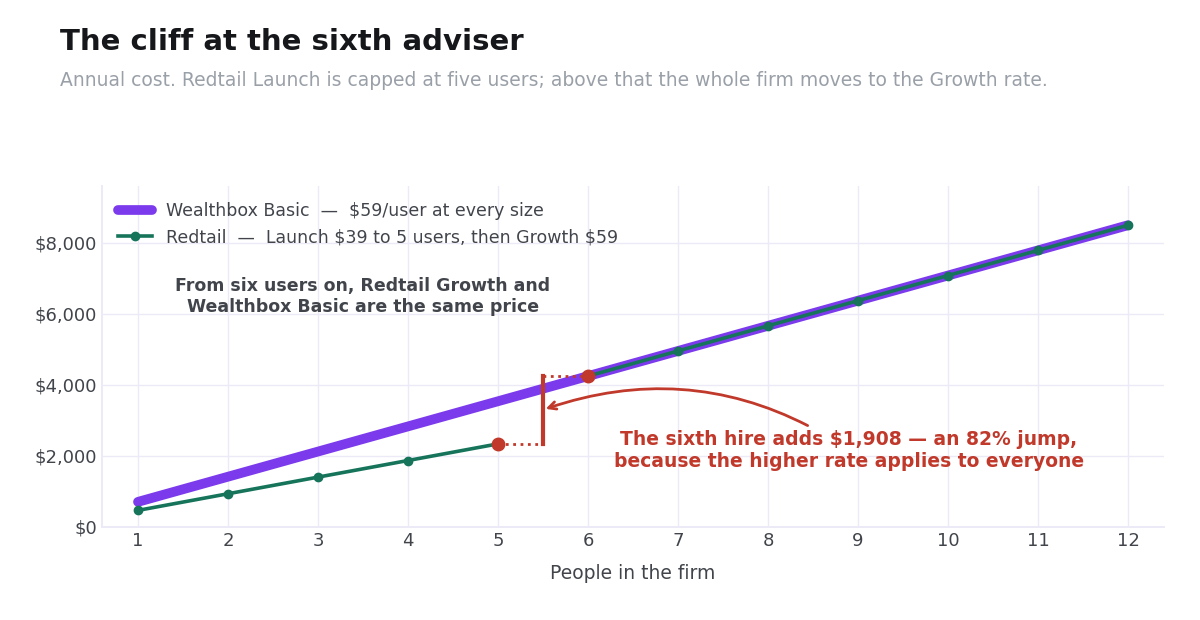
Here is the cliff. Redtail Launch is capped at five users. The moment you hire a sixth person, everybody moves to Growth — and the higher rate applies to the whole firm, not just the new hire.
| Headcount | Plan | Rate | Per year |
|---|---|---|---|
| 5 people | Launch | $39/user | $2,340 |
| 6 people | Growth | $59/user | $4,248 |
| Cost of the sixth person | $1,908 — an 82% increase | ||
One hire, and the software bill nearly doubles. Worth knowing before you make the offer, and worth asking Redtail about if you are at four or five people and growing.
What it costs, side by side
A five-person firm
| Product | Category | Per user | Per year |
|---|---|---|---|
| Zoho CRM Standard | General | $14 | $840 |
| Redtail Launch | Advisor | $39 | $2,340 |
| Pipedrive Growth | General | $39 | $2,340 |
| Redtail Growth | Advisor | $59 | $3,540 |
| Wealthbox Basic | Advisor | $59 | $3,540 |
| Wealthbox Pro | Advisor | $75 | $4,500 |
| Wealthbox Premier | Advisor | $99 | $5,940 |
| HubSpot Sales Professional | General | $100 | $6,000 + onboarding |
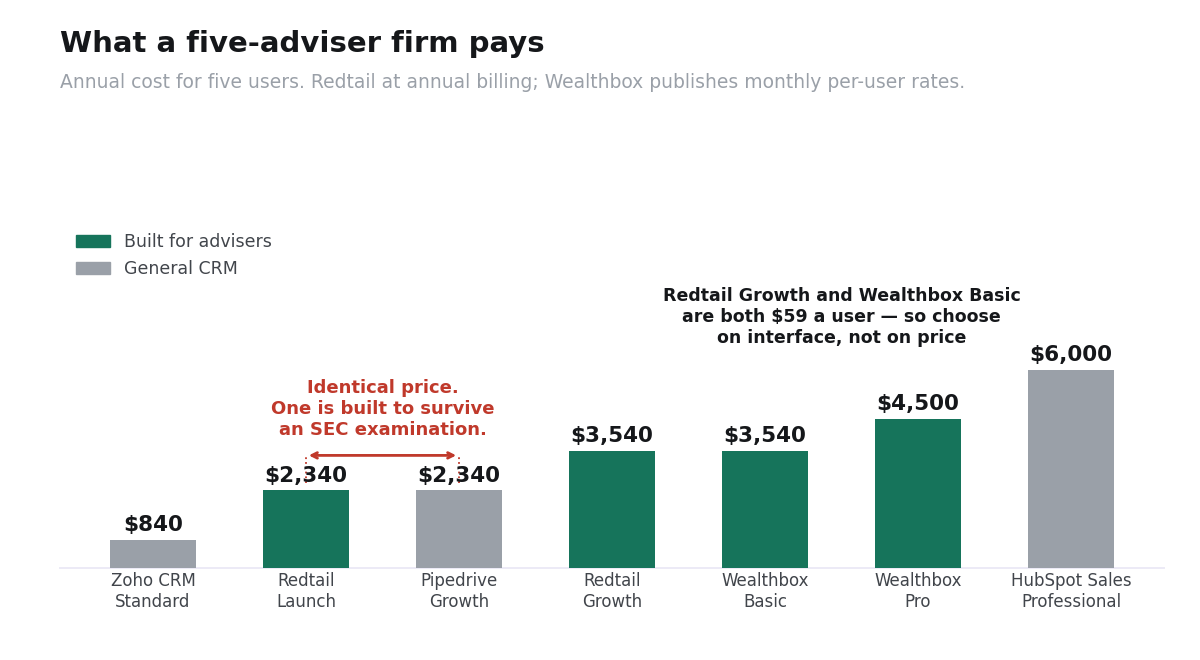
Redtail at annual billing. Wealthbox publishes monthly per-user rates and does not advertise an annual discount. Wealthbox lists compliant note archiving from Basic; two-way email sync from Pro. AI notetaker is $49 per user per month extra.
Look at the two bold rows. At five users, Redtail Launch and Pipedrive Growth cost exactly the same — $39 a user, $2,340 a year. One of them is built for advisors who will be examined. The other is built for sales teams.
Whatever the argument for a general CRM in this industry is, at five users it is not price. The specialist tool costs the same.
Only Zoho is genuinely cheaper, at $840 — a saving of $1,500 a year, against assembling your own recordkeeping compliance around a product that was not designed for it.
The cost that is not on any invoice: integrations
Advisor CRMs are not really sold on features. They are sold on what they connect to — your custodian, your portfolio accounting, your financial planning software, your e-signature, your archiving provider.
That is where the real switching cost lives. Moving CRM after three years means rebuilding every one of those connections, re-testing the data flow, and retraining everyone on where the client record now lives — while the five-year retention clock keeps running on the records in the old system, which you still have to be able to produce.
- Check the integration list against your actual stack before price. A cheaper CRM that does not connect to your portfolio system costs more in the first month than it saves in a year.
- Ask what happens to your records if you leave. Not whether there is an export — whether the export is a legible, true and complete copy you can produce to an examiner three years later.
- Ask who at the vendor has been through a client’s SEC exam. The answer tells you more than any feature comparison.
If you are insurance-only, the constraint is different
Everything above applies to registered investment advisors and broker-dealers. If you sell insurance and annuities only, and you are not making securities recommendations, you are under state insurance regulation rather than Rule 204-2 — and carrier and state requirements vary considerably.
That is a genuinely different situation, and a general CRM can be the right answer for it. Pipeline stages fit insurance sales well: a lead, a needs analysis, an application, underwriting, a policy delivered.
Check with your compliance officer and your carriers first. If any part of your practice touches securities, the section above applies to you and this does not. See Pipedrive pricing and cost per user.
Client newsletters, with one condition
Advisors send market commentary and client newsletters, and advisor CRMs are weak at that — Wealthbox adds broadcast email only at Pro, and neither is a real marketing platform.
A dedicated email tool does this better and costs very little at advisor list sizes. The condition is not optional: advertisements and communications to more than one person are themselves records under Rule 204-2, so whatever you send has to be captured by your archiving arrangement and approved under your firm’s procedures. Confirm that with your CCO before you send anything, not after.
See our Brevo pricing breakdown. Whichever tool you choose, the archiving requirement is the same.
What to buy
| Your situation | Buy | Per year |
|---|---|---|
| Solo RIA | Redtail Launch | $468 |
| Two to five people | Redtail Launch | $936–2,340 |
| Six or more, or you want workflows | Redtail Growth | $59/user |
| You want the more modern interface | Wealthbox Basic | $59/user |
| You need email sync and broadcast email | Wealthbox Pro | $75/user |
| Insurance-only, no securities | Pipedrive Growth | $39/seat |
For most registered advisors the answer is Redtail Launch at $39 a user while you are five people or fewer, and a deliberate decision at the sixth hire rather than a surprise.
Wealthbox is the more modern interface; you are paying about 50% more per seat at the entry tier for that. Both are built for this industry, and that is the thing neither Zoho nor HubSpot can be configured into.
The verdict
Buy for the recordkeeping rule, not the pipeline. Rule 204-2 requires five years of preserved, unalterable, produceable records of the advice you gave, and the SEC has collected over $3 billion from firms that could not produce them.
Redtail Launch at $39 a user is the same price as Pipedrive Growth and is built for the obligation you actually have. Above five users, decide between Redtail Growth and Wealthbox Basic — both $59 — on interface and integrations, since the price is identical.
Then ask your CCO the three questions that matter: what captures our texts, what preserves our CRM notes, and what happens to both if we change vendors.
We earn no commission from Redtail, Wealthbox, Zoho or HubSpot. Rule citations are to 17 CFR § 275.204-2; enforcement figures are from published SEC actions. None of this is legal or compliance advice.
Common questions
What is the best CRM for financial advisors?
Redtail Launch at $39 per user per month for firms of five or fewer, then Redtail Growth or Wealthbox Basic at $59 above that. Both are built around the recordkeeping obligations that general CRMs do not address.
How much does Redtail CRM cost?
$39 per user per month on annual billing for Launch, capped at five users, and $59 for Growth with unlimited users. Monthly billing is $45 and $65. The older per-database plan — around $99 a month for up to fifteen users — no longer appears on the pricing page.
How much does Wealthbox cost?
$59 per user per month for Basic, $75 for Pro and $99 for Premier. Compliant note archiving starts at Basic; two-way email sync and broadcast email start at Pro. The AI notetaker add-on is $49 per user per month.
Can financial advisors use HubSpot or Pipedrive?
Registered advisors generally should not rely on them alone. Rule 204-2 requires records of advice to be preserved for five years and safeguarded from alteration, and general CRMs let users edit and delete records freely. You can assemble compliance around one with separate archiving and written procedures — but you own every gap. Insurance-only practices are in a different position.
Why is Redtail more expensive than it used to be?
The pricing model changed from per database to per user. A ten-person firm that paid a flat rate for a fifteen-user database now pays ten times $59 on Growth. If you are on a legacy plan, price your renewal before it arrives.
What does the SEC actually require a CRM to do?
The rule does not name CRMs. It requires the advisor to preserve written communications about advice for five years, keep the first two years accessible in an office, index them for easy retrieval, produce legible true and complete copies on request, and safeguard them from loss, alteration or destruction. Your CRM has to make that possible.
Are text messages to clients really a problem?
They are the centre of the enforcement campaign. Since 2021 over 100 entities have paid more than $3 billion for failing to preserve off-channel communications including texts, WhatsApp, Signal and personal email. Compliant texting is available on Redtail Growth; otherwise you need a separate archiving arrangement.
Is Wealthbox or Redtail better?
Wealthbox is the more modern interface; Redtail is cheaper under five users and has the longer track record in the industry. At six or more users they are the same price, so choose on interface and on which one connects to your custodian and planning software.
What about the integrations?
Check them before price. The real switching cost is rebuilding connections to your custodian, portfolio accounting, planning software and archiving provider — and doing it while you still have to produce records from the old system.
KEEP EXPLORING