 MailerLite
 ActiveCampaign
 Omnisend
 Klaviyo
 SE Ranking
 Mangools
 Semrush
 Ahrefs
 Pipedrive
 Zoho CRM
 Salesforce
 HubSpot
 Systeme.io
 GoHighLevel
 ClickFunnels
 Vendasta
ActiveCampaign review
The deepest automation builder in email and the #1 inbox-placement score in independent testing, priced so the real cost climbs faster than the headline suggests.
Ratings from G2 (14,647 reviews), Capterra (2,561) and Trustpilot (2.8, 1,000+ reviews), deliverability from EmailToolTester, pricing verified October 11, 2026.
The verdict
ActiveCampaign is the tool you reach for when a simple welcome series stops being enough. It pairs the most capable visual automation builder in email marketing with the best independently measured inbox placement in the category: 94.2% deliverability, first place out of 15 tools in EmailToolTester’s latest round, against an 83.1% average for that group. Add a built-in CRM with lead scoring, advanced segmentation, site and event tracking, and a 2025 to 2026 AI push that can draft full sequences from a text brief, and you have a platform that does far more than send newsletters. Plan-by-plan numbers, add-ons and real team bills are in our ActiveCampaign pricing 2026 breakdown.
The catch is cost and complexity, and we will not soften it. There is no free plan, only a 14-day trial. The learning curve is real. Most importantly, the price you see is rarely the price you pay. The $15 Starter headline is a funnel: it lacks the CRM, lead scoring, and predictive features that make ActiveCampaign worth choosing, so the realistic plan for a 5,000-contact list is Plus at about $145 per month ($1,740 per year), not the $79 Starter sticker. The brand thesis we apply across this site is that the cheapest capable tool is usually the most satisfying one, and ActiveCampaign tests that thesis. Its B2B review scores are excellent (4.4 on G2 across 14,647 reviews, 4.6 on Capterra), yet its open-consumer Trustpilot score sits at 2.8, with a 1-star cluster centered squarely on billing practices and support. It earns a high Lab Score on capability and deliverability, and loses ground on value and satisfaction. Buy it for what it does, not for what it costs.
What ActiveCampaign really costs at scale
The short version is below. For the plan-by-plan detail, the full add-on table and the ways to pay less, see our dedicated ActiveCampaign pricing breakdown.
ActiveCampaign sells four tiers (Starter, Plus, Pro, Enterprise) and prices every one of them against your contact count. The public pricing page hides the numbers behind a contact-volume selector and quotes annual billing by default, which is why so many comparisons understate the bill. Monthly billing runs about 25% higher than the annual rates below. At 1,000 contacts, for example, the annual rate is $15 / $49 / $79 / $145 per month, while month-to-month is $19 / $59 / $99 / $179.
| Contacts | Starter | Plus | Pro | Enterprise |
|---|---|---|---|---|
| 1,000 | $15 | $49 | $79 | $145 |
| 2,500 | $39 | $95 | $149 | $255 |
| 5,000 | $79 | $145 | $205 | $375 |
| 10,000 | $149 | $189 | $375 | $589 |
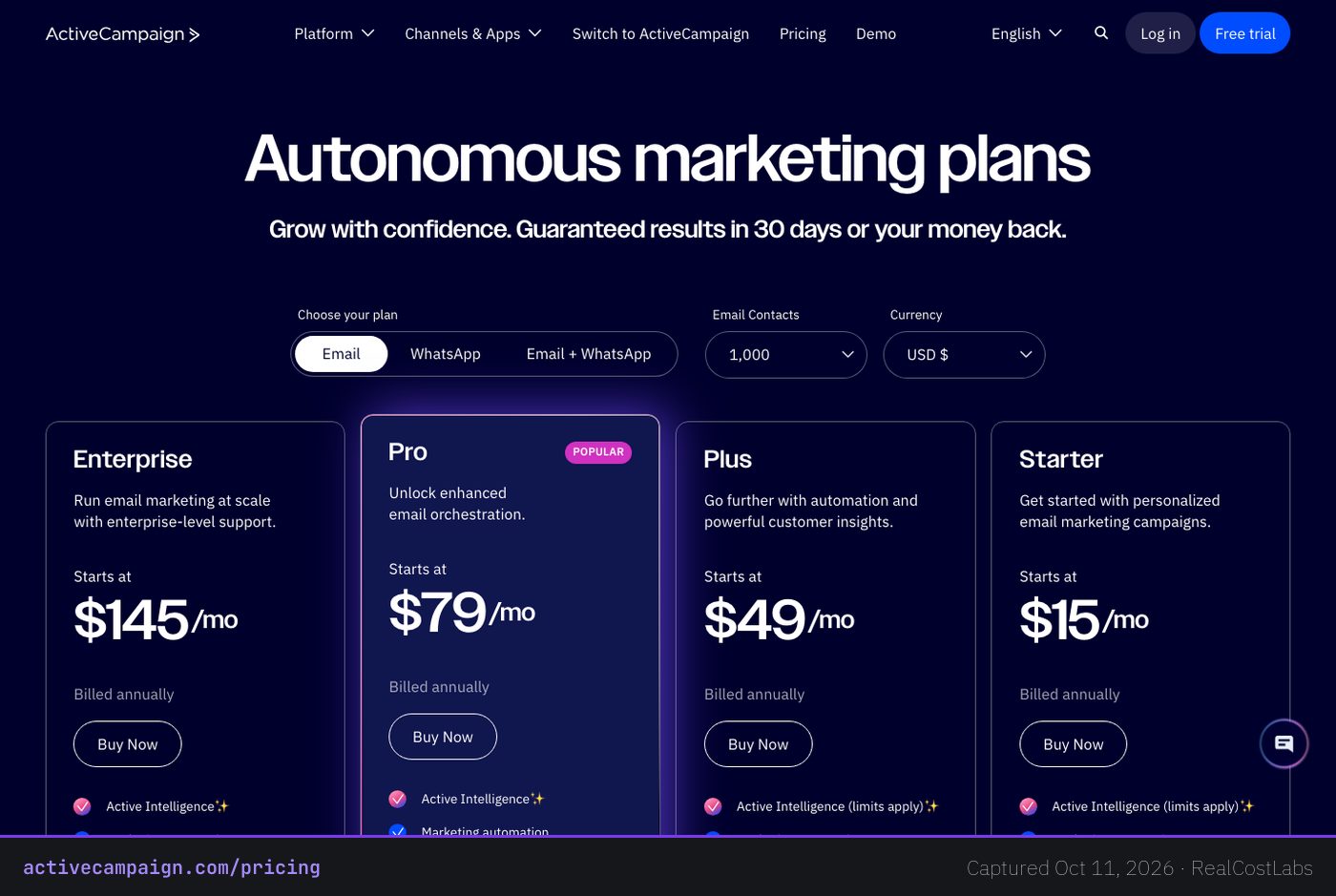
All figures above are per month on annual billing. The trap is the Starter column. It looks like the obvious entry point, but Starter omits the CRM, lead scoring, and predictive sending that are the reasons to choose ActiveCampaign over a cheaper tool, so the realistic plan is Plus. The 5,000-contact row to budget around is not $79: it is $145 per month, which works out to $1,740 per year. Move up to Pro at that same list size and you are at $205 per month ($2,460 per year); Enterprise reaches $375 per month ($4,500 per year). At 5,000 contacts the four tiers cost roughly $948 / $1,740 / $2,460 / $4,500 per year.
Two more cost facts matter when you forecast a year. First, Starter is capped: it is not available above about 25,000 contacts, so a growing list forces you onto Plus or higher whether you planned to upgrade or not. Second, the bill scales with list size rather than with revenue, so adding 5,000 contacts in a strong quarter raises your monthly cost before any of those contacts convert. Because there is no free plan, even evaluating the product properly costs money once your trial ends. None of this makes ActiveCampaign overpriced for what it is, but it does mean the cheapest-looking number on the page is not the one you should budget around. Budget for Plus.
Deliverability: the number that decides email ROI
For an email platform, deliverability is the metric that quietly governs everything else. A campaign that lands in the spam folder cannot be opened, clicked, or converted, so a few points of inbox placement outweigh any feature checklist. This is where ActiveCampaign is genuinely at the front of the field. In EmailToolTester’s latest deliverability test it placed 94.2% of messages in the inbox and ranked first out of 15 tools measured, against an 83.1% average for that round. That is roughly 11 percentage points of mail that reaches a real inbox instead of disappearing, compared to the typical tool in the test.
One qualifier keeps this in proportion. The 94.2% is a strong single round, and ActiveCampaign’s average across the last three EmailToolTester rounds is a 4-star result: good, not perfect, and not guaranteed to repeat at exactly 94.2% every quarter. Inbox placement also depends heavily on your own list hygiene, authentication, and sending habits, so no vendor can promise a number. What you can say with confidence is that ActiveCampaign’s infrastructure consistently competes for the top spot rather than sitting mid-pack. If your revenue depends on email actually arriving (transactional sequences, lead nurture, abandoned-cart recovery), this is the single clearest reason to pay ActiveCampaign’s premium. It is the dimension where the higher price buys something you can measure.
Features, in depth
The automation builder is the core of the product and the reason it exists. It is a visual, drag-and-drop canvas with branching and conditional logic that is the benchmark other email tools are measured against. You can model genuine lifecycle journeys rather than linear drips: behavior-triggered entry, multi-path branches, goal tracking, wait-and-react steps, and re-entry logic that responds to what a contact actually does. Teams outgrow a simpler tool when they hit a ceiling on this kind of branching, and ActiveCampaign is built to remove that ceiling.
- Built-in CRM and sales pipeline with lead scoring, so marketing automation and a sales process live in one tool instead of two that you have to sync.
- Advanced segmentation plus site and event tracking, letting you target contacts on on-site behavior and custom events, not just opens and clicks.
- Ecommerce automation and revenue reporting, including attribution that ties a contact from first touch through to pipeline and sale.
- Omnichannel reach across email, SMS, WhatsApp, and web, with SMS and WhatsApp sold as add-ons on top of the base plan.
- Active Intelligence, the 2025 to 2026 AI layer, including an AI Automation Builder that generates a full sequence from a plain-text brief, suggests segments, and lets you spin up custom AI agents for content, segmentation, or reporting described in everyday language.
- 1,000+ integrations, with deep native ties to Salesforce, Shopify, WooCommerce, HubSpot, WordPress, Slack, Calendly, and Webflow, plus an open API and Zapier. It now also ships a native Claude (Anthropic) connector, so you can query and act on your marketing data through natural language.
The depth is real and independently recognized: ActiveCampaign was named to seven of G2’s 2026 Best Software Award lists and has been the top-rated email tool on TrustRadius for eight consecutive years. The flip side of all this capability is feature gating, covered in the weaknesses below: the features that make the platform special are deliberately spread across the higher tiers.
Ease of use
This is ActiveCampaign’s clearest trade-off. The same depth that makes the automation builder powerful makes the first hour genuinely confusing for a beginner. The sheer volume of features (CRM, scoring, segmentation, attribution, multi-path automations) is a lot to absorb if you arrived expecting a newsletter app.
A few rough edges compound the curve. The native forms and landing pages work and render reliably, but they are less polished than what you get from a dedicated landing-page builder, so design-conscious marketers may feel constrained. The mobile app is monitoring-only: you can watch performance, but you cannot build campaigns or automations from your phone. None of this is a dealbreaker, but it sets the right expectation. If someone on your team will invest the time it takes to learn the builder, the capability pays off. If nobody will, much of what you are paying for becomes shelfware, and a simpler tool is the better fit.
Who it is for
ActiveCampaign fits growing B2B and SMB teams, and the agencies that serve them, that have moved past basic broadcasts and now run layered, behavior-driven journeys. It is the right choice when automation depth, deliverability, and a built-in sales CRM matter more than getting the lowest possible monthly bill, and when you have someone willing to learn the platform properly. It is a particularly good match if email is a measurable revenue channel for you, because inbox placement and attribution are where it leads.
It is the wrong choice for a solo founder who wants to send a good-looking campaign the same afternoon they sign up, for a team whose automations will never go past a welcome series and an abandoned-cart flow, or for anyone who needs a permanent free plan to evaluate or to keep costs at zero on a tiny list. In those cases you are paying for depth you will not touch, and the steep learning curve becomes friction rather than power. The test is simple: if you cannot name two or three branching, multi-step journeys you want to build, you probably do not need ActiveCampaign yet.
Three real-world scenarios
The 5,000-contact B2B SaaS running lifecycle automation
This is the sweet spot. You want trial-to-paid sequences, usage-based nurture, lead scoring, and a pipeline that reacts to product behavior. You will land on Plus at about $145 per month ($1,740 per year), accept a few weeks of ramp, and get a builder and CRM that genuinely earn their keep. The 94.2% deliverability protects your onboarding and transactional mail, which is exactly the email that cannot afford to miss the inbox. For this profile, ActiveCampaign is close to ideal.
The solo founder with a 1,200-contact newsletter
Here the math turns. Your needs are a clean editor, reliable sending, and maybe a simple welcome flow. Starter would technically cost $15 to $19 per month, but it strips out the CRM and predictive features that justify ActiveCampaign over a cheaper rival, and the learning curve buys you capability you will not use. A tool with a free tier and a gentler editor will leave you happier and with more cash, which is precisely the pattern our scoring rewards. ActiveCampaign is overkill at this stage.
The ecommerce store scaling from 2,500 to 10,000 contacts in a season
ActiveCampaign’s ecommerce automation, revenue attribution, and Shopify and WooCommerce integrations fit you well, and abandoned-cart recovery benefits directly from top-tier deliverability. Plan for the cost curve, though: Plus moves from $95 at 2,500 contacts to $189 at 10,000 per month, and your bill rises as the list grows in a good quarter, before those new contacts convert. Budget for the upper end of the range you expect to hit, and the platform rewards the spend with measurable recovered revenue.
ActiveCampaign vs the alternatives
ActiveCampaign sits at the deep, capable, and pricier end of the market. The right comparison depends on whether you value automation depth, a free entry point, or send-volume economics.
| Tool | Best for | Free plan | Deliverability | Trade-off vs ActiveCampaign |
|---|---|---|---|---|
| ActiveCampaign | Deep automation, CRM, deliverability | No (14-day trial) | 94.2% (#1 of 15) | Steep learning curve, cost climbs with contacts |
| HubSpot | All-in-one CRM and marketing suite | Yes (limited) | Not in this test round | Easier UI, but steeper price at scale |
| Mailchimp | Fast, cheap, friendly entry | Yes | Lower than ActiveCampaign | Weaker automation depth, also TP ~2.8 |
| Brevo | Cheaper send-volume pricing | Yes | Not in this test round | Less automation depth and CRM polish |
If you want the bigger all-in-one CRM and a friendlier interface, HubSpot is the obvious cross-shop, with the caveat that its price climbs even harder than ActiveCampaign’s once you scale. If you want the easiest, cheapest way in and a free plan ActiveCampaign does not offer, Mailchimp is the default for solo founders and small teams, though you give up automation depth and Mailchimp carries a similar 2.8 Trustpilot score driven by its own billing complaints. If your real constraint is send-volume cost rather than automation logic, Brevo prices on emails sent with a usable free tier, which can be far cheaper for a large list with modest automation needs. Ecommerce-first teams should also weigh Klaviyo, and GetResponse and Kit appear as reasonable alternatives depending on your stack.
Pros and cons
- Pro: Best independently measured deliverability in the category (94.2%, ranked #1 of 15), the dimension that most directly drives email ROI.
- Pro: The deepest visual automation builder in email, with branching, goals, conditional logic, and site and event tracking.
- Pro: Built-in CRM, sales pipeline, and lead scoring, so marketing and sales live in one tool.
- Pro: Strong, well-evidenced B2B satisfaction: 4.4 on G2 from 14,647 reviews, 4.6 on Capterra, eight years top-rated on TrustRadius.
- Pro: 1,000+ integrations including a native Claude (Anthropic) connector, plus a 2026 AI builder that drafts sequences from a brief.
- Con: No free plan, and a steep learning curve for beginners.
- Con: Cost scales fast with list size, and the realistic plan is Plus (~$145 per month at 5,000 contacts), not the Starter headline.
- Con: Aggressive feature gating: lead scoring, predictive sending, and attribution sit on higher tiers, and Starter is genuinely limited for B2B.
- Con: Support scales with spend (priority help effectively starts at Pro and Enterprise; no true 24/7 on lower plans), and the 2.8 Trustpilot score is concentrated on billing and support complaints.
- Con: Native forms and landing pages are functional but plainer than dedicated builders, and the mobile app is monitoring-only.
FAQ
How much does ActiveCampaign really cost at 5,000 contacts?
The Starter headline is $79 per month on annual billing, but Starter omits the CRM, lead scoring, and predictive features that justify the tool, so the realistic plan is Plus at about $145 per month, which is $1,740 per year. Pro at the same list size is $205 per month ($2,460 per year) and Enterprise is $375 per month ($4,500 per year). Monthly billing runs roughly 25% higher than these annual rates.
Does ActiveCampaign have a free plan?
No. There is no permanent free plan. You get a 14-day free trial on any paid plan, and you can start it without a card. Separately, there is a 30-day money-back guarantee, which some sources confuse with a 30-day trial: they are not the same thing. If you need a free tier to keep costs at zero on a small list, ActiveCampaign is not the tool for that.
Is ActiveCampaign’s deliverability actually the best?
In EmailToolTester’s latest round it placed 94.2% of messages in the inbox and ranked first out of 15 tools, against an 83.1% average for that group, so on that test it was the best. The fair qualifier is that this is one strong round; ActiveCampaign’s average across the last three rounds is a 4-star, good-not-perfect result. Your own list hygiene and authentication also affect placement, so treat 94.2% as evidence it competes for the top, not a personal guarantee.
Why is the Trustpilot score only 2.8 when G2 and Capterra are so high?
The gap is real and worth understanding. G2 (4.4) and Capterra (4.6) draw mostly professional and early-adopter reviewers, and roughly 95% of ActiveCampaign’s G2 reviews are 4 or 5 star. Trustpilot’s open consumer base is split: about 45% 5-star and 24% 1-star, with the negative cluster centered on billing and pricing practices plus support. The company replies to only about 46% of negative reviews. Read the B2B scores for capability and the Trustpilot score as the honest counterweight on billing and support.
How hard is ActiveCampaign to learn?
Harder than a simple newsletter tool, by design. The depth of the automation builder, segmentation, and CRM is the reason, and it is the same depth that makes the platform powerful. Budget the ramp time; if no one will invest it, much of the value goes unused.
What support do you get on the lower plans?
Support is chat and email, and its quality scales with your tier. Lower plans lean on documentation and are slower, while priority and real-time help effectively begin at Pro and Enterprise. There is no universal 24/7 support across all plans, and onboarding or migration help is reserved for higher tiers. This is a documented weakness on Starter and Plus, so factor it in if responsive help matters to you.
How does ActiveCampaign compare to HubSpot and Mailchimp?
HubSpot is the bigger all-in-one CRM and marketing suite with an easier interface, but its price climbs even harder at scale. Mailchimp is the cheaper, friendlier entry point and has a free plan ActiveCampaign lacks, but its automation is shallower and its deliverability lower, and it carries a similar 2.8 Trustpilot score. Choose ActiveCampaign for automation depth and inbox placement, HubSpot for an all-in-one suite, and Mailchimp for the fastest, cheapest start.
Who should not buy ActiveCampaign?
Skip it if you are a solo founder or small team whose automations will not go beyond a welcome series and an abandoned-cart flow, if you need a free plan, or if no one will invest the time to learn it. In those cases you pay for depth you will not use, and a simpler, cheaper tool will leave you both happier and with more budget, which is exactly the outcome our scoring favors.
KEEP EXPLORING
Ready to try ActiveCampaign?
Start the 14-day trial, build one real branching automation, and judge it on whether the depth and the inbox placement earn their price for your list.
Try ActiveCampaign →RealCostLabs is independent and reader-supported. We may earn a commission on purchases made through our links, at no extra cost to you, and our scores are never for sale.