 MailerLite
 ActiveCampaign
 Omnisend
 Klaviyo
 SE Ranking
 Mangools
 Semrush
 Ahrefs
 Pipedrive
 Zoho CRM
 Salesforce
 HubSpot
 Systeme.io
 GoHighLevel
 ClickFunnels
 Vendasta
CRM for charities
Two of the platforms marketed as free are the most expensive on this page, because fundraising fees stack — a platform percentage on top of a processing percentage, published in different places. And buying a payment form does not buy the donor database a small charity actually needs. Here is both problems, with the numbers.
RealCostLabs is independent and reader-supported. We may earn a commission on purchases made through our links, at no extra cost to you, and our scores are never for sale.
Disclosure: we earn nothing from any fundraising platform or donor CRM named here — not Zeffy, Givebutter, Donorbox, Little Green Light or Bloomerang. Nothing in this analysis is sponsored. The one place we do earn is marked, and it is not the main recommendation.
Fundraising fees stack, and the headline rate hides it
Nearly every comparison of donation platforms quotes one number. There are almost always two, charged by different companies and disclosed on different pages:
- The platform fee — what the fundraising software takes
- The processing fee — what Stripe or PayPal takes to move the money
Add them, and the ranking inverts.
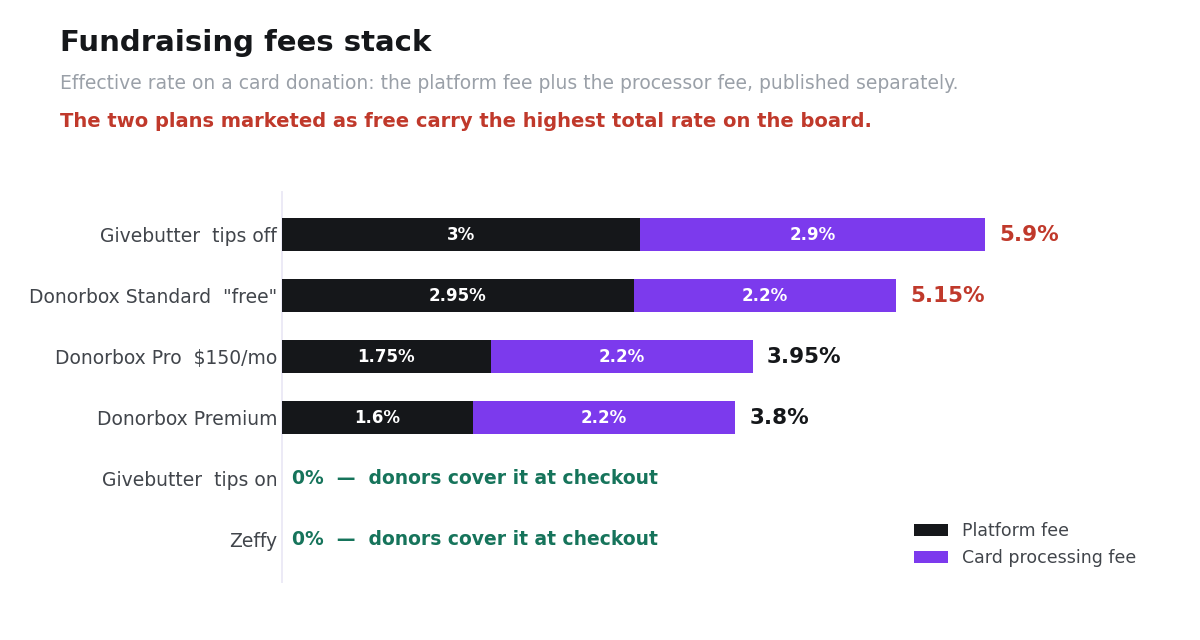
| Platform | Platform fee | Card processing | Bank / ACH | Effective rate on card |
|---|---|---|---|---|
| Zeffy | 0% | 0% | 0% | 0% |
| Givebutter — tips on | 0% | 0% | 0% | 0% |
| Donorbox Premium | 1.6% | 2.2% + $0.30 | 0.8%, capped $5 | 3.8% + $0.30 |
| Donorbox Pro — $150/mo | 1.75% | 2.2% + $0.30 | 0.8%, capped $5 | 3.95% + $0.30 |
| Donorbox Standard — “free” | 2.95% | 2.2% + $0.30 | 0.8%, capped $5 | 5.15% + $0.30 |
| Givebutter — tips off | 3% | 2.9% + $0.30 | 1.9% + $0.30 | 5.9% + $0.30 |
US rates as published by each vendor, 2026. Donorbox platform fees are higher again for ticketing and memberships — 3.95% on Standard. Stripe nonprofit rates shown; PayPal differs.
Read the bottom two rows against the top two. The plans described as free carry the highest total rate on the board, and the difference between the cheapest and dearest is roughly six percentage points of everything you raise.
On $200,000 raised online, six points is $12,000 a year.
“Free” here means your donor pays, not that nobody does
Zeffy and Givebutter genuinely charge the charity nothing when tips are enabled. That is not a trick and we are not going to pretend it is. Zeffy states it covers both platform and processing costs itself, funded entirely by optional contributions donors add at checkout; Givebutter’s pricing page states that fees are covered by 92% of donors.
But be clear about what the model does. It does not remove the cost — it moves the cost onto your donors, as a small additional ask on every single transaction, permanently. Whether that is a good trade depends on facts about your donors rather than about the software:
- It works well for grassroots giving, event tickets, peer-to-peer campaigns and community fundraising, where donors are close to the cause.
- It sits badly where an extra checkout ask is inappropriate — corporate gifts, grant disbursements, board giving, or a major donor who has just committed $25,000 and is then invited to add a tip.
- Your reported income changes shape. Donors give slightly more in total than they intended to give you, and the difference goes to the platform rather than the cause. Some boards are entirely comfortable with that; some are not. Ask yours rather than deciding alone.
A zero-fee platform is usually the right answer for a small charity; adopt it knowing exactly who is paying.
The $150-a-month question, answered precisely
Donorbox Pro costs $150 a month and cuts the platform fee from 2.95% to 1.75% — a saving of 1.2% on everything you raise.
So the plan pays for itself at $1,800 ÷ 0.012 = $150,000 of annual online fundraising.
- Below $150,000 raised online, Standard is cheaper. Pro is a loss.
- Above $150,000, Pro is cheaper, and the gap widens quickly — at $400,000 raised, Pro saves about $3,000 a year net of its own cost.
That single number is the whole upgrade decision. Work out what you raised online last year and you have your answer without a sales call.
One major gift can cost more than a year of software
This is the most expensive mistake on this page, and it takes one transaction.
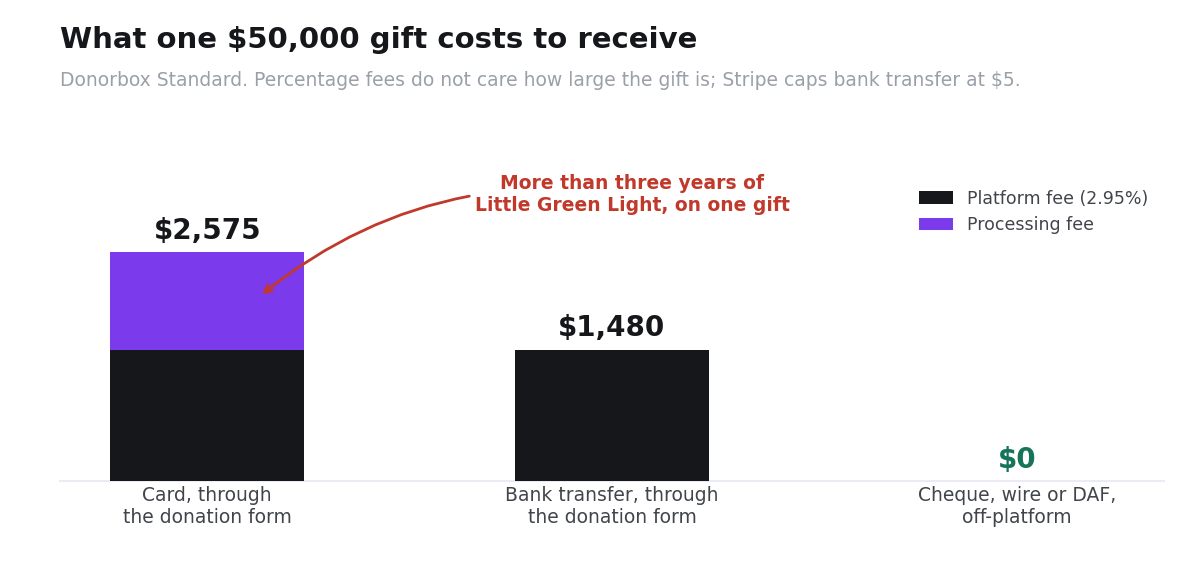
Percentage fees do not care about gift size. A $50,000 gift put through a donation form on Donorbox Standard costs:
| How the $50,000 gift arrives | Platform fee | Processing | Total cost |
|---|---|---|---|
| Credit card through the donation form | $1,475 | $1,100 | $2,575 |
| Bank transfer through the donation form | $1,475 | $5 (ACH capped) | $1,480 |
| Cheque, wire or stock transfer, off-platform | — | — | $0 |
Two thousand five hundred dollars, on one gift, for a form submission. That is more than three years of Little Green Light.
The rule that follows: take major gifts off the platform. Cheque, wire, stock or a donor-advised fund grant — all standard, all free, all what a major donor expects anyway. Use the online form for the giving it was built for.
And note the ACH cap in that middle row: Stripe’s bank-transfer fee is 0.8% capped at $5. On any gift above about $625, bank transfer stops scaling while card keeps climbing. Offering bank transfer prominently is worth real money on your larger online gifts.
The mistake underneath the fees: two different products
Everything above concerns the transaction. The larger problem is the other half, which a fundraising platform does not include.
| Fundraising platform | Donor CRM | |
|---|---|---|
| Examples | Zeffy, Givebutter, Donorbox | Little Green Light, Bloomerang |
| What it is | The transaction layer | The relationship layer |
| Takes the gift | Yes | Via an integration |
| Sends the receipt | Yes | Yes |
| Tracks who lapsed | Weakly | Core function |
| Moves a major donor through cultivation | No | Core function |
| Records a phone call, a visit, a soft credit | No | Yes |
| Reports retention by cohort | No | Yes |
| Tracks restricted funds and donor intent | By campaign | Properly |
| Costs a percentage of income | Yes | No |
A charity three years into a fundraising platform has thousands of transactions and no donor base. It can tell you what it raised in March. It cannot tell you which forty people give most of its money, which of last year’s supporters have quietly stopped, or whether the spring appeal actually retained anybody.
Those are the questions that determine income. The transaction layer cannot answer any of them.
What that blindness costs, in sector numbers
The Fundraising Effectiveness Project, run by the Association of Fundraising Professionals, publishes the benchmarks. In its 2025 reporting:
- Overall donor retention was 43.3% — well over half of donors do not give again
- First-time donor retention hit its lowest recorded level, with fewer than one in five new donors giving a second time
- New donor numbers fell 10.7%, and total donor counts fell an estimated 3.6%
What that means for your budget
Donors lost each year × their average gift = the income you must re-raise before you grow at all.
A charity with 800 donors giving $250 on average raises $200,000. At the sector retention rate it loses about 454 donors and $113,500 of income every year, and starts each January acquiring replacements.
Move retention ten points, from 43% to 53%, and that is 80 donors and $20,000 a year. Against a $540-a-year donor CRM.
This is the actual case for spending money on software, and it has nothing to do with the features list. You cannot improve a retention rate you cannot see, and the donation form does not show it to you.
What a donor CRM costs
Note what is absent from this table: a percentage. Donor CRMs charge a subscription by database size and take nothing off your income.
| Records | Little Green Light | Per year | Users |
|---|---|---|---|
| Up to 2,500 | $45/mo ($40.50 annual) | $486 | Unlimited |
| Up to 5,000 | $60/mo ($54) | $648 | Unlimited |
| Up to 10,000 | $75/mo ($67.50) | $810 | Unlimited |
| Up to 20,000 | $90/mo ($81) | $972 | Unlimited |
| Up to 50,000 | $135/mo ($121.50) | $1,458 | Unlimited |
Annual prepayment saves 10%. Payment processing is 2.2% + $0.30 direct to Stripe or PayPal — Little Green Light adds nothing to it. 30-day trial, no card required.
| Bloomerang | From | Per year | Note |
|---|---|---|---|
| Bloomerang CRM | $125/mo | $1,500+ | Priced by constituent count — tiers not published |
| Bloomerang Fundraising | $40/mo | $480+ | Must be bundled with CRM |
| The Giving Platform | $242/mo | $2,904+ | Everything bundled |
Bloomerang is a capable product and a reasonable choice for a charity with a real development function. But it publishes only a starting price: the actual tiers depend on your constituent count and require a quote. If you are comparing on budget, that is a call you have to make before you can compare, and Little Green Light publishes its whole ladder.
Restricted gifts are a legal obligation, not a category
When a donor gives “for the winter shelter,” that restriction is binding on you. The money cannot quietly fund general operations because the shelter is fully funded, and at year end you must be able to show what came in restricted, what was spent against it, and what carried forward.
Fundraising platforms model this as a campaign — a label on a transaction. That is enough to total it up and nothing more. A donor CRM models the restriction as a property of the gift, reportable across years, which is what your auditor and your board actually need.
If any meaningful share of your income is restricted, this decides the category on its own.
General guidance, not legal or accounting advice. Your treasurer or auditor should confirm what your jurisdiction and constitution require.
What to buy
| Your situation | Buy | Cost per year |
|---|---|---|
| All-volunteer, under $50k raised | Zeffy alone | $0 |
| Community fundraising, events, peer-to-peer | Givebutter with tips on | $0 |
| Under 2,500 donors, one part-time fundraiser | Zeffy + Little Green Light | $486 |
| Over $150k online, want one integrated system | Donorbox Pro | $1,800 + 1.75% |
| Real development function, major gifts programme | Bloomerang — get the tier quoted | $1,500+ |
| Any size, receiving major gifts | Take them by cheque, wire or DAF, off-platform | |
For most small charities the answer is a zero-fee platform for the transactions and a cheap donor CRM for the relationships — Zeffy plus Little Green Light, about $486 a year all in, with nothing taken off your income.
That combination costs less than the fees alone on a “free” platform at $50,000 raised, and it is the only version of this that gives you a retention number to work with.
The one thing that moves retention, and what it needs
Fewer than one in five first-time donors gives again. The intervention is unglamorous: a proper welcome sequence for a new donor — a thank you that is not a receipt, then a short series over the following weeks showing what the gift did, before you ever ask again.
Fundraising platforms send receipts. Donor CRMs record that a gift happened. Neither runs a scheduled, segmented, automated sequence well, and at charity list sizes a tool that does is inexpensive or free.
This is the one recommendation on the page from which we earn, and we are putting it here rather than at the top because it is genuinely the highest-leverage line item, not because it pays.
Brevo fits a charity that wants to treat a first-time $25 donor differently from a lapsed major donor, and to text supporters on the day of an event. See our Brevo pricing breakdown.
If the newsletter is written by whoever has time this month, pick the tool that is easiest to pick up. See MailerLite pricing.
The verdict
Check the two fees, not the one. A platform advertising 0% platform fee while a processor takes 2.9% is a 2.9% platform, and the two plans on this page marketed as free carry effective rates above 5%.
For most small charities: Zeffy for transactions, Little Green Light for donors. Roughly $486 a year, no percentage of income, and a database that can actually tell you who lapsed.
Take major gifts off the platform entirely — one $50,000 gift through a card form costs $2,575, which is several years of the software.
Then spend the attention on retention rather than on features. At a sector rate of 43.3%, ten points of improvement is worth more than every software decision on this page combined.
We earn no commission from Zeffy, Givebutter, Donorbox, Little Green Light or Bloomerang. The recommendation follows the published rates and the sector data.
Common questions
What is the cheapest donation platform for a nonprofit?
Zeffy charges the charity nothing at all — no platform fee and no processing fee — funding itself through optional contributions donors add at checkout. Givebutter is also 0% to the charity when tips are enabled. Both move the cost to your donors rather than removing it.
Is Donorbox really free?
The Standard plan has no monthly fee, but it takes a 2.95% platform fee on donations and Stripe takes 2.2% + $0.30 on top — an effective 5.15% + $0.30. Ticketing and memberships are 3.95% platform fee. The $150-a-month Pro plan cuts the platform fee to 1.75%.
When is Donorbox Pro worth $150 a month?
At $150,000 of annual online fundraising. The plan saves 1.2% of donation volume, so $1,800 ÷ 0.012 = $150,000. Below that, stay on Standard.
Do I need a donor CRM as well as a donation platform?
If you want to know your retention rate, who your top donors are, or who has lapsed — yes. Fundraising platforms record transactions; donor CRMs record relationships. Little Green Light starts at $45 a month with unlimited users and takes no percentage of income.
What does Little Green Light cost?
$45 a month for up to 2,500 records, rising to $135 for 50,000, with a 10% discount for annual prepayment and unlimited users on every tier. Processing is 2.2% + $0.30 paid directly to Stripe or PayPal — Little Green Light adds nothing.
How should we accept a large donation?
Off the platform. A $50,000 gift by card through a donation form can cost $2,575 in combined fees; by cheque, wire, stock transfer or donor-advised fund grant it costs nothing. Bank transfer is the next best option online, since Stripe caps ACH at $5 per transaction.
What is a good donor retention rate?
The Fundraising Effectiveness Project put overall retention at 43.3% in its 2025 reporting, with fewer than one in five first-time donors giving again. Anything above the mid-forties is above sector average; first-time donor retention, at fewer than one in five, is the largest gap.
Can we use Salesforce or HubSpot as a donor CRM?
Salesforce’s Nonprofit Cloud has a donated-licence programme, but it needs configuration and usually a consultant. For a charity under a few thousand donors, a purpose-built donor CRM at $45 a month arrives at the same place without the project.
Do nonprofits get discounted payment processing?
Yes — Stripe offers a discounted nonprofit rate of 2.2% + $0.30 rather than its standard rate, and PayPal has a nonprofit rate too. Confirm your platform is passing the nonprofit rate through to you rather than billing the standard one.
KEEP EXPLORING