 MailerLite
 ActiveCampaign
 Omnisend
 Klaviyo
 SE Ranking
 Mangools
 Semrush
 Ahrefs
 Pipedrive
 Zoho CRM
 Salesforce
 HubSpot
 Systeme.io
 GoHighLevel
 ClickFunnels
 Vendasta
Restaurant CRM and email marketing
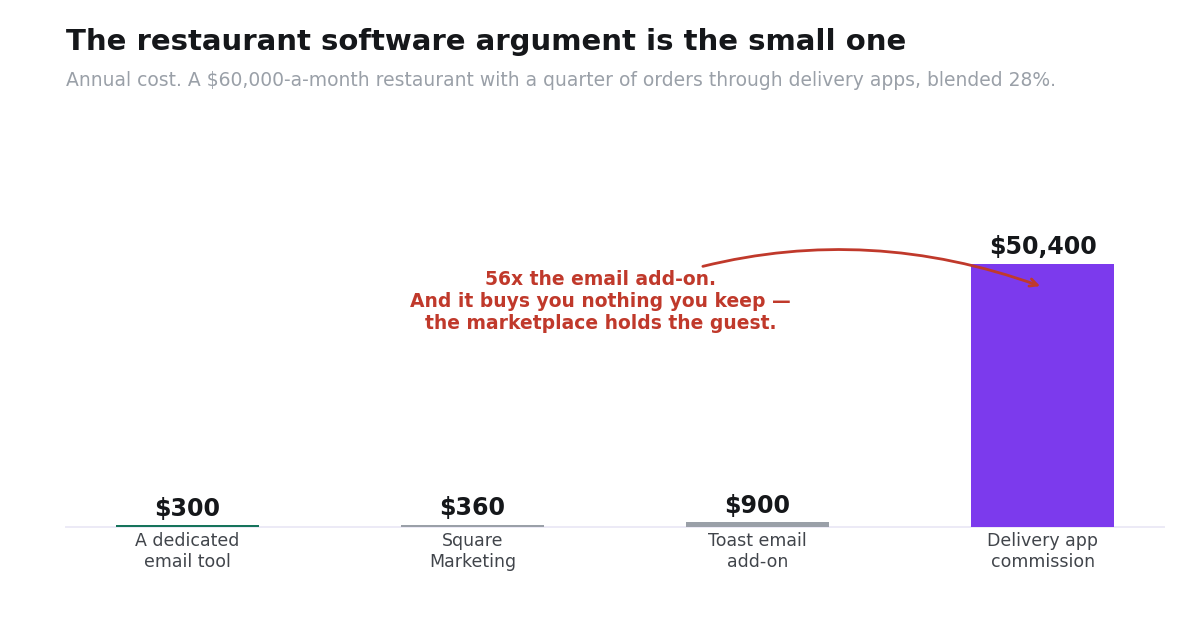
Every comparison of restaurant software argues about $30 a month versus $75. Meanwhile the delivery apps take up to 30 percent commission on every order they send you — and they keep the guest’s email, so you can never invite that person back yourself. This page is about the second number, because it is roughly fifty times the first.
RealCostLabs is independent and reader-supported. We may earn a commission on purchases made through our links, at no extra cost to you, and our scores are never for sale.
Disclosure: the two email tools we recommend at the end are ones we earn a commission from. We are telling you up front because the recommendation is partly an argument against spending more — the case here is that a $75-a-month add-on from your POS is usually the wrong purchase.
Start with the number that is not software
A restaurant’s largest technology cost is almost never the technology. It is the commission on marketplace orders.
| Platform | Published commission | Pickup |
|---|---|---|
| DoorDash | 15% Basic · 25% Plus · 30% Premier | Flat pickup commission |
| Uber Eats | 20% Lite · 25% Plus (30% on Uber One orders) · 30% Premium | 7% with validated in-store pricing, otherwise 10% |
| Grubhub | 5–20% plus paid placement | — |
Published US rates, 2026. Card processing is typically another 2–3% and is charged separately from commission.
Those are the headline rates. Add 2–3% card processing and any paid placement to a 25% or 30% tier and the blended cost of a marketplace order is 27% to 33%; the example below uses 28%.
What that is worth on a real P&L
Take a restaurant turning over $60,000 a month with a quarter of that arriving through delivery apps — $15,000 a month, $180,000 a year of marketplace volume.
| Line | Per month | Per year |
|---|---|---|
| Marketplace order volume | $15,000 | $180,000 |
| Commission at a blended 28% | $4,200 | $50,400 |
| Toast email marketing add-on | $75 | $900 |
| A dedicated email tool | $0–25 | $0–300 |
The commission line is fifty-six times the software line. Any conversation about restaurant marketing software that does not start here is having the wrong conversation.
The part that makes it structural: they keep the guest
A 28% commission would be survivable if it bought you a customer. It does not.
When someone orders your food through a marketplace, the marketplace holds the relationship. You get an order ticket. You do not get an email address you can use, and you have no way to tell that person about Tuesday’s special, the new patio, or the fact that ordering direct is cheaper for both of you.
So the 28% is not a one-time acquisition cost. It is rent, charged on the same customer, forever. Someone who orders from you forty times a year is forty commissions, and at no point do you acquire them.
That is the actual argument for a restaurant CRM, and it has nothing to do with features. A guest list is the only asset that lets you stop paying rent on people who already like your food.
What moving orders direct is worth
The formula
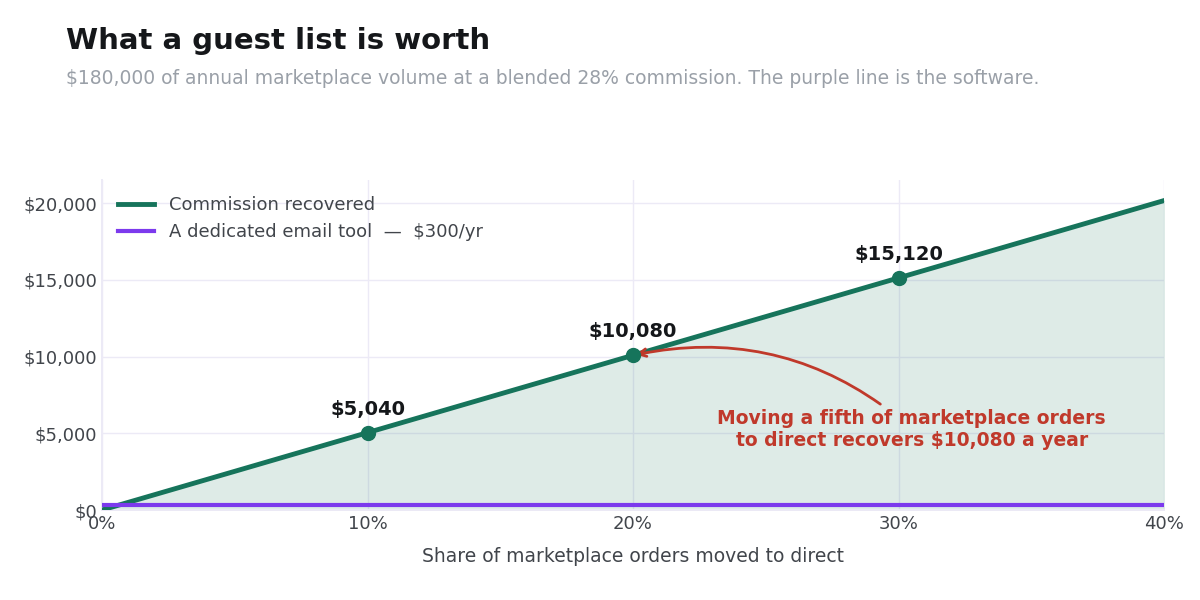
Marketplace volume × the share you move direct × your blended commission rate.
Run it with your own numbers. On the $60,000-a-month restaurant above:
| Share moved to direct ordering | Recovered per year | Against software at $300/yr |
|---|---|---|
| 10% | $5,040 | 17× |
| 20% | $10,080 | 34× |
| 30% | $15,120 | 50× |
The caveat: you do not move orders direct by buying software. You move them by having somewhere to send people, a reason to go there, and a list to tell. The software is the list. The reason is yours to invent — a direct-only discount, a loyalty tier, first access to a special, or simply telling people plainly that the apps take a third.
And be realistic about the ceiling. Some marketplace customers will never order direct, and some are genuinely new discovery you would not have got otherwise. Moving 20% of it is a good year, not a floor.
Where your guest data actually lives
Before buying anything, work out what you already have, starting with the POS — which is probably holding it.
- Toast, Square, Clover and Lightspeed all capture guest data through online ordering, loyalty sign-ups, digital receipts and reservations. It is already yours in principle.
- The question is whether you can get it out. Ask specifically: can I export guest names, emails and order history to a CSV, on my own, without a support ticket? If the answer is no, the POS is not storing your list — it is holding it.
- Marketplace orders usually do not flow in. That is the gap that matters most, and it is why direct online ordering — through your POS or your own site — is the single highest-value thing to set up.
A restaurant CRM, in practice, is not a new database. It is an export from your POS plus a place to send email. Buy in that order.
What the tools cost
The POS marketing add-ons
| Tool | Per month | Per year | Priced by |
|---|---|---|---|
| Toast email marketing | $75 | $900 | Flat add-on |
| Toast marketing suite | ~$185 | ~$2,220 | Bundle, on top of the POS subscription |
| Square Marketing | $15 → $30 → $40 | $180–480 | Number of contacts (500 / 1,000 / 2,000) |
Reported figures. Neither vendor publishes these on a page we could verify at source, so treat them as indicative and confirm before you buy — which is itself worth noting about this category.
Two things follow.
Toast prices marketing as separate modules, and they stack. Online ordering, loyalty, gift cards and email are each their own line on top of the POS subscription. A restaurant that wants all four is well past $200 a month before the POS itself.
Square charges by contact count, so success raises the bill. Growing your list from 500 to 2,000 guests — exactly what you are trying to do — moves you from $15 to $40 a month. Small in absolute terms, but note the shape: you are being charged for the asset you are building.
You probably should not buy your POS’s email add-on
This is the practical recommendation, and it is $600 to $900 a year cheaper than the Toast add-on.
A dedicated email platform does this job better and costs less. At a list of 1,000 guests, MailerLite is free and Brevo has a free tier.
| Option | At 1,000 guests | Per year |
|---|---|---|
| Toast email marketing | $75/mo | $900 |
| Square Marketing | $30/mo | $360 |
| A dedicated email tool | $0–25/mo | $0–300 |
Three reasons beyond the price:
- Better at the job. Templates, segmentation, scheduling and the deliverability work that keeps a 1,500-address send out of spam folders. POS add-ons send announcements; email platforms run campaigns.
- No lock-in. If your list lives in your POS and you change POS, you are negotiating for your own guest data at the worst possible moment. If it lives in an email platform, switching POS is just switching POS.
- SMS in the same place. Restaurants text — table ready, order confirmed, tonight only. Running both from one tool is simpler than a separate SMS add-on.
The exception: if you want loyalty tied to the point of sale — points that apply automatically when the guest pays — that has to live in the POS, because it needs the transaction. Buy loyalty from your POS, and email from an email platform.
Brevo fits restaurants specifically because the text message and the newsletter come from the same place, and its pricing is driven by sends rather than by how many guests you have stored. See our Brevo pricing breakdown.
If the newsletter gets written by whoever has twenty minutes on a Tuesday, choose the tool that is easiest to pick up rather than the most capable. See MailerLite pricing.
What to buy
| Your situation | Buy | Per year |
|---|---|---|
| Under 1,000 guests on the list | MailerLite free tier | $0 |
| You text guests as well as email them | Brevo | Free tier, then usage |
| You want points applied at the till | Loyalty from your POS | ~$50/mo |
| You have no direct ordering channel | Fix that before anything else | — |
| Already deep in the Square ecosystem, small list | Square Marketing | $180–480 |
| Toast email add-on | Usually not — $900 a year for less capability | |
The verdict
Stop comparing $30 against $75. On a $60,000-a-month restaurant the delivery apps take about $50,400 a year, and they keep the customer, so you pay it again next time.
Set up direct ordering, capture the email, and use a dedicated email tool rather than your POS’s add-on. A list of 1,000 guests costs nothing to hold and roughly $10,000 a year if you can move a fifth of your marketplace volume onto it.
Then check one thing before signing a POS contract: can you export your guest list yourself, today, without asking anyone? If not, that is the question to settle before the software question.
We earn no commission from Toast, Square, DoorDash, Uber Eats or Grubhub. We do earn from Brevo and MailerLite, and those links are marked.
Common questions
What is a restaurant CRM?
In practice it is a guest list with order history attached, and a way to email or text that list. Most of the data already exists in your POS from online orders, loyalty sign-ups and digital receipts; the work is exporting it and putting it somewhere you can actually send from.
How much do delivery apps take?
DoorDash publishes 15%, 25% and 30% by tier; Uber Eats 20%, 25% and 30%, with 30% on Uber One orders; Grubhub 5–20% plus paid placement. Add 2–3% card processing and any paid placement and the blended cost of a marketplace order is 27% to 33%.
Can I get customer emails from DoorDash or Uber Eats?
Not in a usable form. That is the core problem: the marketplace holds the relationship, so the commission is charged again on every repeat order rather than functioning as a one-time acquisition cost.
Is Toast email marketing worth $75 a month?
Usually not. A dedicated email platform does the job better for $0 to $25 at typical restaurant list sizes, adds SMS, and does not tie your guest list to your POS contract. Buy loyalty from Toast if you want points at the till; buy email elsewhere.
How much does Square Marketing cost?
Reported at $15 a month for up to 500 contacts, $30 for 501–1,000 and $40 for 1,001–2,000. Note it is priced by how many guests you store, so growing the list raises the bill.
What is the cheapest way to email my guests?
MailerLite is free to 1,000 subscribers. Brevo has a free tier and adds SMS from the same platform.
How much can I actually save by moving orders direct?
Marketplace volume times the share you move times your blended rate. On $180,000 of annual marketplace volume at 28%, shifting 20% direct recovers about $10,080 a year. Shifting 10% recovers about $5,040.
Should I leave the delivery apps entirely?
Generally no. They deliver genuine discovery you would not otherwise get. The goal is to stop paying discovery rates on guests who have already found you — which means capturing them the first time and giving them a reason to come back direct.
What should I ask before signing a POS contract?
Whether you can export guest names, emails and order history to a CSV yourself, without a support request, and what happens to that data if you leave. Ask it before you sign, because the answer is much harder to get afterwards.