 MailerLite
 ActiveCampaign
 Omnisend
 Klaviyo
 SE Ranking
 Mangools
 Semrush
 Ahrefs
 Pipedrive
 Zoho CRM
 Salesforce
 HubSpot
 Systeme.io
 GoHighLevel
 ClickFunnels
 Vendasta
CRM for churches
The software is nearly free. The giving processing is not — and on a $400,000 church the gap between the best and worst choice is over $8,000 a year, against subscriptions that differ by a few hundred. Here is the arithmetic, plus the switching trap that quietly costs churches real recurring income.
RealCostLabs is independent and reader-supported. We may earn a commission on purchases made through our links, at no extra cost to you, and our scores are never for sale.
Disclosure that matters here: we earn nothing from any church software on this page — not Planning Center, not Tithely, not ChurchTrac. There is no affiliate program pushing this analysis in any direction. Where we do earn, at the bottom, we mark it clearly.
Start with the number that actually decides this
Every comparison of church software argues about $32 a month versus $72 a month. That is the small number. The large number is what your giving platform takes off every gift.
| Platform | Card | Amex | ACH / bank |
|---|---|---|---|
| Planning Center Giving | 2.15% + $0.30 | — | 0% + $0.30 |
| Tithely (and Breeze) | 2.9% + $0.30 | 3.5% + $0.30 | 1% + $0.30 |
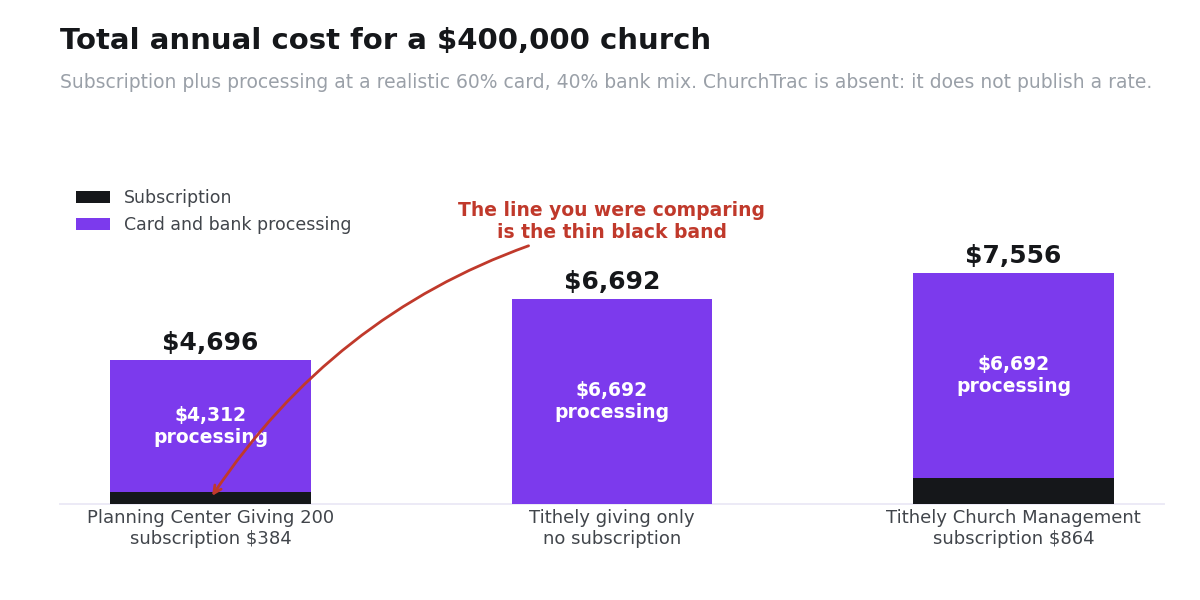
| ChurchTrac | Not published — described only as “Stripe’s discounted nonprofit rate” | ||
US rates as published by each vendor, 2026. International cards add roughly 1.5%.
Read the Planning Center ACH row again: zero percent, plus thirty cents. Not a reduced percentage — none.
What that means on a real budget
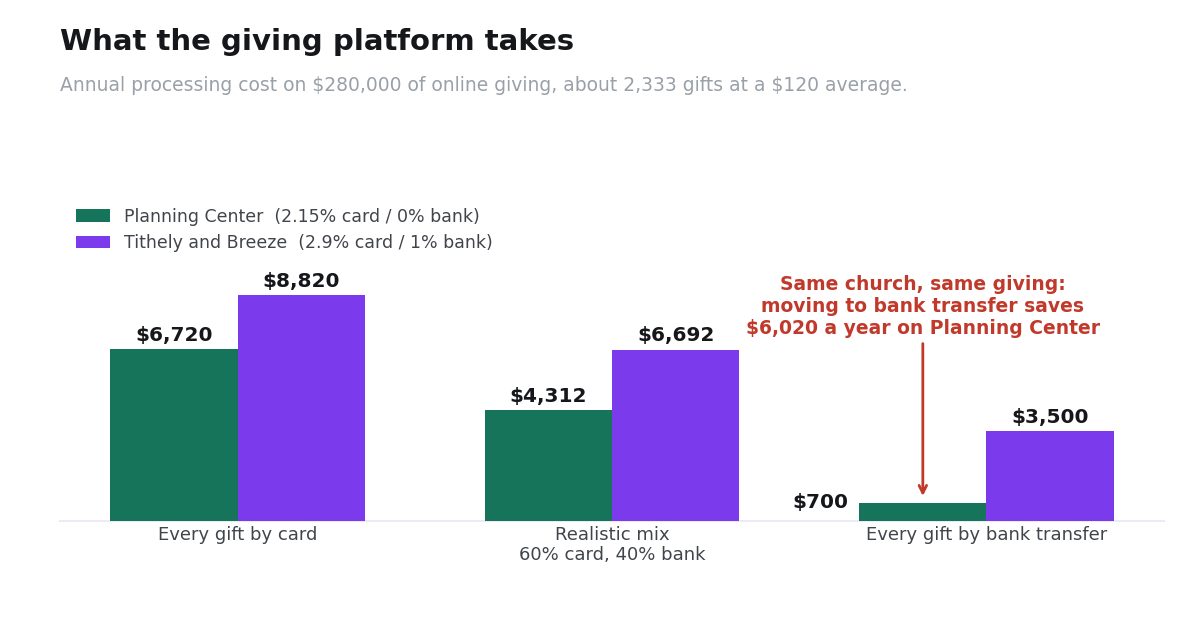
Take a church receiving $400,000 a year in giving, with 70% given online — $280,000 — at an average gift of $120, so roughly 2,333 gifts a year, about 194 a month.
| Annual processing cost | Planning Center | Tithely / Breeze | Difference |
|---|---|---|---|
| If every gift is by card | $6,720 | $8,820 | $2,100 |
| Realistic mix (60% card, 40% bank) | $4,312 | $6,692 | $2,380 |
| If every gift is by bank transfer | $700 | $3,500 | $2,800 |
The full spread on identical giving runs from $700 to $8,820. That is an eight-thousand-dollar range decided entirely by which platform you signed with and how your people give. The subscriptions you were comparing differ by about five hundred.
The highest-value action on this page: move recurring giving to bank transfer. On Planning Center that takes the fee on a $150 monthly gift from $3.53 to $0.30. Across sixty recurring givers that is roughly $2,300 a year — a real line in a church budget, recovered by changing a default rather than raising anything.
The switching trap: recurring gifts do not simply move
This is the part that costs churches money and almost nobody puts it in a comparison chart.
When a donor sets up a recurring gift, their card is stored by the payment processor as a token — a reference, not the card number. That token belongs to the processor and the platform, not to you. Whether a platform will coordinate a token transfer to a new provider is a question to ask, and Planning Center states plainly that recurring donations cannot be transferred in — donors set up a new recurring gift instead.
So plan on this: unless both platforms confirm token migration in writing, every recurring donor has to re-enroll by hand. Some will do it that week. Some will do it in three months. Some never will, and you will not find out which until the giving report is short.
- Ask the question before you sign, not after. “Will you migrate our stored payment tokens, and will our current provider export them?” Both halves have to be yes.
- If the answer is no, price the switch in full. Forty recurring givers at $150 a month, with a quarter never re-enrolling, is $18,000 of annual giving — against a processing saving that might be $2,400. The saving is still real, but it may take years to catch up.
- Switch deliberately. Announce it twice, keep both live through one full giving cycle, and follow up individually with the recurring givers who have not moved. Personal contact is what actually recovers them.
None of this means do not switch. It means the real comparison is processing saving minus the giving you lose in the transition, and a new church plant with no recurring base switches almost free while an established one does not.
Why “CRM” is the wrong word here
A CRM is built around a contact moving through a sales pipeline. A church has neither. What a church actually runs is a membership roll, a giving ledger, a volunteer schedule and a children’s check-in desk, and the software category that does those is church management software — ChMS.
The record is a household, not a person
This is the structural reason a general CRM never quite fits, and it is worth being precise about.
A CRM’s central object is an individual. A church’s is a household, with people attached and relationships between them that carry real meaning:
- Giving is frequently recorded per household, and the year-end statement goes to the household — but individual gifts still have to roll up correctly
- A child checks in under a guardian, and which adults may collect that child is a defined list, not a note
- Custody arrangements, guardianship and split households have to be representable without awkwardness
- One mailing goes to an address; one email goes to a person; both have to work from the same record
- Membership status, baptism, and pastoral notes belong to individuals but are read in the context of the family
You can force a CRM to hold some of this in custom fields and linked records. It breaks at the children’s check-in desk on a Sunday morning, which is exactly where it must not break.
Children’s check-in is a safeguarding function, not a feature
If your church has any children’s ministry, this alone settles the category question.
Check-in produces a matched pair of labels — one on the child, one held by the person who dropped them off — and only that code releases the child. The system also holds allergies, medical notes and the authorized-collection list, available to a volunteer at the desk in seconds.
This is a child-protection control. No general CRM does it, and the workaround — a paper list and a marker pen — is not a workaround, it is the absence of the control. Planning Center Check-Ins, Tithely and ChurchTrac all include it.
The requirement a CRM cannot meet at all
Under IRS rules, a donor claiming a deduction of $250 or more must obtain a contemporaneous written acknowledgment from the church. It has to state whether any goods or services were provided in return, and the donor must have it before they file their return for that year.
In practice that means producing accurate annual contribution statements for every giving household, split correctly across designated funds — general, missions, building — and reconciling to the bank. Church management software does this as a report you run in January. A general CRM has no concept of a contribution statement, a designated fund, or a quid pro quo disclosure, and rebuilding that in custom objects is not a project a volunteer treasurer should be handed.
This is a summary of a general requirement, not tax advice. Your treasurer or accountant should confirm what your church needs to file.
What the software costs
Planning Center prices each product separately, with a genuinely usable free tier on most of them — People, its membership database, is free and unlimited.
Planning Center Giving, by monthly donation volume
| Donations per month | Per month | Per year | Roughly |
|---|---|---|---|
| Up to 10 | Free | $0 | A church plant |
| 75 | $15 | $180 | Under 100 people |
| 200 | $32 | $384 | 150–300 people |
| 500 | $69 | $828 | 400–700 people |
| 1,000 | $115 | $1,380 | Large church |
| 1,500 | $179 | $2,148 | Large church |
| Unlimited | $239 | $2,868 | Multi-site |
The alternatives
| Platform | Structure | Per month | Per year |
|---|---|---|---|
| Tithely Church Management | Flat | $72 | $864 |
| Tithely giving only | Free, processing only | $0 | $0 |
| Tithely All Access | Flat, bundles app and website | $119 | $1,428 |
| ChurchTrac | By names tracked | $29–119 | $348–1,428 |
| Breeze | Now Tithely Church Management — see below | ||
Published list prices, 2026. ChurchTrac ranges from $29 for 75 names to $119 unlimited; setup services are quoted separately from $399.
Breeze and Tithely are the same company
Worth knowing before you build a shortlist. Tithely acquired Breeze in 2021, and Breeze Church Management is now Tithely Church Management. The Breeze giving pages redirect to Tithely.
So a church carefully comparing Breeze against Tithely is comparing one company with itself, at the same processing rates. If you want a genuine second option, the alternatives are Planning Center and ChurchTrac.
Two of these vendors will not publish a processing rate
Given that processing is six to ten times the subscription, a vendor that publishes a monthly price but not a percentage is asking you to choose on the small number and find out about the large one later.
ChurchTrac describes its rate only as “Stripe’s discounted nonprofit rate.” That may well be competitive — we are not saying it is not. We are saying get it in writing before you sign, and get the ACH rate separately, because that is where the money is. Ask for three numbers: card percentage, per-transaction fee, and bank-transfer rate.
What the problem costs if you do not fix it
Compare software against the giving it protects, not against other software.
The formula for lapsed recurring gifts
Recurring givers whose card expires × their monthly gift × months before anyone notices.
Fill in your own numbers. To give a sense of scale: eight recurring givers at $150 a month, lapsed for five months before anyone runs the report, is $6,000 — more than the entire annual processing bill on the Planning Center bank-transfer route, and many times any subscription on this page.
Cards expire. They get reissued after fraud. People change banks. This happens continuously and silently, and the only defense is a system that flags failed recurring gifts and someone whose job it is to look. That is a report and a habit, not a purchase — but the software has to make the report possible.
The same arithmetic applies to first-time givers who are never thanked, and to pledge campaigns nobody reconciles.
The volunteer administrator problem
Churches are unusual buyers in one specific way: the person who administers the software is often a volunteer, and in two years it will be a different volunteer.
- Count admin seats before you count features. A tool that charges per administrator fights against how a church actually staffs. Tithely Church Management includes unlimited admin users; Planning Center’s pricing keys off donation volume rather than staff.
- Optimize for handover, not for power. The relevant question is whether the next volunteer can run a contribution statement in January without the last one available to ask.
- Write down who owns the account. The login, the bank account it deposits to, and the person who can authorize changes should be recorded and known to the board — not held in one person’s memory.
What to buy
| Your situation | Buy | Software per year |
|---|---|---|
| Church plant, under 10 gifts a month | Planning Center — free tier | $0 |
| Under 100 people | Planning Center Giving 75 | $180 |
| 150–300 people | Planning Center Giving 200 | $384 |
| 400–700 people | Planning Center Giving 500 | $828 |
| You want one flat price and unlimited admins | Tithely Church Management | $864 |
| Small roll, high gift volume | ChurchTrac — get the rate in writing | $348–1,428 |
For most churches the answer is Planning Center, and the reason is the processing rate rather than the features: 2.15% on cards and zero on bank transfers, against 2.9% and 1% elsewhere. On a $400,000 church that is roughly $2,400 a year at a realistic payment mix, and considerably more if you move recurring giving to bank transfer.
Choose Tithely if you want one flat monthly price covering everything including an app and a website, and you would rather not assemble products. It is a reasonable trade — you are paying about $2,400 a year in extra processing for that simplicity, so make it knowingly.
Where a separate email tool earns its keep
ChMS email is built for notices: service times, volunteer-schedule reminders, a note to the small-group leaders. It is fine at that and you should not replace it.
It is not built for a weekly newsletter that people actually read — templates, segmentation, scheduling, and the deliverability work that keeps a thousand-address send out of spam. If communication is a real part of what your church does, a dedicated email tool is the right instrument, and at church list sizes it is inexpensive or free.
Brevo suits churches specifically because email and text sit in one place, which matters the Sunday morning the building has no heat. See our Brevo pricing breakdown for what it costs as the list grows.
If the newsletter is written by a different volunteer every few months, choose the tool that is easiest to pick up rather than the most capable. See MailerLite pricing.
The verdict
Do not buy a CRM. Buy church management software, because the giving ledger, the children’s check-in and the January contribution statements are not things a CRM does at all.
Then choose on the processing rate, because that is where six to ten times more money moves than through the subscription line. Planning Center at 2.15% on cards and 0% on bank transfers is the cheapest all-in route for most churches, and the free membership database means a small church can run on almost nothing.
Before you switch anything, ask the token migration question. A processing saving of $2,400 a year is not worth losing $18,000 of recurring giving in a badly handled transition — and it does not have to, if you plan the move properly.
We do not earn a commission from Planning Center, Tithely or ChurchTrac. The recommendation follows the published rates.
Common questions
Do churches need a CRM or church management software?
Church management software. A CRM tracks individuals through a sales pipeline; a church needs households, a giving ledger, children’s check-in and annual contribution statements. None of the last three exist in a general CRM.
What is the cheapest church management software?
Planning Center’s free tier: an unlimited membership database at no cost, with Giving free up to ten donations a month. Above that, Giving starts at $15 a month for 75 donations. ChurchTrac starts at $29 a month for 75 names.
What do church giving platforms charge per donation?
Planning Center charges 2.15% + $0.30 on cards and 0% + $0.30 on bank transfers. Tithely, which now includes Breeze, charges 2.9% + $0.30 on cards, 3.5% on Amex, and 1% + $0.30 on bank transfers. ChurchTrac does not publish its rate.
How can our church reduce giving fees?
Move recurring gifts to bank transfer. On Planning Center that is 0% plus thirty cents rather than 2.15% plus thirty cents — on a $150 monthly gift, $0.30 instead of $3.53. Across sixty recurring givers it is around $2,300 a year.
Is Breeze still separate from Tithely?
No. Tithely acquired Breeze in 2021 and Breeze Church Management is now Tithely Church Management. Comparing the two is comparing one company with itself.
Will our recurring donors transfer if we switch platforms?
Only if both platforms support payment token migration; Planning Center states recurring donations cannot be transferred in. Assume every recurring donor re-enrolls by hand, and expect to lose some. Ask both vendors in writing before you commit.
Can we use Salesforce or HubSpot for our church?
Salesforce offers discounted nonprofit licensing. For a church under a few thousand people it is a great deal of configuration to arrive somewhere a $384-a-year product already is, and it still will not run children’s check-in.
What about contribution statements for taxes?
A donor claiming $250 or more needs a contemporaneous written acknowledgment stating whether goods or services were provided, before they file. Church management software produces these as an annual report per household, split by designated fund. Confirm the specifics with your treasurer or accountant.
How much should a church spend on software?
A church of 150–300 people should expect roughly $400 to $900 a year in subscriptions, and several thousand in processing. If a quote is much higher than that, check whether you are buying an app and a website you have not decided you need.
KEEP EXPLORING