 MailerLite
 ActiveCampaign
 Omnisend
 Klaviyo
 SE Ranking
 Mangools
 Semrush
 Ahrefs
 Pipedrive
 Zoho CRM
 Salesforce
 HubSpot
 Systeme.io
 GoHighLevel
 ClickFunnels
 Vendasta
Is Mailchimp worth it?
Rarely, on price alone. Mailchimp is the most familiar name in email marketing and one of the most expensive ways to send the same newsletter. The advertised $13 becomes $135 at a normal list size, and the meter counts people who will never open your email.
RealCostLabs is independent and reader-supported. We may earn a commission on purchases made through our links, at no extra cost to you, and our scores are never for sale.
The short answer
Mailchimp is a competent product with a pricing model that punishes growth. You are paying a premium for brand familiarity, a good template editor, and the largest integration catalog in the category. Whether that premium is worth it depends almost entirely on how big your list is and how tidy you keep it. Plan-by-plan numbers, add-ons and real team bills are in our Mailchimp pricing 2026 breakdown.
Worth it if
- Your list is under about 1,000 contacts and you value the editor and the integrations more than $20 a month.
- You need a specific integration that only Mailchimp has. The catalog is the deepest in the category.
- You are handing the tool to non-technical colleagues. The interface is the most forgiving of the mainstream options.
- Switching cost is high — deep automations already built, and no time to rebuild them.
Not worth it if
- Your list is over 5,000. This is where the bill stops being reasonable and the alternatives stop being a compromise.
- You are on Essentials and want real automation. Essentials caps automations at four steps, which is not automation.
- You keep unsubscribed contacts in your audience. You are being billed for them. See below.
- You run multiple audiences with overlapping people. Mailchimp bills the same person twice.
- Price is a genuine constraint. Brevo does the same job for less than half.
What Mailchimp actually costs
Mailchimp advertises $13. Across our pricing analysis the realistic working plan came out at $135 — a 5.2× multiple on the advertised entry price. Here is the full grid.
| Contacts | Essentials | Standard | Premium |
|---|---|---|---|
| 500 | $13/mo | $20/mo | n/a |
| 5,000 | $75/mo | $100/mo | n/a |
| 10,000 | $110/mo | $135/mo | $350/mo |
| 25,000 | $270/mo | $310/mo | $620/mo |
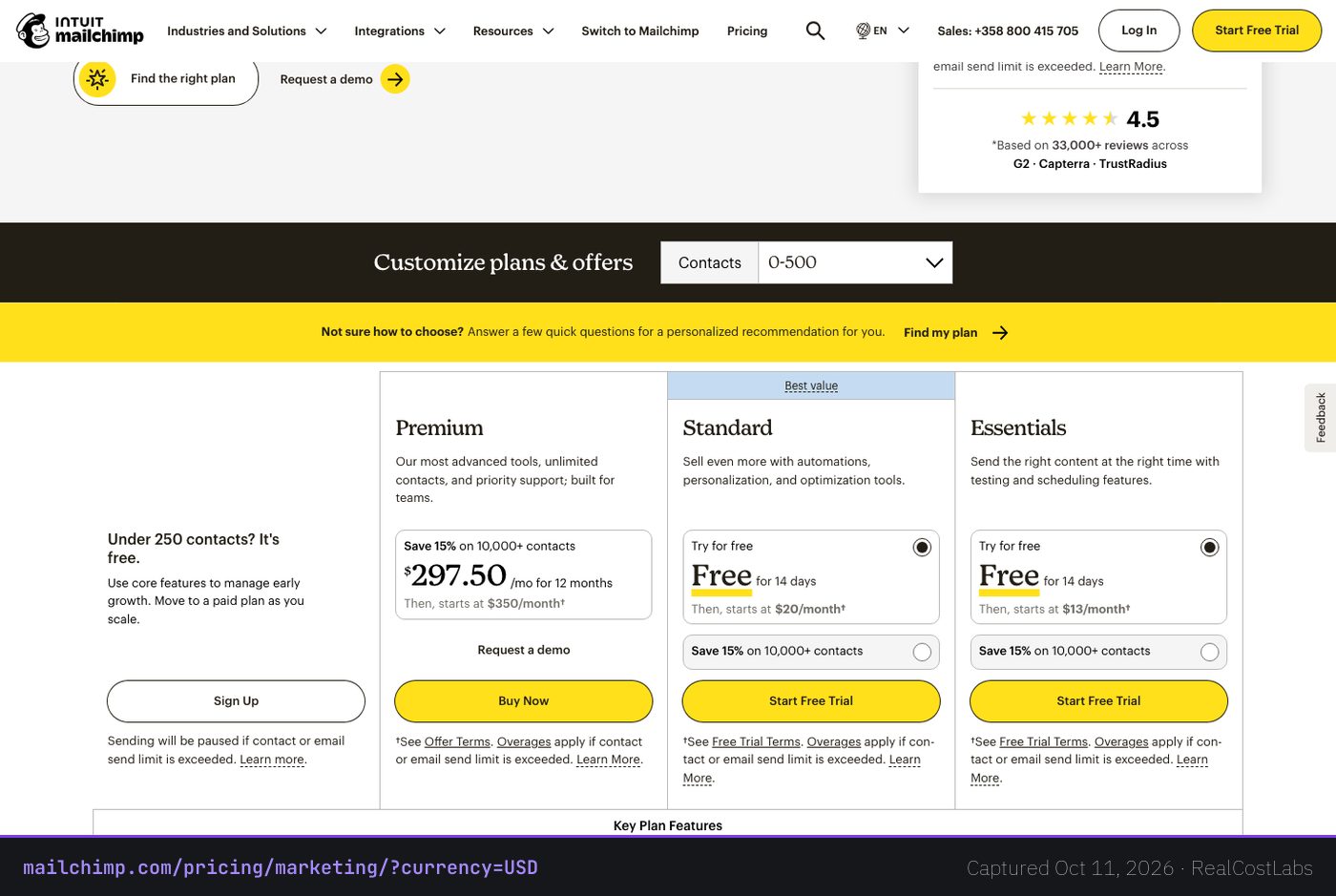
Prices verified against Mailchimp’s published rate card, June 2026. Standard is the realistic working tier.
Read the 5,000-contact row carefully. Standard at that size is $100 a month, about $1,200 a year — and 5,000 contacts is a small list. At 25,000 you are at $310 a month, or $3,720 a year, for a newsletter.
The billing quirk that costs real money
This is the single most important thing on this page, and it is not on the pricing page.
Mailchimp counts contacts you have not manually archived. Unsubscribed people, bounced addresses, and long-dead records stay in your contact count until you go and remove them. You are paying, every month, for people who will never receive another email from you.
Mailchimp does not deduplicate across audiences. If the same person is in two lists, you are billed for two contacts.
What this looks like in practice
A business with a nominal 4,500-person list and two years of accumulated unsubscribes and duplicates can easily be billed at the 5,000 tier — or the 10,000 one. The difference between the 5,000 and 10,000 Standard tiers is $35 a month, or $420 a year, for contacts that generate nothing.
Before you decide whether Mailchimp is worth it, do this: archive unsubscribed contacts, merge duplicate audiences, and check what tier you actually land on before you judge the price.
The Essentials trap
Essentials looks like the sensible choice. At 10,000 contacts it is $110 against Standard’s $135 — a $25 saving, or $300 a year.
Then you find that Essentials caps automations at four steps. A welcome sequence, an abandoned-cart flow, a re-engagement series — the things you bought an email platform to do — do not fit in four steps. The $300 saving on Essentials lasts until the first flow needs a fifth step.
If you are comparing Mailchimp to anything else, compare at Standard. That is the real number.
What the ratings gap tells you
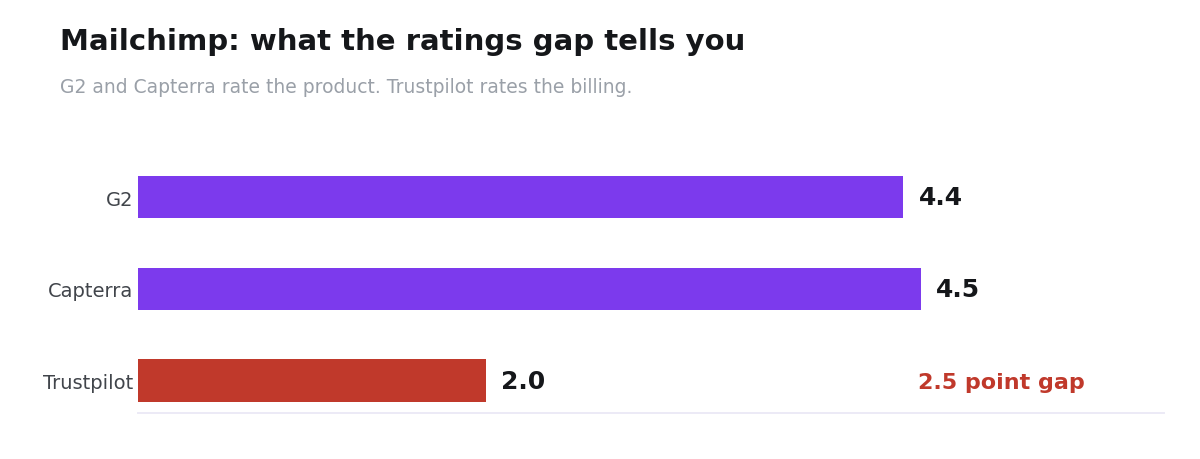
Mailchimp has more reviews than almost any product we cover: roughly 12,885 on G2 and 17,626 on Capterra, scoring in the low-to-mid 4s on both. On Trustpilot it sits around 2.
| Platform | Score | Reviews | What it measures |
|---|---|---|---|
| Capterra | ~4.5 / 5 | 17,626 | Whether the product works |
| G2 | ~4.4 / 5 | 12,885 | Capability and ease of use |
| Trustpilot | ~2 / 5 | — | Billing and support experience |
The sub-scores tell the story more precisely than the headline numbers: G2 and Capterra reviewers rate ease of use highly and rate value for money and customer support clearly lower. The gap between “this tool works” and “I am happy paying for it” is where Mailchimp lives.
That is a specific, actionable finding: you are not buying a bad product. You are buying an expensive one with thin support.
Worth it, by list size
| Your list | Mailchimp Standard | Brevo equivalent | Verdict |
|---|---|---|---|
| 500 | $240/yr | Free tier covers it | No — but the cost is trivial |
| 2,000 | ~$600/yr | ~$300/yr | Marginal |
| 5,000 | $1,200/yr | ~$400/yr | No — $800 a year for familiarity |
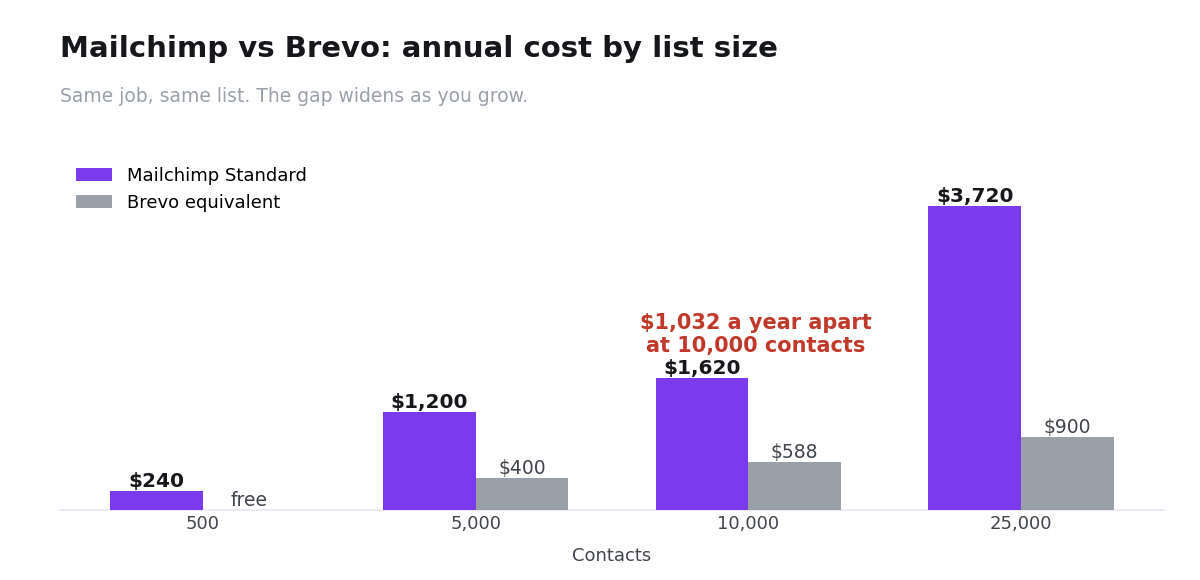
| 10,000 | $1,620/yr | $588/yr | No — a $1,032 gap |
| 25,000 | $3,720/yr | from $108/yr | No — price it properly first |
At 10,000 contacts, Mailchimp Standard is $1,620 a year and Brevo is $588. That is a difference of $1,032 annually for a job both tools do. Across our eight-platform comparison at 10,000 contacts, Mailchimp ranked fifth of eight on price.
Mailchimp is worth it below roughly 2,000 contacts, where the absolute numbers are small enough that convenience wins. Above 5,000 it becomes difficult to defend on anything except switching cost.
The three-year number
| List size, Standard tier | Year 1 | 3 years | Brevo, 3 years |
|---|---|---|---|
| 5,000 contacts | $1,200 | $3,600 | ~$1,200 |
| 10,000 contacts | $1,620 | $4,860 | $1,764 |
| 25,000 contacts | $3,720 | $11,160 | from $324 |
At 10,000 contacts the three-year gap against Brevo is roughly $3,100. Lists usually grow, so these are floors rather than estimates — and Mailchimp’s tier steps mean the gap widens as you grow, not narrows.
If the answer is no, what instead
- Brevo — $49 a month at 10,000 contacts, the cheapest in our eight-platform comparison. It bills on emails sent rather than contacts stored, which inverts the math if you send rarely to a large list. If you send daily, price it carefully — the ranking flips.
- MailerLite — $73 a month at 10,000. The closest thing to Mailchimp in feel at roughly half the price.
- GetResponse — $65 a month at 10,000, with stronger automation than Mailchimp Essentials at any price.
- Kit — free to 10,000 subscribers, then $139 a month at that same size. Excellent if you are under the ceiling, expensive the moment you cross it.
Full comparison in our Mailchimp alternatives guide, and side-by-side breakdowns for MailerLite vs Mailchimp, ActiveCampaign vs Mailchimp and Kit vs Mailchimp.
The verdict
Mailchimp is worth it if your list is small, your needs are simple, and you value not thinking about it. Under about 2,000 contacts, the price difference against cheaper tools is small enough that familiarity and the integration catalog win.
Above 5,000 contacts the case falls apart. You are paying a brand premium of $800 to $1,000 a year for a product that ranks mid-table on capability and below mid-table on value and support — and the billing model quietly charges you for contacts who unsubscribed two years ago.
Before you renew, do the archive exercise in the section above. It takes twenty minutes and it is the highest-return thing you can do with this page.
We score tools on real value rather than headline features. Mailchimp’s Lab Score reflects a capable product carrying a price that its own users rate below the competition.
Common questions
Is Mailchimp’s free plan still usable?
It exists but it is tightly capped and carries Mailchimp branding. Treat it as a trial rather than a tier. Brevo’s free allowance — roughly 9,000 emails a month within a 300-a-day cap — is the more usable free option.
Why did my Mailchimp bill go up when my list did not grow?
Almost always contact bloat. Unsubscribed and bounced contacts stay in your count until manually archived, and duplicates across audiences are billed separately. Archive them and re-check your tier.
Is Essentials or Standard the right plan?
Standard, for almost anyone doing real email marketing. Essentials caps automations at four steps, which rules out most welcome, cart and re-engagement flows.
How much does Mailchimp cost for 10,000 contacts?
$110 a month on Essentials, $135 on Standard, $350 on Premium. Standard at $1,620 a year is the realistic figure at that size.
Is Mailchimp cheaper if I pay annually?
Mailchimp’s discounting is less generous than the category norm and varies by plan. The larger saving is not the billing cycle — it is cleaning the contact list.
Is Mailchimp worth it for e-commerce?
It is serviceable, but Klaviyo and Omnisend are built for it and Mailchimp is not. If revenue attribution and product-level segmentation matter, price those two before defaulting to Mailchimp.