 MailerLite
 ActiveCampaign
 Omnisend
 Klaviyo
 SE Ranking
 Mangools
 Semrush
 Ahrefs
 Pipedrive
 Zoho CRM
 Salesforce
 HubSpot
 Systeme.io
 GoHighLevel
 ClickFunnels
 Vendasta
Is Klaviyo worth it?
Yes, if you run e-commerce and email is a revenue channel rather than a newsletter. No, for almost anything else — because Klaviyo bills on every profile you store, and the price ladder has a step at 11,500 contacts that raises your bill 50% for 15% more people.
RealCostLabs is independent and reader-supported. We may earn a commission on purchases made through our links, at no extra cost to you, and our scores are never for sale.
The short answer
Klaviyo is the best e-commerce email platform on the market and it charges accordingly. Its G2 profile claims more than 170,000 businesses, the segmentation is genuinely ahead of the field, and the revenue attribution is the reason serious online stores put up with the bill.
The catch is the pricing model. You are billed on active profiles stored, not emails sent and not engaged subscribers. Every abandoned signup, every one-time customer from 2023, every profile you imported and forgot — all of it is on the meter, every month, forever.
Worth it if
- You run e-commerce with real order volume. Revenue attribution per flow is the feature, and it justifies the price when the numbers are large enough.
- You use behavioral segmentation seriously — browse abandonment, predicted lifetime value, purchase-cycle timing. This is where Klaviyo is genuinely ahead.
- Email drives more than about 15% of your revenue. Below that, the platform is over-specified for the job.
- You keep your profile list actively pruned. This is not optional at Klaviyo prices.
Not worth it if
- You send a newsletter. You are buying an e-commerce engine to send text, at three times the price of tools built for that.
- Your list is near 10,000 and growing. Read the cliff section below before you commit.
- You have a large, cold list. You will pay full price for people who will never buy again.
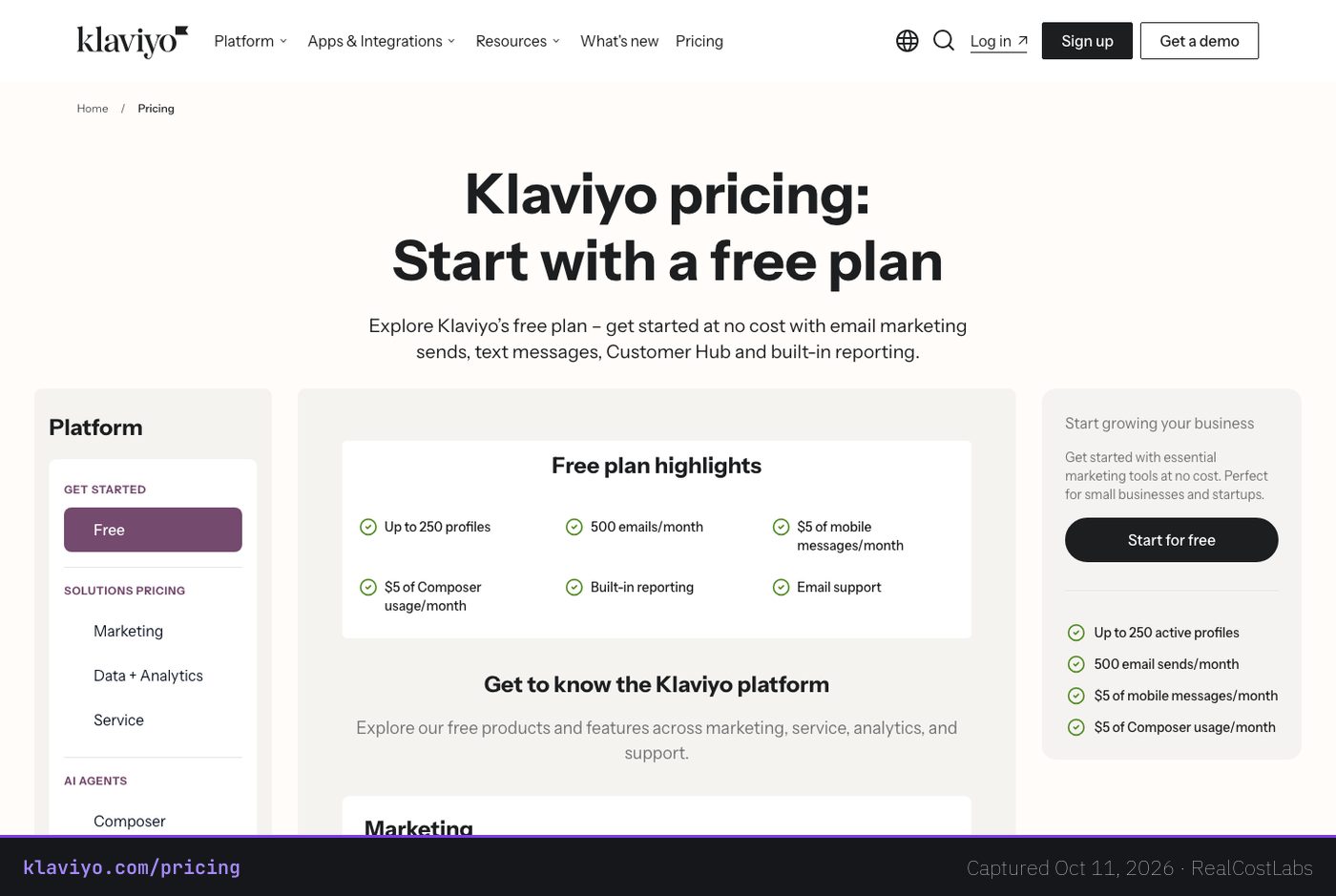
- You are pre-revenue or early. The free tier stops at 250 profiles, which is nothing.
What Klaviyo actually costs
Klaviyo advertises $20. Our pricing analysis put the realistic working plan at $150 — a 7.5× multiple, the second-widest gap of the 20+ tools we priced. Here is the ladder.
| Active profiles | Email only, per month | Per year |
|---|---|---|
| Up to 250 | Free (500 sends/mo) | — |
| 251–500 | $20 | $240 |
| 1,500 | $45 | $540 |
| 5,000 | $100 | $1,200 |
| 10,000 | $150 | $1,800 |
| 11,500 | $225 | $2,700 |
| 25,000 | $400 | $4,800 |
| 60,000 | $860 | $10,320 |
| 85,000 | $1,205 | $14,460 |
| 110,000 | $1,495 | $17,940 |
Email-only pricing, read from Klaviyo’s published rate card in August 2026. SMS is billed separately.
The 11,500 cliff
This is the most important number on this page and the reason we wrote it.
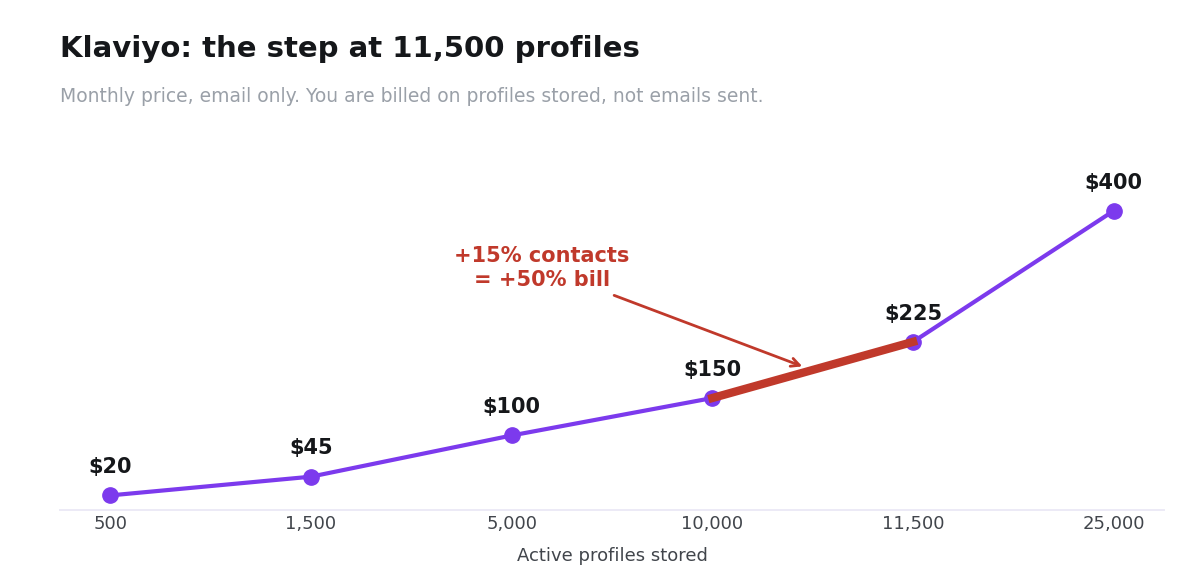
Going from 10,000 to 11,500 profiles — a 15% increase in list size — takes your bill from $150 to $225 a month. That is a 50% price increase. Annualized, adding 1,500 contacts costs you $900 a year.
It gets sharper. At around 13,000 profiles the bill is roughly double the 10,000 price. You have grown your list by 30% and doubled your software cost.
Why this matters more than the headline price
Most pricing comparisons check one list size and stop. Klaviyo’s ladder is not linear, and the steepest step sits exactly where a successful small store ends up. If you are at 8,000 profiles and growing, you are not looking at $150 a month — you are looking at $225 within a year and $400 within two.
Price Klaviyo at the list size you expect in eighteen months, not the one you have today. If that number still works, the tool is worth it. If it only works at today’s size, you have a problem scheduled.
You are billed for people who will never buy
Klaviyo counts active profiles, and the definition is broad: it includes profiles that have never opened an email, never placed an order, and never will.
Three things quietly inflate the number:
- Imported historical customers. Every one-time buyer from three years ago sits on the meter unless you suppress them.
- Abandoned signups. People who entered an email for a discount code and vanished are full-price profiles.
- Integration sync. A store connection imports customer records as profiles, and the first bill is where you find out how many.
The practical fix
Suppress or delete unengaged profiles on a schedule — quarterly is reasonable. At the 10,000-to-11,500 boundary, removing 1,500 dead profiles is worth $900 a year. There are not many list-hygiene tasks with that return.
This is also the counterargument to the price: Klaviyo is expensive partly because the list is allowed to bloat. A disciplined 9,000-profile list at $150 is a very different proposition from a neglected 13,000-profile one at $300.
SMS is a separate bill
Klaviyo SMS starts at $35 a month and includes only 150 SMS/MMS credits. After that it is usage-based, and US toll-free messaging carries its own per-message rate.
Add the other channels and the picture changes again: Social runs about $50 a month at 10,000 profiles, and Reviews is priced separately on top.
So the realistic all-in figure for a store running email plus SMS at 10,000 profiles is not $150. It is closer to $185 before a single text is sent beyond the included credits — and SMS volume is exactly the thing that scales with a good campaign.
What the ratings gap tells you
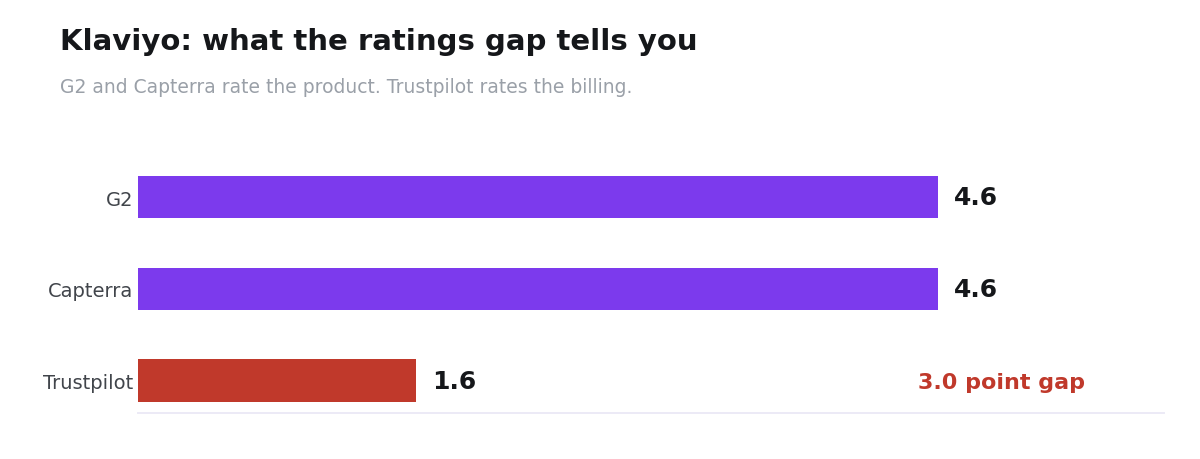
Klaviyo scores in the mid-4s on G2 across 1,361 reviews and on Capterra across 537. On Trustpilot it sits around 1.x across 367 reviews — the lowest of the four major tools we have run this comparison on.
| Platform | Score | Reviews | What it measures |
|---|---|---|---|
| G2 | ~4.6 / 5 | 1,361 | Capability and results |
| Capterra | ~4.6 / 5 | 537 | Features and fit |
| Trustpilot | ~1.x / 5 | 367 | Billing and support |
Roughly a three-point spread, and it is the widest we track. The interpretation is consistent with the pricing model: marketers who get results rate the product highly, and people who watched the bill climb without warning rate the company badly.
Klaviyo also sits clearly below the value leaders on price-to-satisfaction. That is not a claim that the product is bad — it is a claim that a meaningful number of customers do not feel the price matched what they got.
Worth it, by who you are
| You are | Realistic annual cost | Verdict |
|---|---|---|
| Newsletter with 5,000 readers | $1,200 | No — Brevo does it for ~$400 |
| Small store, 5,000 profiles | $1,200 | Marginal — depends on order volume |
| Growing store, 10,000 profiles | $1,800 | Yes, if email drives 15%+ of revenue |
| Established store, 25,000 profiles | $4,800 | Yes — attribution pays for itself |
| Large list, low engagement | $4,800–17,940 | No — prune before you decide |
The break-even is measurable, which is unusual and to Klaviyo’s credit: the platform reports revenue per flow. At 10,000 profiles you are paying $1,800 a year. If attributed email revenue exceeds that by a comfortable margin, the answer is yes and the rest of this page is detail.
If you cannot attribute revenue to email, you are paying e-commerce prices for newsletter work.
The three-year number
Klaviyo’s cost rises with your success, so a static figure understates it. Here is a store growing at a modest pace.
| Year | Profiles | Monthly | Annual |
|---|---|---|---|
| Year 1 | 10,000 | $150 | $1,800 |
| Year 2 | 13,000 | ~$300 | ~$3,600 |
| Year 3 | 25,000 | $400 | $4,800 |
| Three-year total, email only | ~$10,200 | ||
Add SMS and the three-year figure clears $11,000 comfortably. That is the number to weigh — not $150 a month.
If the answer is no, what instead
- Omnisend — $132 a month at 10,000 contacts, built for e-commerce, and the closest like-for-like swap. See Klaviyo vs Omnisend.
- Brevo — $49 a month at 10,000. Bills on emails sent rather than profiles stored, which is the exact opposite of Klaviyo’s model and much kinder to large, rarely-mailed lists.
- MailerLite — $73 a month at 10,000, with solid automation and none of the e-commerce depth. The right answer if you are running a newsletter.
- ActiveCampaign — $189 a month at 10,000. More expensive than Klaviyo at this size; choose it for CRM-style automation, not for price. See ActiveCampaign vs Klaviyo.
Full breakdown in our Klaviyo alternatives guide.
The verdict
Klaviyo is worth it for e-commerce stores where email is a measured revenue channel. The segmentation and attribution are genuinely best-in-class, and when you can point at the revenue a flow generated, $1,800 a year is an easy decision.
It is not worth it for anyone sending a newsletter, anyone with a large cold list, or anyone who has not looked at the price ladder past the tier they are on today. The 11,500 cliff and the profile-based meter mean Klaviyo gets more expensive precisely as you succeed, and it does so in steps rather than smoothly.
The test is one question: can you name what email earned you last month? If yes, Klaviyo is probably worth it. If no, you are buying the most expensive way to find out.
We score tools on real value rather than headline features. Klaviyo earns a strong Lab Score for capability, held back by a pricing ladder that punishes growth and a consumer rating that reflects it.
Common questions
How much is Klaviyo for 10,000 contacts?
$150 a month email-only, or $1,800 a year. Adding SMS starts at $35 a month for 150 credits, so a realistic all-in figure is nearer $185 a month before SMS overage.
What is an “active profile” and why is my count so high?
It is any profile stored in your account, including people who have never opened an email or placed an order. Historical customer imports and abandoned signups are the two usual causes of an unexpectedly high count.
Is the Klaviyo free plan useful?
Only for testing. It covers up to 250 active profiles and 500 email sends a month, plus a small SMS credit. It is a sandbox rather than a tier you can operate in.
Why did my Klaviyo bill jump so much?
Almost certainly a tier boundary. The step from 10,000 to 11,500 profiles is a 50% increase, and around 13,000 the bill is roughly double the 10,000 price. Check your profile count against the ladder above.
Is Klaviyo better than Mailchimp?
For e-commerce, clearly — segmentation and revenue attribution are not comparable. For a newsletter, Mailchimp is cheaper and Klaviyo is over-specified. See Klaviyo vs Mailchimp.
How do I reduce my Klaviyo bill without leaving?
Suppress or delete unengaged profiles quarterly. At the 10,000-to-11,500 boundary, removing 1,500 dead profiles saves $900 a year, which is the highest-return list-hygiene task available to you.