 MailerLite
 ActiveCampaign
 Omnisend
 Klaviyo
 SE Ranking
 Mangools
 Semrush
 Ahrefs
 Pipedrive
 Zoho CRM
 Salesforce
 HubSpot
 Systeme.io
 GoHighLevel
 ClickFunnels
 Vendasta
Email list hygiene
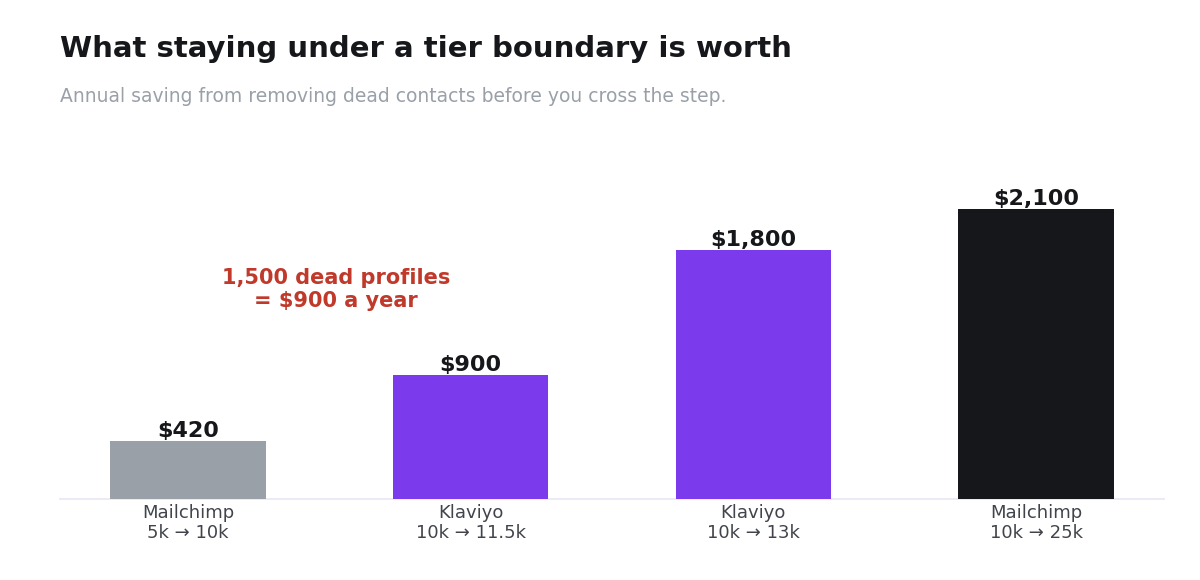
Most advice on cleaning your list is about deliverability. This one is about money. If your platform bills on contacts stored rather than emails sent, every dead address on your list is a line item — and at one common tier boundary, 1,500 of them cost $900 a year.
RealCostLabs is independent and reader-supported. We may earn a commission on purchases made through our links, at no extra cost to you, and our scores are never for sale.
First, find out which meter you are on
This decides how much list hygiene is worth to you, and the two models behave completely differently.
| Billed on | Platforms | What a dead contact costs you |
|---|---|---|
| Contacts stored | Mailchimp, Klaviyo, HubSpot marketing contacts | Money, every month, forever |
| Emails sent | Brevo | Nothing directly — only deliverability |
| Subscribers | Kit, MailerLite, GetResponse | Money, at tier boundaries |
If you are on a stored-contact platform, the rest of this page is a costed maintenance task. If you are on Brevo, it is purely about deliverability — still worth doing, just not worth money.
The two billing quirks that cost the most
Mailchimp counts what you have not archived
Unsubscribed people, bounced addresses and long-dead records stay in your billable contact count until you manually archive them. Unsubscribing removes someone from your sends, not from your invoice.
Worse: Mailchimp does not deduplicate across audiences. The same person in two lists is two billable contacts.
Klaviyo bills on every profile you store
An “active profile” includes anyone in your account — never opened, never purchased, never will. Historical customer imports and abandoned discount-code signups are full-price profiles.
What the cleanup is actually worth
Tier boundaries are where the money is, because the steps are large and they do not care that the contacts are dead.
| Platform | Boundary | Price step | Annual value of staying under |
|---|---|---|---|
| Klaviyo | 10,000 → 11,500 profiles | $150 → $225/mo | $900 |
| Klaviyo | 10,000 → ~13,000 | Roughly doubles | $1,800 |
| Mailchimp | 5,000 → 10,000 contacts | $100 → $135/mo | $420 |
| Mailchimp | 10,000 → 25,000 | $135 → $310/mo | $2,100 |
Removing 1,500 dead profiles from a Klaviyo account sitting just over 10,000 is worth $900 a year. There are not many twenty-minute tasks with that return.
The quarterly routine
- Archive unsubscribes and hard bounces. On Mailchimp this is the single highest-value action, because unsubscribing does not remove them from billing.
- Merge duplicate audiences. Mailchimp bills the same person once per audience.
- Suppress non-openers. Define a window — 6 or 12 months with zero opens and zero clicks — and suppress rather than delete, so you keep the record without the charge where the platform allows it.
- Check your count against the ladder. Find your next tier boundary and see how close you are. That number tells you how urgent this is.
- Re-engage before you cut. One “are you still interested” send makes the rest a clean decision.
The deliverability half
The money is the sharper argument, but the deliverability case is real and compounds. Sending to dead addresses raises bounce rates and lowers engagement, and mailbox providers read both as quality signals. A smaller engaged list outperforms a larger stale one on open rate, click rate and inbox placement — while costing less.
This is the rare case where the cheap option and the effective option are the same option.
Or change the meter
If your list is large and you mail it infrequently, storage-based billing is structurally wrong for you. Brevo bills on emails sent, which is why it costs $49 a month at 10,000 contacts where Klaviyo costs $150.
The trade-off is real and worth stating: if you send daily to a small list, sends-based billing punishes you and stored-contact billing is kinder. Price both against your actual send pattern rather than your list size.
Common questions
Does unsubscribing remove someone from my Mailchimp bill?
No. Unsubscribed contacts stay in your billable count until you archive them manually. This is the most expensive misunderstanding in email marketing.
How often should I clean my list?
Quarterly is enough. Do it more often if you are near a tier boundary.
Should I delete or suppress?
Suppress where the platform lets you keep the record without billing for it, so you do not re-import the same dead addresses later. Delete where suppression still counts toward your total.
How much can list hygiene actually save?
At the Klaviyo 10,000-to-11,500 boundary, $900 a year. At the Mailchimp 10,000-to-25,000 step, up to $2,100. Below a boundary, nothing — which is why the first step is checking where you sit.