 MailerLite
 ActiveCampaign
 Omnisend
 Klaviyo
 SE Ranking
 Mangools
 Semrush
 Ahrefs
 Pipedrive
 Zoho CRM
 Salesforce
 HubSpot
 Systeme.io
 GoHighLevel
 ClickFunnels
 Vendasta
CRM for accountants and bookkeepers
You are not shopping for a CRM. You are shopping for practice management, and the three leading options price it in three completely different ways — one of which only publishes a three-year commitment price, and one of which charges add-ons per client on top of per-user seats. Here is what each actually costs, and the number that beats all of them.
RealCostLabs is independent and reader-supported. We may earn a commission on purchases made through our links, at no extra cost to you, and our scores are never for sale.
Disclosure: we earn nothing from TaxDome, Canopy or Karbon — the three products this page is mostly about. The two links we do earn from sit against specific side problems and are marked.
“CRM” is the wrong word, and it matters
A CRM tracks a deal through a pipeline. An accounting firm has one of those only if it is actively selling rather than growing on referrals.
What a firm actually runs is a recurring production process: the same three hundred clients, the same forms, the same deadlines, every year. The work is chasing documents, moving jobs through stages, getting signatures and billing. The category that does that is practice management, and every tool below includes a CRM as one module inside it.
Search for a CRM and you will find Pipedrive and HubSpot. They will not chase a client for a missing 1099.
Three vendors, three pricing models
| Vendor | Entry | Next tier | Priced by | Term |
|---|---|---|---|---|
| Karbon | Team $59/user/mo | Business $89/user/mo | Per user | Annual; monthly only for teams of 4+ |
| Canopy | Standard $74/user/mo | Plus $109, Premium $149 | Per user + per client add-ons | Annual saves 20% |
| TaxDome | Essentials $700/yr/seat (solo only) | Pro $900, Business $1,100 | Per seat | 3-year commitment, billed upfront |
Read from each vendor’s own pricing page, August 2026. Karbon figures are the USD setting; the page defaults to your local currency. TaxDome prices are the only ones published and they carry a three-year term.
What a five-person firm pays
| Option | Per year | Note |
|---|---|---|
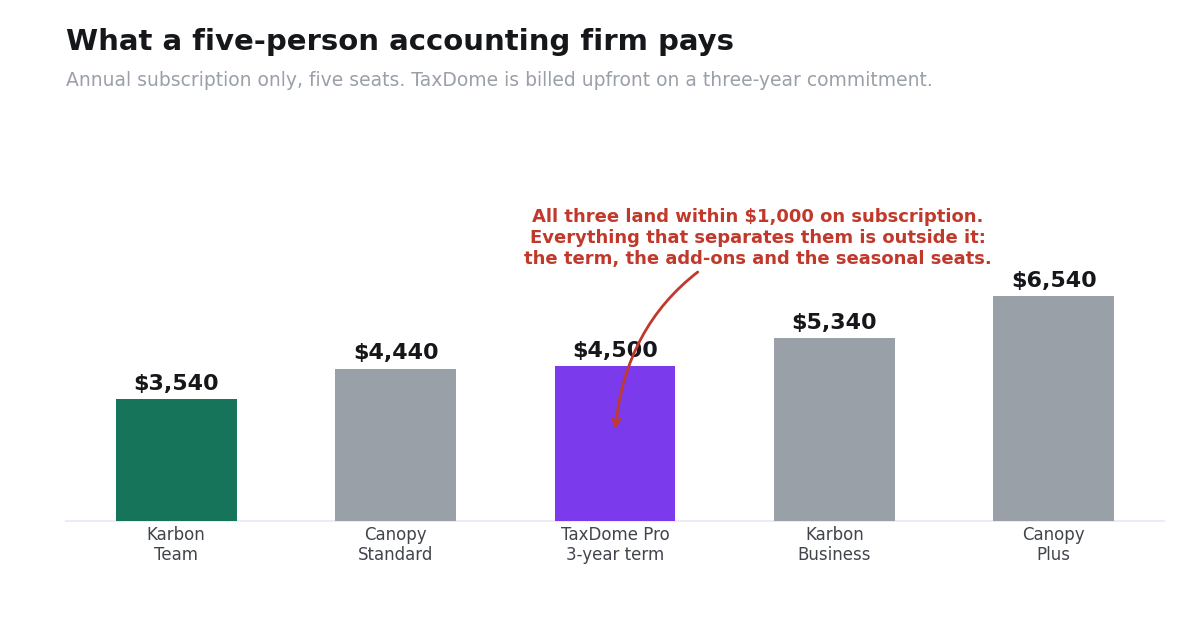
| Karbon Team | $3,540 | Annual billing |
| Canopy Standard | $4,440 | Annual billing; add-ons extra |
| TaxDome Pro | $4,500 | Billed upfront, three-year term |
| Karbon Business | $5,340 | |
| Canopy Plus | $6,540 |
On subscription alone the three land within about $1,000 of each other. What separates them is everything around the subscription.
TaxDome publishes only a three-year price
This is unusual enough to state plainly. TaxDome’s pricing page shows $700, $900 and $1,100 per seat per year — and every one of them is annotated “with a 3-year commitment”.
There is no toggle for a one-year term and no monthly option shown. What a shorter commitment costs is not published at all.
Two further details from the same page:
- All plans are billed upfront. A five-person firm on Pro is a $4,500 payment, not a monthly line.
- Installment plans exist only above $9,000. Below that, the whole term is due.
What to do: ask for the one-year and two-year rates in writing before you evaluate anything else. If they are materially higher, the published figure is a three-year price being compared against competitors’ annual prices — which is not a like-for-like comparison.
Canopy charges add-ons by client, not by user
Canopy’s seat price is the middle of the three. Its add-ons are where the model changes shape.
| Add-on | Price | At a 5-person firm with 300 clients |
|---|---|---|
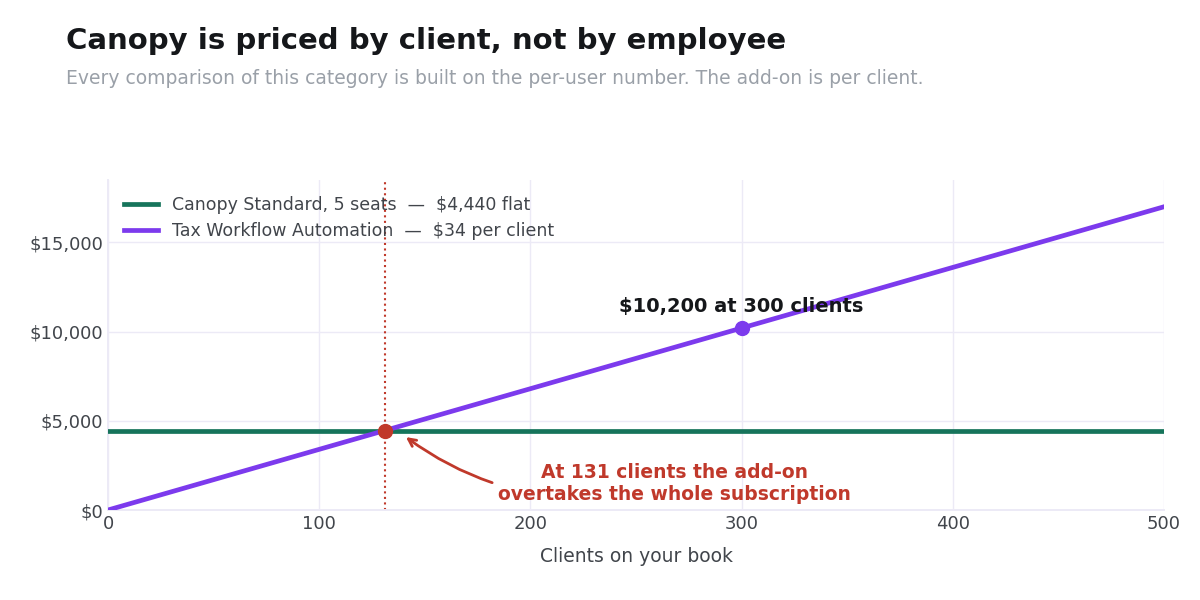
| Tax Workflow Automation | From $34 per client | $10,200/yr |
| Tax Resolution | $50/user/month | $3,000/yr |
| Close Automation | $10 per connected client/month (first 5 free) | $3,000/yr at 30 monthly clients |
Annual billing; Canopy states volume discounts are available on the per-client add-ons.
Tax Workflow Automation at $34 a client is $10,200 a year on a 300-client book — more than twice the $4,440 subscription it sits on top of.
That is not hidden and it is not unreasonable for what it does. But it inverts the usual arithmetic: on Canopy, the number of clients you serve matters more to your bill than the number of people you employ, and a comparison built on the per-user number misses it.
Get the volume-discounted per-client rate at your actual client count before you compare Canopy with anything.
Karbon will not let a small firm pay monthly
Karbon is the cheapest of the three at entry — $59 per user per month on annual billing, $708 a year per seat. Two things sit behind that number.
- Monthly billing is only available to teams of four or more. A solo practitioner or a three-person firm must commit annually. That is the opposite of how most software works, where small buyers get the flexible option and large ones get the discount.
- Annual billing saves 25% at Team level ($59 against $79) and 10% at Business ($89 against $99) — put the other way, monthly costs 34% more on Team. Even where monthly is available it is expensive at the tier a small firm would buy.
For a growing firm this is worth planning around: the billing flexibility arrives at the fourth hire, not before.
The cost nobody prices: seasonal staff
Accounting has a staffing shape almost no other industry shares. From January to April a firm may double its headcount with temporary preparers, then return to normal for eight months.
Per-seat annual software handles that badly, and only TaxDome prices it explicitly:
| TaxDome seat | Cost | Per month |
|---|---|---|
| Core seat, Pro plan | $900/year | $75 |
| Temporary seat, monthly | $100/month | $100 |
| Seasonal seat, 4-month term | $500 | $125 |
A seasonal seat costs 67% more per month than a permanent one. Four temporary preparers for the season is $2,000 on top of your core seats.
TaxDome notes seasonal seats auto-renew on the firm’s unified renewal date. Check that clause — a seasonal seat that renews itself is a permanent seat with extra steps.
The planning question is not which tool is cheapest per seat. It is what a seat costs for four months, and whether you can remove it in May. Ask all three vendors that before you compare anything else.
What the problem costs: the document chase
Now the number that makes the software decision look small.
The thing that consumes the most time in season is not preparation. It is getting source documents out of clients — the emails, the reminders, the second reminders, the phone call, the wrong file format, the missing 1099.
The formula
Returns × minutes spent chasing per client ÷ 60 × your billable rate.
| Minutes chasing, per client | Hours across 300 returns | At $150/hour |
|---|---|---|
| 30 | 150 | $22,500 |
| 45 | 225 | $33,750 |
| 60 | 300 | $45,000 |
At forty-five minutes a client, the chase costs $33,750 a year — seven and a half times the entire Canopy subscription. And unlike most software arguments, this one is directly addressable: automated document requests, structured questionnaires and scheduled reminder sequences are precisely what practice management software does.
This is the case for spending the money. Not the features list, not the client portal. If the software takes fifteen minutes off the average chase, it returns $11,250 a year on a $4,440 subscription.
Measure your own number first.
What to buy
| Your firm | Buy | Per year |
|---|---|---|
| Small firm, straightforward workflow | Karbon Team | $708/user |
| Solo practitioner | TaxDome Essentials — get the 1-year rate first | $700/seat (3-year price) |
| Heavy tax workflow, want it automated | Canopy + Tax Workflow — price it per client | $888/user + $34/client |
| Automation and reporting depth | Karbon Business or Canopy Plus | $1,068–1,308/user |
| Large seasonal swing | Ask all three what a four-month seat costs | |
| Actively selling advisory services | A real CRM alongside — see below | $468/seat |
Karbon Team at $708 per user is the cheapest credible entry, with the caveat that a firm under four people cannot pay monthly. Canopy is the pick if tax workflow automation is the point — just price the add-on at your client count, not your headcount. TaxDome is competitive on the published number, but that number is a three-year commitment and you should see the one-year figure before treating it as comparable.
The two places a different tool earns its keep
Practice management runs the work. It is weak at two things, and both matter to a growing firm.
1. The January document campaign
The document chase above is largely a communication problem, and the highest-leverage version of it is not chasing at all — it is a scheduled sequence that goes out in early January, segmented by client type, before anyone has to chase anybody.
Practice management tools send transactional requests well and campaigns badly. A dedicated email platform runs the sequence, tracks who opened, and lets you follow up only with the people who did not respond.
Useful specifically for the deadline reminders that need to reach people who do not read email. See our Brevo pricing breakdown.
2. Selling advisory work
If your firm is actively pursuing advisory engagements — CFO services, systems work, consulting — that genuinely is a pipeline with stages, proposals and decision dates. Practice management tools track work you have won, not work you are chasing.
Only worth it if someone owns business development. For a referral-led firm it is a second system with nothing to put in it. See Pipedrive pricing.
The verdict
Buy practice management, not a CRM. The three leading options land within about $1,000 of each other on subscription, so the decision is made on the pricing model rather than the price.
Get three numbers in writing before you sign anything: TaxDome’s one-year rate, Canopy’s per-client add-on rate at your client count, and what a four-month seasonal seat costs on all three. Each of those moves the annual bill by more than the gap between the vendors.
Then measure the document chase. At forty-five minutes a client across three hundred returns it is $33,750 a year — seven times the software — and it is the only number on this page the software can actually change.
We earn no commission from TaxDome, Canopy or Karbon. We do earn from Brevo and Pipedrive, and those links are marked.
Common questions
What is the best CRM for accountants?
The right category is practice management rather than CRM. Karbon Team at $59 per user per month is the cheapest credible entry; Canopy and TaxDome are comparable on subscription. A general CRM only makes sense alongside, if you are actively selling advisory work.
How much does TaxDome cost?
$700, $900 and $1,100 per seat per year for Essentials, Pro and Business — but every published price carries a three-year commitment and all plans are billed upfront. A one-year rate is not published. Temporary seats are $100 a month or $500 for a four-month seasonal term.
How much does Canopy cost?
$74 per user per month for Standard on annual billing, $109 for Plus and $149 for Premium; annual billing saves 20% against monthly. Add-ons are separate: Tax Workflow Automation from $34 per client, Tax Resolution $50 per user per month, Close Automation $10 per connected client per month with the first five free.
How much does Karbon cost?
$59 per user per month on Team and $89 on Business, billed annually, or $79 and $99 monthly. Monthly billing is only available to teams of four or more, so smaller firms must commit annually.
Which is cheapest for a five-person firm?
Karbon Team at $3,540 a year, then Canopy Standard at $4,440 and TaxDome Pro at $4,500. But Canopy’s per-client add-ons and TaxDome’s three-year term can change that ranking substantially, so price your own configuration.
What does seasonal staff cost?
Only TaxDome publishes it: $100 a month or $500 for a four-month seasonal seat, which works out at $125 a month against $75 for a permanent Pro seat — a 67% premium. Ask Canopy and Karbon what a four-month seat costs before assuming it is cheaper.
Do I need a CRM as well as practice management?
Only if someone at the firm is actively selling. Practice management handles clients you have; a CRM handles prospects you are pursuing. A referral-led firm does not need both.
What is the biggest hidden cost?
Not a fee — it is the document chase. At forty-five minutes a client across three hundred returns that is 225 hours, or $33,750 at a $150 billable rate. It is seven times the subscription and it is the thing the software exists to reduce.
Should I pay annually?
Usually yes, but check the terms. Karbon does not offer monthly below four users. Canopy’s annual saving is 20%. TaxDome bills the whole term upfront and only offers installments above $9,000.