 MailerLite
 ActiveCampaign
 Omnisend
 Klaviyo
 SE Ranking
 Mangools
 Semrush
 Ahrefs
 Pipedrive
 Zoho CRM
 Salesforce
 HubSpot
 Systeme.io
 GoHighLevel
 ClickFunnels
 Vendasta
Kartra review
One bill replaces your whole stack, but the entry price and the contact ceilings are where the real cost hides.
Ratings from G2 (57 reviews), Capterra (168) and Trustpilot (3.5 from 125 reviews), pricing verified October 11, 2026.
The verdict
Kartra is one of the few tools that is genuinely all-in-one and not just marketing copy pretending to be. It bundles an email platform, an automation engine, a drag-and-drop page and funnel builder, a checkout with integrated payments, a course and membership builder, video hosting, webinars, a help desk, and built-in affiliate management under a single login and a single bill. For a solo creator or small coaching business running on a duct-taped stack of five separate subscriptions, the consolidation is real and the math can work in your favor. Plan-by-plan numbers, add-ons and real team bills are in our Kartra pricing 2026 breakdown.
The catch is twofold, and both halves cost money. First, the entry tier carries a 5% transaction fee on every checkout sale, which quietly taxes the exact low-revenue users the cheap plan is supposed to serve. Second, the contact limits are hard ceilings with no overage option, so a growing list does not nudge your bill up gently. It snaps you onto the next plan. A creator who crosses 12,500 contacts jumps from Growth to Professional, which is $429 a month annual instead of $189. That is the pattern RealCostLabs cares about: the sticker is fine, the bill at realistic scale is the story.
Independent satisfaction is mixed rather than glowing. Capterra users are warm at 4.5 out of 5, but G2 sits at 3.9 and Trustpilot at 3.5. Kartra earns a 6.7. It is a capable, mature platform that does what it promises, held back from a higher score by price, hard ceilings, and ticket-only support. The cheapest capable tool in this category is usually the most satisfying one, and Kartra is at the opposite end of that trade: powerful, but you pay for it in dollars and in patience.
What Kartra really costs at scale
The short version is below. For the plan-by-plan detail, the full add-on table and the ways to pay less, see our dedicated Kartra pricing breakdown.
Kartra has four tiers and no free plan. There is a 14-day free trial (historically promoted as a $1 trial) that rolls into the Starter plan. Annual billing saves roughly 17% over monthly. Here is the full ladder, with the figures verified on the official pricing page in June 2026.
| Plan | Monthly | Annual (per mo) | Contacts | Seats | Domains |
|---|---|---|---|---|---|
| Essentials | $59 | $52 | 500 | — | 1 |
| Starter | $119 | $99 | 2,500 | 5 | 1 |
| Growth | $229 | $189 | 12,500 | 10 | 3 |
| Professional | $549 | $429 | 25,000 | 20 | 5 |
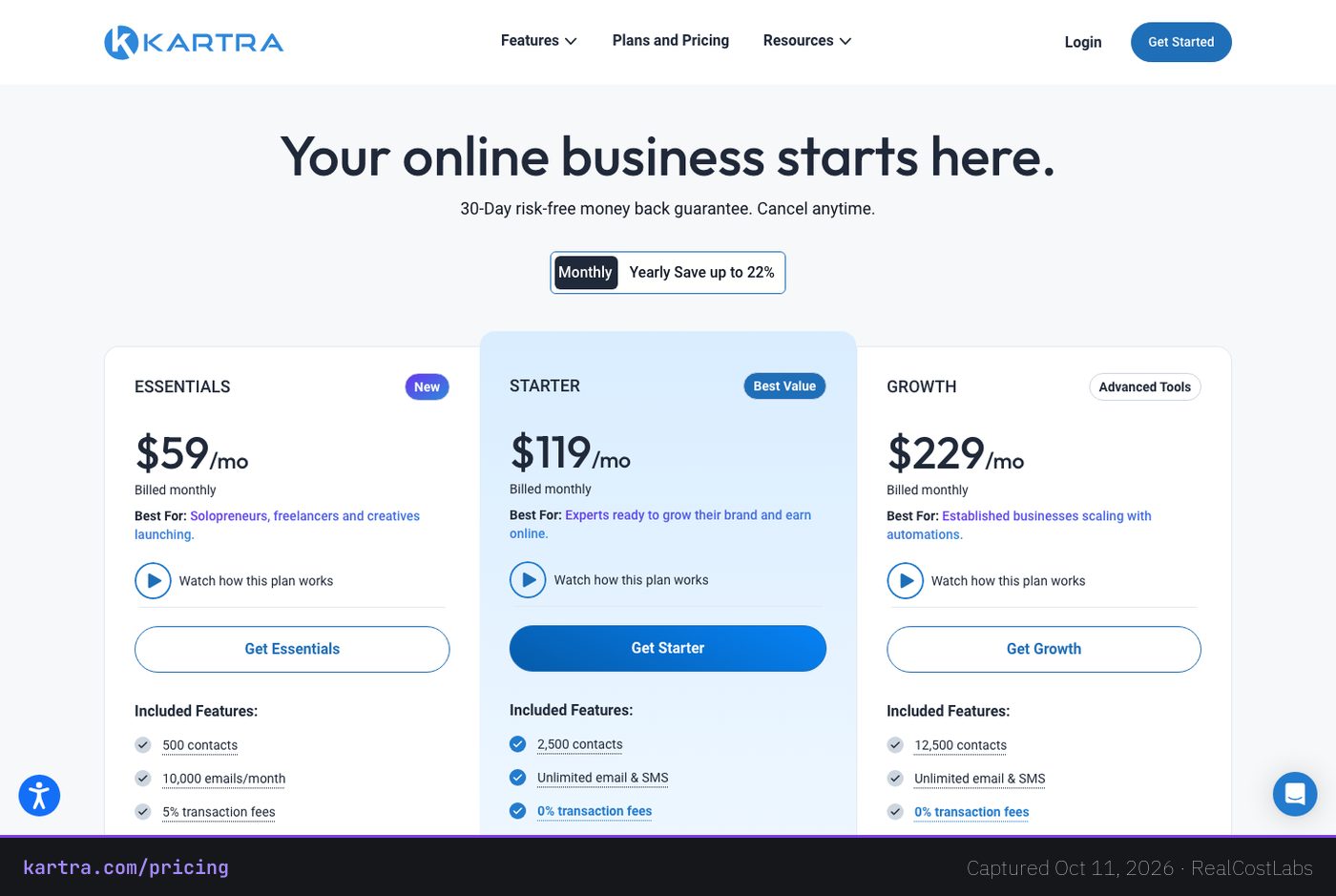
Essentials is the only tier that carries a 5% transaction fee on checkout sales, and it limits you to one course and 30 AI uses a month. That fee is the trap. On $1,000 a month in sales, 5% is about $50, which roughly doubles the real cost of the $52 plan and stacks on top of whatever Stripe or PayPal already takes. The moment you sell anything, Starter at $99 a month annual (fee-free, with unlimited courses, pages, videos, products, emails, and SMS) is almost always the smarter buy than Essentials.
Now the realistic part. A solo creator or coach with a growing email list does not stay at 2,500 contacts. They land on Growth at 12,500 contacts, which is $229 a month billed monthly or $189 a month billed annually. That is about $2,748 a year monthly versus roughly $2,268 a year on the annual plan. Growth is also where the teaching and engagement tools live: webinars (up to 300 attendees), surveys and quizzes, completion certificates, the Funnel Simulator, and the help desk. So for a creator past 2,500 contacts, Growth is the real entry point, not Essentials, and the real annual number is around $2,268 to $2,748, not $624.
The ceilings deserve their own warning. There is no per-contact overage. Cross a limit and Kartra forces an upgrade to the next plan. Hit 12,501 contacts and you do not pay a few dollars more, you move to Professional at $429 a month annual, more than double Growth. Budget against the ceiling you are approaching, not the one you are sitting in, because list growth is the thing that quietly reprices this platform.
Deliverability and email performance
For an all-in-one suite, the email engine is the load-bearing wall, so this is the dimension that matters most. EmailToolTester, the most-cited independent inbox-placement lab, does not publish a Kartra inbox-placement percentage. Kartra is excluded from their head-to-head deliverability percentage set because it is a full marketing suite rather than a dedicated newsletter ESP, and their methodology now rates platforms on deliverability features (authentication, bounce suppression, IP warmup) rather than percentage alone. For context, their benchmark treats anything above 89% inbox placement as excellent and 83% to 88% as acceptable. We will not invent a number for Kartra, because there isn’t a verified one.
What can be verified is structural, and it is genuinely reassuring. Kartra supports SPF, DKIM, and DMARC authentication, the three records that decide whether mailbox providers trust your sends. More notably, Kartra enforces a platform-wide spam-complaint threshold of 0.03% (per its own deliverability guidance), which is ten times stricter than the 0.3% bulk-sender rule Gmail and Yahoo apply. A tight platform-wide complaint ceiling protects shared sending reputation. It is a sound, well-authenticated sender, just not a specialist that publishes a headline inbox number.
In short: if your single most important job is maximum newsletter inbox placement and nothing else, a dedicated ESP that publishes a tested percentage is the safer pick. If email is one of six things you need under one roof, Kartra’s authentication support and strict complaint policy mean deliverability is unlikely to be the thing that lets you down.
Features, in depth
This is where Kartra earns its keep. The breadth is real, and the pieces are designed to talk to each other rather than sit in separate silos.
- Email and automation. Broadcasts plus visual sequence automation, with behavior-based triggers tied to checkout, page visits, and membership activity.
- Pages and funnels. A drag-and-drop builder with a deep library of pre-built funnel templates, including campaigns built by marketer Frank Kern. The Funnel Mapper lets you diagram a campaign visually, and the Funnel Simulator (Growth and up) projects revenue across steps before you launch.
- Checkout and payments. A native cart with one-click upsells, order bumps, and integrated payment gateways. From Starter up there is no transaction fee, so the platform takes nothing beyond your processor.
- Courses and memberships. A full membership and course builder with drip scheduling, plus completion certificates on Growth and above, so Kartra can stand in for a dedicated course platform.
- Video hosting with embedded CTAs. Host videos and drop opt-in forms or buttons directly into the player, which is unusual outside dedicated video tools.
- Webinars. Built-in webinars for up to 300 attendees on Growth and up, removing a separate webinar subscription.
- Affiliate management. Native affiliate program tools with automated commission tracking, a feature most rivals make you bolt on.
- Help desk. A support-desk module with customer history attached, so you can run buyer support inside the same tool that holds the purchase record.
- Surveys, quizzes, and calendars. Surveys and quizzes (Growth and up) for lead scoring and course assessment, plus a booking calendar.
- Kartra AI. Native AI assistance for copy and content, capped by tier: 30 uses a month on Essentials, 100 on Starter, 500 on Professional.
The thesis is straightforward. Kartra replaces an ESP, a page builder, a course platform, a checkout, and an affiliate tool with one subscription. If you were paying separately for all five, the consolidation alone can justify the Growth plan, and you get a single source of truth for contacts, purchases, and behavior instead of five disconnected databases.
Ease of use
This is the most consistent knock against Kartra, and the rating data backs it up: Capterra scores Ease of Use at 4.0, below its 4.5 overall. Kartra is powerful precisely because it does many things, and that surface area is exactly what makes it hard to learn.
The flip side is that the depth is there once you climb the curve, and Kartra invests in onboarding: a detailed knowledge base, the Kartranauts community, and structured training. If you are willing to put in the time to learn the system, it rewards you. If you want to publish a funnel this afternoon with no ramp, the learning curve will frustrate you, and a simpler tool will get you live faster.
Who it is for
Kartra fits the established solo creator, coach, or small course business that already sells and is tired of paying for and reconciling five separate tools. If you have product revenue, a growing list, and the patience to learn one deeper system, the consolidation pays off and the fee-free checkout from Starter up keeps your processor as your only sales cut.
It is a poor fit for three groups. Pure beginners with no audience will find it expensive and overwhelming. Low-revenue solos get punished by the Essentials 5% transaction fee. And anyone whose single priority is the absolute cheapest capable all-in-one will find a rival undercuts Kartra dramatically, free trial promo aside.
Three real-world scenarios
The new coach launching a first $39 course
On Essentials at $52 a month annual, the 5% checkout fee bites every sale on top of Stripe. With a 500-contact cap and one course allowed, this is the wrong starting point. The cheaper-on-paper plan is the expensive one in practice. A free-plan rival, or jumping straight to fee-free Starter, serves this person better.
The established creator with an 11,000-contact list
This is Kartra’s sweet spot. Growth at $189 a month annual (about $2,268 a year) covers webinars, quizzes, certificates, and fee-free checkout, replacing an ESP, course platform, webinar tool, and affiliate manager. The single bill genuinely beats a five-tool stack here. The one thing to watch is the 12,500 ceiling closing in.
The fast-growing list crossing 12,500 contacts
The hard ceiling fires. There is no overage, so contact 12,501 forces the jump from Growth to Professional: $429 a month annual instead of $189, more than doubling the bill overnight. A creator who did not budget for the ceiling gets an unwelcome surprise, which is exactly why the contact limit, not the headline price, is the number to plan around.
Kartra vs the alternatives
Kartra sits in a crowded all-in-one field, and the right comparison depends on your priority: price, courses, or CRM depth.
| Tool | Best for | Entry price | Free plan |
|---|---|---|---|
| Kartra | Established creators wanting true all-in-one | $59 | No |
| Systeme.io | Budget-first solos and beginners | $0 | Yes |
| Kajabi | Course and membership creators | $$$ | No |
| Ontraport / Keap | CRM-heavy automation for SMBs | Keap from $249/mo | No |
The sharpest contrast is Systeme.io, the direct all-in-one rival and the budget disruptor of the category. It offers a genuine free plan and undercuts Kartra by a wide margin. If price is your deciding factor, Systeme.io wins on cost before Kartra’s polish or depth enters the conversation. For course and membership creators specifically, Kajabi is the premium head-to-head: more focused on the teaching experience, generally pricier, and the natural alternative if your business is the course itself rather than the funnel around it. And if your real need is CRM-grade marketing automation, the all-in-ones to weigh against Kartra are Ontraport and Keap, both built around contact-centric automation for the same small-business buyer. Adjacent names like ClickFunnels and HubSpot Marketing Hub also surface for funnel-first and inbound-first teams respectively.
Pros and cons
- Pro: Genuinely all-in-one. Email, funnels, checkout, courses, video, webinars, help desk, and affiliates under one bill.
- Pro: No checkout transaction fee from Starter up, so your payment processor is your only sales cut.
- Pro: Strong deliverability fundamentals, with SPF/DKIM/DMARC support and a strict 0.03% platform-wide spam-complaint threshold.
- Pro: Built-in affiliate management with automated commission tracking, a feature most rivals charge extra for or omit.
- Pro: Deep funnel tooling, including pre-built templates, the Funnel Mapper, and the Funnel Simulator.
- Con: Steep learning curve: Capterra Ease of Use is 4.0, below its 4.5 overall.
- Con: Expensive at realistic scale, and hard contact ceilings force upgrades with no overage option.
- Con: The Essentials 5% transaction fee punishes the low-revenue solos that plan is aimed at.
- Con: Ticket-only support with no live phone or Zoom help.
- Con: Limited native third-party integrations, leaning heavily on Zapier, plus weak blogging and external-calendar sync.
FAQ
Does Kartra have a free plan?
No. There is no free plan. Kartra offers a 14-day free trial (historically promoted as a $1 trial) that rolls into the Starter plan, but the cheapest ongoing tier is Essentials at $59 a month, or $52 a month billed annually.
What does Kartra actually cost for a typical creator?
An established creator with more than 2,500 contacts lands on the Growth plan (12,500 contacts) at $229 a month monthly or $189 a month annual. That is roughly $2,268 a year on annual billing versus about $2,748 a year paying monthly. Essentials looks cheaper but caps you at 500 contacts and adds a transaction fee.
Why does the entry plan have a transaction fee?
Essentials is the only tier with a 5% fee on checkout sales, charged on top of your Stripe or PayPal processing. On $1,000 a month in sales that is about $50, which roughly doubles the plan’s real cost. Every tier from Starter up is fee-free, so once you sell anything, Starter is usually the better value.
What happens when I hit a contact limit?
There is no per-contact overage. Exceeding a tier’s contact ceiling forces an upgrade to the next plan. Crossing 12,500 contacts, for example, moves you from Growth to Professional, which is $429 a month annual rather than $189. Plan your budget against the ceiling you are approaching.
Is Kartra’s email deliverability good?
EmailToolTester does not publish an inbox-placement percentage for Kartra because it tests dedicated ESPs, not full suites. On fundamentals Kartra is solid: it supports SPF, DKIM, and DMARC authentication and enforces a strict 0.03% platform-wide spam-complaint threshold, ten times tighter than the Gmail and Yahoo bulk-sender rule.
Is Kartra good for beginners?
Not especially. Capterra rates Ease of Use at 4.0, below its 4.5 overall. The depth pays off once you learn it, but if you want to launch quickly with no ramp, a simpler tool will get you live faster.
How is Kartra’s customer support?
Support is ticket-based with around a 24-hour target response, backed by a knowledge base and the Kartranauts community. There is no live phone or Zoom support.
What integrates with Kartra?
Kartra has about 20 native integrations, including payment gateways (Stripe, PayPal, Authorize.net, Braintree), email gateways (SendGrid, MailGun, Elastic Mail, Postmark), SMS gateways (Twilio, Plivo, Nexmo), and membership platforms. It also has an API, and Zapier is its primary route to other apps, bridging 5,000+ services. Native direct integrations are limited compared with some rivals.
KEEP EXPLORING
Ready to try Kartra?
Start the 14-day trial and test the full stack before your list grows into the next tier.
Try Kartra →RealCostLabs is independent and reader-supported. We may earn a commission on purchases made through our links, at no extra cost to you, and our scores are never for sale.