 MailerLite
 ActiveCampaign
 Omnisend
 Klaviyo
 SE Ranking
 Mangools
 Semrush
 Ahrefs
 Pipedrive
 Zoho CRM
 Salesforce
 HubSpot
 Systeme.io
 GoHighLevel
 ClickFunnels
 Vendasta
CRM for therapists
One question comes before every feature comparison: will the vendor sign a HIPAA business associate agreement? That single test rules out most CRMs and nearly every email marketing tool. Then the real cost turns out to be metered — per claim, per reminder, per transaction — and which platform is cheaper flips depending on how you practice.
RealCostLabs is independent and reader-supported. We may earn a commission on purchases made through our links, at no extra cost to you, and our scores are never for sale.
An unusual disclosure. On most pages here we point readers to email tools we earn from. On this page we are telling you that you cannot put your client list in them — Brevo, Mailchimp and MailerLite do not sign business associate agreements. There is one legitimate use we do recommend, and it is deliberately narrow. We earn nothing from SimplePractice or TherapyNotes.
Not legal or compliance advice. This summarizes published rules and vendor pricing so you can ask better questions. Your own compliance advisor decides what your practice needs.
The question that comes first
Under 45 CFR § 164.502(e), a covered entity may disclose protected health information to a business associate only where it “obtains satisfactory assurance that the business associate will appropriately safeguard the information” — and that assurance has to be documented in “a written contract or other written agreement” meeting the requirements of § 164.504(e).
In practice: any vendor whose system touches your client data has to sign a BAA before you put anything in it. Not after. Not on request later.
And the definition of protected health information is broader than clinical notes. The fact that a named person is your client is itself health information — it identifies them as receiving mental health treatment. Your appointment list is PHI. Your intake enquiries are PHI. Your mailing list of clients is PHI.
That is the test to run on every tool on your shortlist, and it eliminates most of them before you reach the feature comparison.
Why “CRM” is the wrong search
A CRM is built for a sales team tracking deals. What a therapy practice runs is a clinical record with a schedule and a billing system attached: progress notes, treatment plans, intake documents, a client portal, telehealth, superbills and insurance claims.
The category is practice management software, or an EHR. And the deciding factor is not that the CRM lacks a progress note template — it is that HubSpot, Pipedrive and Zoho are not going to sign your BAA, so the question of features never arises.
Both platforms below sign one. Confirm it for yourself before you sign anything — each publishes a BAA link in its site footer.
What the two real options charge
| Plan | Per month | Additional clinicians | Non-clinical staff |
|---|---|---|---|
| TherapyNotes Solo | $69 (one user) | — | — |
| TherapyNotes Group | $79 (first clinician) | $50 each | Free |
| SimplePractice Starter | $49 | Not available | — |
| SimplePractice Essential | $79 | Not available | — |
| SimplePractice Plus | $99 | From $74 each | Not stated |
Published rates, 2026. TherapyNotes states no signup fee and no long-term contract, with a 30-day trial and free data import from another EMR. SimplePractice offers 50% off three months if you start a paid plan within seven days of signing up.
Two things to notice. Adding a second clinician on SimplePractice requires the Plus plan — group practice is not available on Starter or Essential. And TherapyNotes gives administrative staff free seats, which for a practice with a biller and a receptionist is two logins that cost nothing.
The subscription is not the bill
Both platforms meter the things a practice does all day. This is where the comparison actually happens.
| TherapyNotes | SimplePractice | |
|---|---|---|
| Electronic insurance claims | 14¢ each, unlimited (also ERA and eligibility) | 10 free/mo on Essential, 35 free/mo on Plus, then 50¢ each |
| Text or voice reminders | 14¢ each (email free) | Free on Essential and Plus |
| Card processing | 3.1% + 30¢ | Stripe rates, not published |
| Premium telehealth | +$15/mo per clinician | Included |
| ePrescribe | +$65/mo per prescriber | +$49/mo, $89 setup |
| CPT code access | — | $20/year per clinician |
| MIPS reporting | +$359/yr per clinician | — |
Free reminders on one side, published claim pricing on the other. Neither platform is simply cheaper — which one wins depends on whether your practice generates more reminders or more claims.
Run it at your own profile, because the answer flips
A solo therapist, private pay, about 108 sessions a month
| Option | Subscription | Reminders | Per year |
|---|---|---|---|
| SimplePractice Starter (no reminders) | $588 | — | $588 |
| SimplePractice Essential | $948 | Free | $948 |
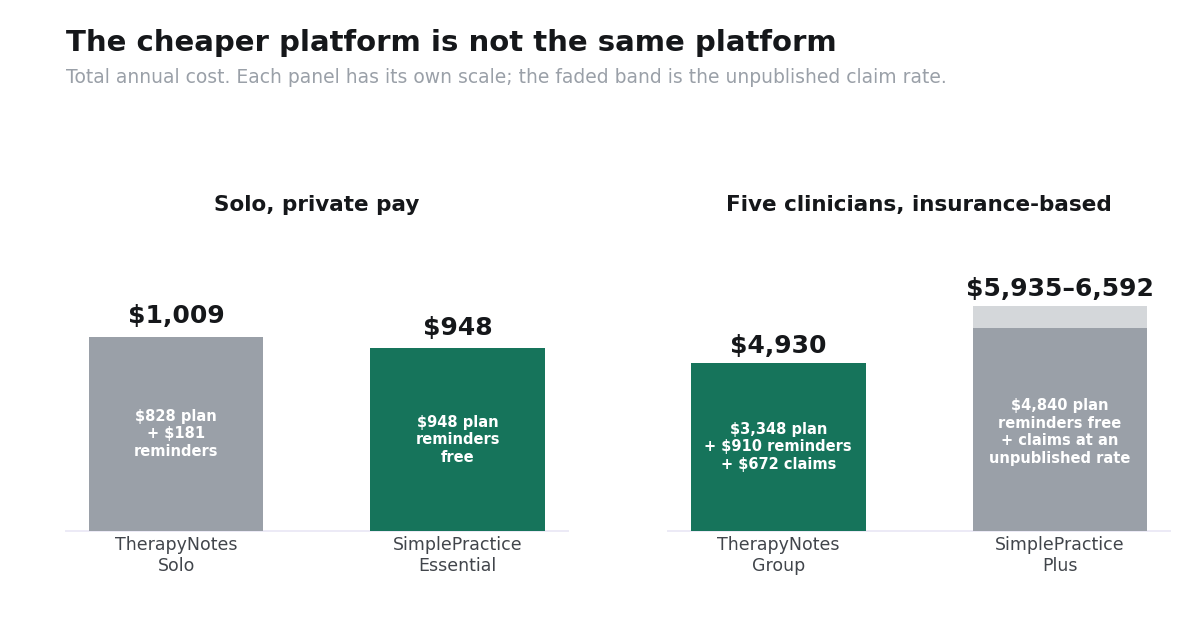
| TherapyNotes Solo | $828 | $181 | $1,009 |
A five-clinician group, insurance-based, 400 claims a month, 542 sessions
| Option | Subscription | Reminders | Claims | Per year |
|---|---|---|---|---|
| TherapyNotes Group | $3,348 | $910 | $672 | $4,930 |
| SimplePractice Plus | $4,740 (+$100 CPT) | Free | $2,190 | $7,030 |
Card processing excluded from both, since it depends on your private-pay mix. SimplePractice claim costs are 365 chargeable claims a month at its published 50¢ rate.
The result reverses. Solo and private-pay, SimplePractice Essential is cheaper and includes free reminders. Group and insurance-based, TherapyNotes is roughly $2,100 a year cheaper, mostly because claims cost 14¢ flat and administrative staff are free.
So do not ask which platform is cheaper. Ask how many claims and how many reminders, then run these two lines with your own numbers.
The rates are published — on a page you would not think to open
TherapyNotes publishes every fee on its pricing page: 14¢ a claim, 14¢ a reminder, 3.1% + 30¢ on cards, $15 for premium telehealth, $65 for ePrescribe, $359 a year for MIPS. You can build an entire annual budget from that one page.
SimplePractice splits it in two. The pricing page shows the plan prices and the free claim allowances but not what a claim costs above them. Those numbers sit on the plan comparison page, one click further in:
- Electronic claim filing — 50¢ per claim
- Manual insurance status check — 25¢ each
- ePrescribe — $49 a month, plus an $89 setup fee
- ePrescribe PDMP integration — $6.25 a month, plus a $699 setup fee
- Care Aide — $59 a month, plus $49 for each additional clinician
- Note Taker — $35 a month, included with Care Aide
Two of those matter more than the others. At 50¢ a claim, SimplePractice charges 3.6 times what TherapyNotes does, which on an insurance-based group practice is over $2,000 a year from one line. And the PDMP setup fee is $699 — a one-time charge larger than a full year of the Starter plan, disclosed nowhere near the price you were comparing.
Correction, 30 August 2026. An earlier version of this page said SimplePractice did not publish its per-claim rate, and used third-party estimates of 25¢ to 40¢. That was wrong twice over: the rate is published, and at 50¢ it is higher than any of those estimates. Every figure on this page is the corrected one.
What still is not published: the card processing rate. Neither page states it, and the footnote only says Stripe fees are passed through. Get that figure, and confirm whether your biller and receptionist need paid seats, before you sign.
The four costs in the footnote
SimplePractice’s promotional footnote lists what its discount does not apply to, and that list is the most useful part of the pricing page:
- $20 a year per clinician for AMA CPT code access — an $18 royalty to the AMA plus a $2 processing fee. Small, but it is per clinician and it is not in the plan price.
- Stripe credit card processing fees — passed through, rate not stated.
- ePrescribe setup fee — $89 one-time, plus $49 a month.
- Prescription Drug Monitoring Program registration — $6.25 a month plus a $699 setup fee, listed only on the plan comparison page.
None of this is hidden in a bad-faith sense; it is all written down. It is simply written down somewhere other than the number you were comparing.
What the problem costs: the hour you cannot resell
Software should be measured against the revenue it protects, and a therapy practice has an unusually clean version of that calculation.
A no-show is not a delayed sale. The hour is gone and cannot be sold to anyone else.
The formula
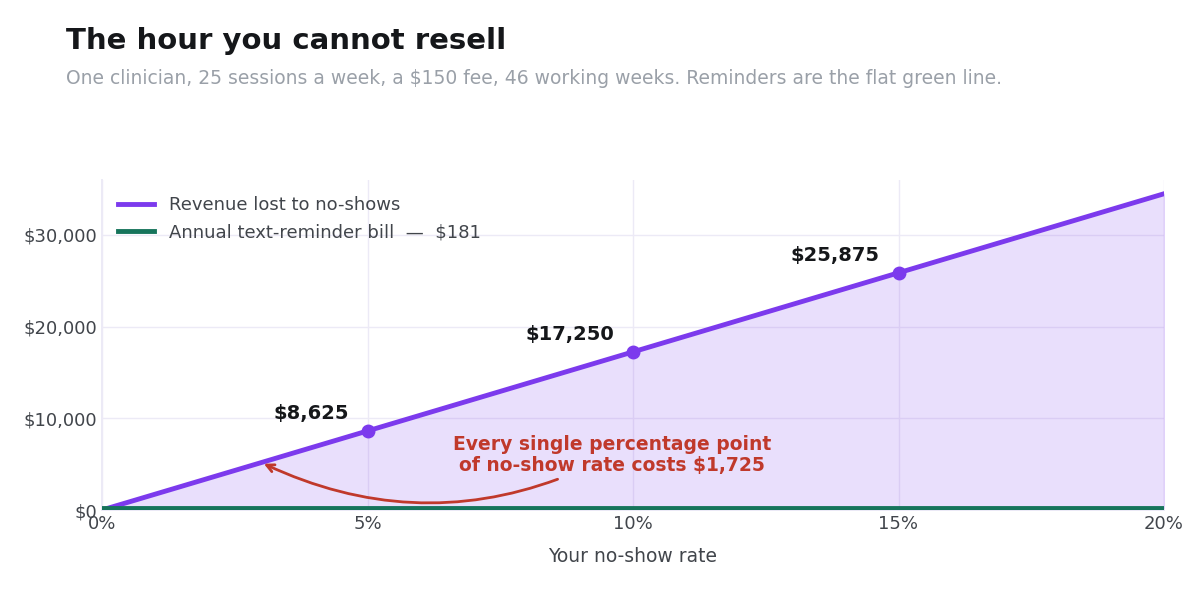
Sessions per week × your no-show rate × your fee × working weeks.
Take one clinician at 25 sessions a week, a $150 fee, 46 working weeks. Every percentage point of no-show rate costs $1,725 a year. A rate of 10% costs $17,250; a rate of 15% costs $25,875.
Now look at the reminder fee again. On TherapyNotes, texting a reminder for all 108 monthly sessions costs about $15 a month. If that moves your no-show rate by a single percentage point, it returns roughly nine times its cost.
Check your own no-show rate before you optimize anything else. It is almost always the largest number on this page.
Where email marketing genuinely fits — and where it does not
This is the part we have to be careful about, because the obvious recommendation is the wrong one.
You cannot put your client list into a general email marketing platform. Brevo, Mailchimp and MailerLite do not sign business associate agreements and do not support PHI. Since a list of your clients identifies people receiving mental health treatment, uploading it is a disclosure of PHI to a vendor with no BAA in place.
Use your practice management system for anything addressed to clients. That is what its BAA covers.
There is a real and separate job that these tools do well, and it does not involve clients at all:
- Your referral network — GPs, psychiatrists, schools, other clinicians, community organizations. These are professional contacts, not patients.
- A public-audience newsletter where subscribers are members of the public who are not your clients — and where you keep it that way.
For a private practice that fills its caseload through referrals, staying visible to twenty referrers is worth more than any software feature on this page.
Keep the two lists physically separate and never import from your EHR. See MailerLite pricing for what it costs as the list grows. If you are unsure whether a particular list counts as PHI, ask your compliance advisor before you upload it — not after.
What to buy
| Your practice | Buy | Per year |
|---|---|---|
| Solo, private pay, no reminders needed | SimplePractice Starter | $588 |
| Solo, private pay, wants reminders | SimplePractice Essential | $948 |
| Solo, insurance-based | TherapyNotes Solo | $828 + 14¢/claim |
| Group practice, any billing model | TherapyNotes Group | $79 + $50/clinician |
| Group with heavy reminder volume, low claims | Run both columns yourself | — |
| Any practice, referral marketing | A separate email tool, no clients on it | $0 to start |
The short version: SimplePractice for solo private-pay practice, TherapyNotes once you add a second clinician or start billing insurance. The free administrative seats and the flat 14¢ claim rate compound quickly at group scale.
The verdict
Start with the BAA. It is a legal precondition rather than a feature, and it removes every general CRM and nearly every marketing tool from consideration before you compare anything else.
Then price the metered fees, not the subscription. A five-clinician insurance-based practice pays about $4,930 a year on TherapyNotes and $7,030 on SimplePractice — a gap driven almost entirely by claim fees and staff seats, neither of which appears in the headline price.
And get the three unpublished numbers in writing before you sign: per-claim rate above your allowance, card processing rate, and whether your biller needs a paid seat.
We earn no commission from SimplePractice or TherapyNotes. Rule citation is to 45 CFR § 164.502(e); vendor pricing is as published in 2026. None of this is legal or compliance advice.
Common questions
Can therapists use a regular CRM?
Generally no. Any system holding client information handles protected health information, and 45 CFR § 164.502(e) requires a signed business associate agreement before you disclose PHI to a vendor. HubSpot, Pipedrive and Zoho do not sign BAAs for this purpose, so the feature comparison never starts.
Is SimplePractice or TherapyNotes cheaper?
It depends on how you practice. Solo and private pay, SimplePractice Essential is $948 a year with free reminders against $1,009 for TherapyNotes Solo. A five-clinician insurance practice pays about $4,930 on TherapyNotes and $7,030 on SimplePractice.
How much does TherapyNotes cost?
$69 a month solo, or $79 for the first clinician plus $50 for each additional one, with non-clinical staff free. Electronic claims and text reminders are 14¢ each, card processing is 3.1% + 30¢, and there is no signup fee or contract.
How much does SimplePractice cost?
$49 Starter, $79 Essential, $99 Plus per month. Adding clinicians requires Plus and starts at $74 each. Reminders are free on Essential and Plus. There is also a $20 annual per-clinician fee for AMA CPT code access.
What are SimplePractice’s insurance claim fees?
Essential includes 10 free claims a month and Plus includes 35. Above the allowance it is 50¢ a claim — published on the plan comparison page rather than the pricing page. That is 3.6 times the 14¢ TherapyNotes charges.
Can I use Mailchimp or Brevo for my client newsletter?
Not for a list of clients. Those platforms do not sign business associate agreements, and a list identifying people as receiving mental health treatment is PHI. Use them for your referral network or a public list with no clients on it, and send anything client-facing from your practice management system.
Is a mailing list really protected health information?
If it identifies individuals as your clients, yes — the treatment relationship itself is health information. Confirm it with your compliance advisor before you upload anything.
What is a no-show actually worth?
Sessions per week times your no-show rate times your fee times working weeks. At 25 sessions, a $150 fee and 46 weeks, each percentage point of no-show rate is $1,725 a year — which makes a $15 monthly reminder bill trivially worth paying.
Do I need telehealth as an add-on?
Basic telehealth is included on every TherapyNotes plan, with premium telehealth at $15 a month per clinician; SimplePractice includes telehealth in its core features. Check what “basic” covers against how you actually run sessions before assuming you need the upgrade.