 MailerLite
 ActiveCampaign
 Omnisend
 Klaviyo
 SE Ranking
 Mangools
 Semrush
 Ahrefs
 Pipedrive
 Zoho CRM
 Salesforce
 HubSpot
 Systeme.io
 GoHighLevel
 ClickFunnels
 Vendasta
Brevo review
The cheapest serious way to email a big list, if you can live with mid-pack inbox placement.
Ratings from G2 (2,637 reviews), Capterra (~3,474 reviews) and Trustpilot (~4.2, ~7,000 reviews), pricing verified October 11, 2026.
The verdict
Brevo, formerly Sendinblue, is the value play in email marketing, and it earns that label on one structural decision: it charges by the number of emails you send, not the number of contacts you store. Contacts are unlimited. That is why a business with a 60,000-person list can run real campaigns for $9 to $69 a month, while the same list on Mailchimp or ActiveCampaign costs several times more. On top of that you get SMS, WhatsApp, a built-in CRM, landing pages and a usable free plan, all in one account. Plan-by-plan numbers, add-ons and real team bills are in our Brevo pricing 2026 breakdown.
The catch is just as concrete. Brevo’s email deliverability tests below its main rivals. In EmailToolTester’s latest round it placed 88.3% of messages in the inbox and ranked 8th of 15 tools, at the bottom of that tester’s “acceptable” band and just under “excellent.” ActiveCampaign hit 94.2%, MailerLite averaged 94.41% across five rounds, and GetResponse reached 90.9%. Brevo trails all three. There is also a quiet layer of add-on fees, removing the Brevo logo costs $12 a month on its own, that erodes the headline price.
So the Lab Score of 8.4 reflects a clear trade. Brevo is one of the cheapest capable tools in the category, and its independent satisfaction is high (4.5 on G2, 4.6 on Capterra, and a roughly 4.2 on Trustpilot that towers over the 2.6 to 2.8 the big incumbents post there). Cheap and well-liked is exactly the combination our scoring rewards. What keeps it out of the 9s is performance: the one number that decides email ROI, inbox placement, is the one number where Brevo is average. Buy it for large lists and multichannel reach on a budget. Look elsewhere if deliverability or deep automation is your first priority.
What Brevo really costs at scale
The short version is below. For the plan-by-plan detail, the full add-on table and the ways to pay less, see our dedicated Brevo pricing breakdown.
Brevo’s pricing is unusual enough that the sticker price and the real price can diverge fast, so it is worth walking through carefully. There are four tiers: Free, Starter, Business and Enterprise. The volume number in every paid plan is emails per month, and your contact list size never moves the price.
The Free plan is $0 forever and sends up to 300 emails a day, roughly 9,000 a month. It includes the drag-and-drop editor, 40-plus templates, basic CRM, and pay-as-you-go SMS and WhatsApp, with storage for up to 100,000 contacts. The two real limits are the daily send cap, which you cannot lift without paying, and the Brevo logo stamped on every email.
Starter removes the daily sending limit and is priced purely on monthly volume: 5,000 emails for $9, 20,000 for $29, and 100,000 for $69 a month. Some resellers quote $8.08 a month for the 5,000 tier when billed annually, and annual billing shaves roughly 10% off across the board. Business adds the things serious senders actually need, unlimited marketing automation, A/B testing, landing pages, advanced statistics, predictive sending, multiple users and phone support, at 5,000 emails for $18, 20,000 for $69, and 100,000 for $129 a month. Enterprise is a custom quote that brings sub-account management, single sign-on, a dedicated success manager and an SLA.
| Monthly emails | Free | Starter | Business |
|---|---|---|---|
| Up to ~9,000 (300/day) | $0 | n/a | n/a |
| 5,000 | included on Free cap | $9 | $18 |
| 20,000 | over Free cap | $29 | $69 |
| 100,000 | over Free cap | $69 | $129 |
| Contacts | up to 100,000 | unlimited | unlimited |
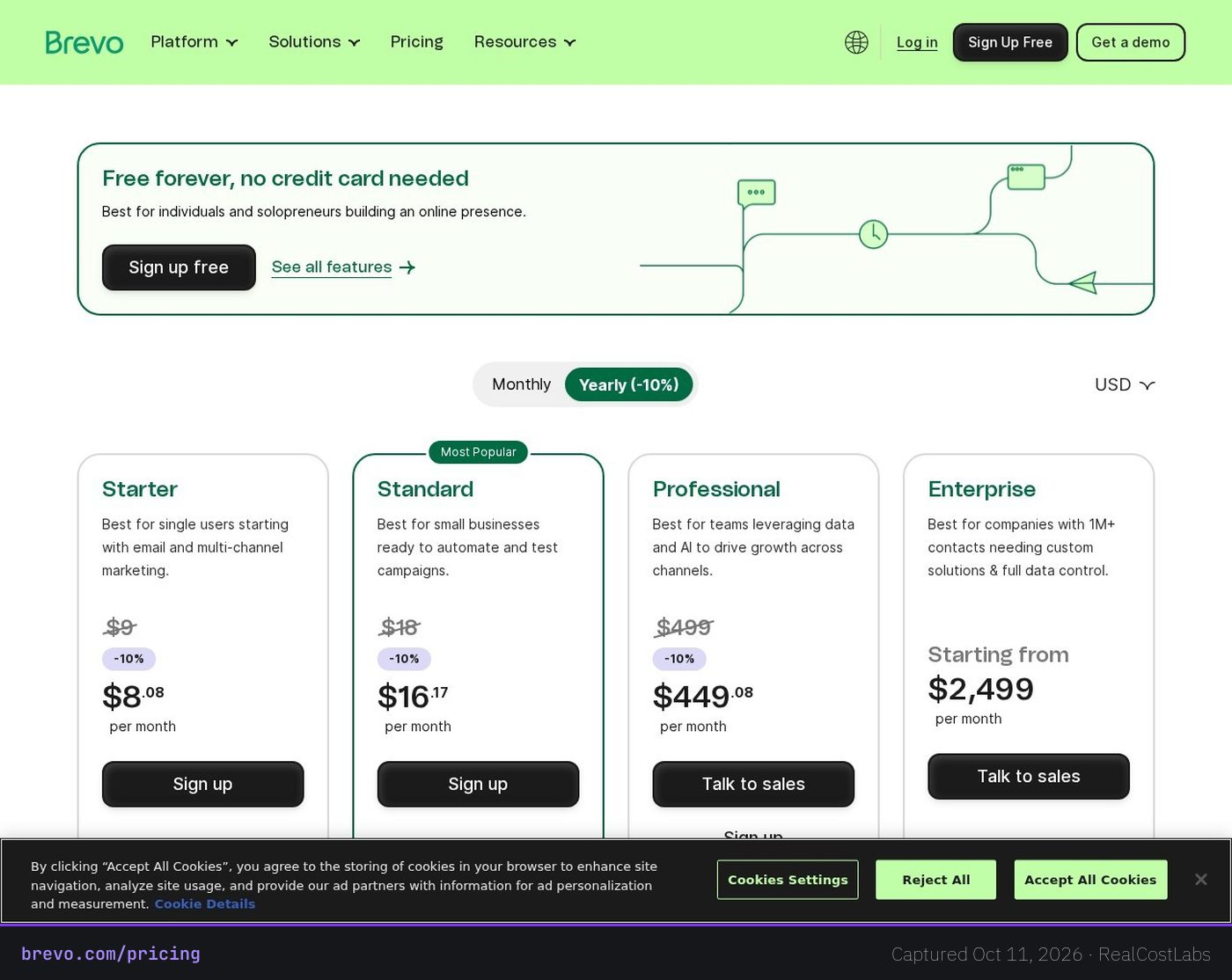
Now the realistic annual math. A typical US small or mid-size business sending around 100,000 emails a month, to a list of 30,000 or 80,000 people, pays $69 a month on Starter, about $828 a year, if plain campaigns are all it needs. The same business on Business, which it wants the moment it needs automation and landing pages, pays $129 a month, about $1,548 a year. A contact-priced competitor can charge past $250 a month for a 50,000-contact list before any send volume, which is the whole point: the more contacts you have relative to how often you mail them, the better Brevo looks.
The asterisks are the add-ons, and they are material enough that you should price them before you commit:
- Remove Brevo branding from your emails: an extra $12 a month, and it is not bundled even on Starter. If a clean sender identity matters, this is a real line item.
- Dedicated IP: roughly $251 a year. It is worth budgeting for because of the shared-IP deliverability results covered below.
- Extra users on Business: $12 a month each.
- Landing pages bundle (5 pages): around $24 a month on lower tiers, after Brevo recently moved this off the entry plans.
- SMS, pay-as-you-go to the US and Canada: about $10.90 per 1,000 messages, so roughly $1,090 for 100,000 texts. WhatsApp is billed separately.
Stack branding removal plus a dedicated IP on a Business plan and your $129 a month quietly becomes about $162 plus the IP’s annual charge. The entry price is genuinely low and genuinely real. Just plan for the line items the marketing page does not lead with.
Deliverability: the number that decides email ROI
For an email tool, inbox placement is the metric that governs everything downstream. A campaign that lands in spam cannot be opened, clicked or converted, so a few points of deliverability outweigh any feature checklist. This is also where Brevo’s story gets uncomfortable, and where this review has to slow down.
In EmailToolTester’s latest deliverability test, Brevo placed 88.3% of messages in the inbox and ranked 8th of 15 tools measured. EmailToolTester grades anything above 89% as “excellent,” 88 to 83% as “acceptable,” and below 83% as “poor.” Brevo therefore sits at the top of “acceptable,” a hair under the “excellent” cutoff. Not broken, but not a leader. In the same test, ActiveCampaign placed first at 94.2%, MailerLite held its multi-round award at a 94.41% average, and GetResponse came in third at 90.9%. Brevo trails every one of them.
| Tool | Inbox placement | Rank (of 15) |
|---|---|---|
| ActiveCampaign | 94.2% | #1 |
| MailerLite | 94.41% (5-round avg) | top tier |
| GetResponse | 90.9% | #3 |
| Brevo | 88.3% | 8th |
Independent testing outside EmailToolTester points the same direction. Encharge’s June 2025 testing put Brevo at 89.1% overall, with per-provider inbox rates of 72.1% at Gmail, 75.3% at Outlook, 76.1% at Yahoo and 73.4% at iCloud, and noted a historical dip to around 68% in 2023. EmailDeliverabilityReport’s 2026 review is kinder at near 92. The spread, 88 to 94 depending on round and method, is the takeaway: this is where Brevo’s results are inconsistent. Brevo sends from a shared IP pool unless you pay for a dedicated one, which is why the roughly $251-a-year dedicated IP is worth budgeting if email is core to your revenue.
Put plainly: if your business lives or dies by transactional sends, lead nurture or cart-recovery sequences arriving, Brevo’s 88.3% should give you pause, and ActiveCampaign or MailerLite are built to beat it. If your sends are more forgiving, newsletters, announcements, promotions to an engaged list, the gap matters far less than the money you save.
Features, in depth
Where Brevo stops being a budget compromise is breadth. Most tools at this price are email and little else. Brevo is closer to an all-in-one marketing stack with email at the center.
The headline feature is the unlimited-contacts model, which is hard to beat for anyone sitting on a large list they mail occasionally. Around it, Brevo bundles email plus SMS, WhatsApp, a free built-in CRM, a chat and shared-inbox tool, transactional email with a strong SMTP relay and API (the part of the product that traces directly back to Sendinblue’s developer heritage), landing pages and Facebook ads. For a small team that would otherwise be paying for three or four separate subscriptions, having all of that under one login and one bill is the real draw.
On the email side you get a drag-and-drop editor, an AI content assistant, and, on Business, predictive send-time optimization and unlimited automation workflows. The transactional and API layer is a standout for developers: if you need a reliable relay for password resets, receipts and other system mail, Brevo’s SMTP and REST API are a legitimate reason to choose it on their own.
The limits show up when you push on depth. The template library is thinner than design-first tools offer. The automation builder handles welcome series, abandoned carts and basic re-engagement well, but lacks the deep conditional branching and goal logic ActiveCampaign and other premium tools provide, so complex lifecycle journeys can hit a ceiling. And the CRM is light: contact and deal tracking, not a true sales CRM you would run a quota-carrying team on. Brevo gives you a lot of capable tools rather than a few deep ones, the right trade for a small business that wants breadth and the wrong one for a team that needs a single tool taken to its limit.
Ease of use
Brevo is straightforward for everyday work, and its independent scores back that up: Capterra reviewers rate ease of use 4.6 out of 5, in line with the platform’s 4.6 overall there. The interface is clean, campaign setup is simple, and a non-technical user can build and send a real email without a manual. The drag-and-drop editor and the 40-plus templates cover the common cases, and because the free plan is fully featured for sending, you can learn the whole workflow before you pay anything.
Friction appears as you climb. The automation builder gets fiddly once you model anything with multiple branches, and the number of bundled modules, email, SMS, WhatsApp, CRM, chat, landing pages, can make the dashboard feel busier than a single-purpose tool. None of it is hard, but the all-in-one breadth that makes Brevo good value also means more to learn than on a tool that only does newsletters. The learning curve is mild and front-loaded into the first afternoon.
Who it is for
Brevo fits a specific and common profile well: a small or mid-size business with a large contact list, a tight budget, and a need to reach people across more than one channel. If you have tens of thousands of contacts you mail occasionally, the unlimited-contacts pricing is close to unbeatable. If you want email, SMS and WhatsApp from one tool, the bundle saves both money and integration hassle. And if you are a developer or a lean team that needs a dependable transactional relay alongside marketing email, the SMTP and API heritage is a real plus.
It is the wrong tool for two groups. The first is anyone whose results hinge on maximum inbox placement, high-stakes transactional flows, revenue-critical automations, where the 88.3% deliverability gap against 94%-plus rivals translates directly into lost money. The second is teams that need deep automation or a real sales CRM, who will outgrow Brevo’s branching logic and light CRM and be happier paying more for ActiveCampaign or a dedicated CRM. Brevo is the value and reach choice, not the performance or depth choice.
Three real-world scenarios
The ecommerce store with a 75,000-person list
An online shop has built a big subscriber base but mails it only a few times a month: new arrivals, sales, the occasional newsletter. On a contact-priced tool, 75,000 contacts alone would cost a fortune regardless of how rarely they send. On Brevo, they pay for the send volume and nothing for the list size, so even heavy months land in the $69 Starter or $129 Business range. Add SMS for flash sales and they still run one account. This is Brevo’s sweet spot, and the deliverability trade-off is tolerable because promotional email to an engaged buyer list is forgiving.
The SaaS startup that needs transactional email plus marketing
A small software company needs two things: reliable system email (password resets, receipts, alerts) and a basic marketing newsletter. Brevo covers both from one account, with a solid SMTP relay and API for the transactional side and the standard editor for campaigns, while the free CRM tracks signups. The team should budget for a dedicated IP here, since transactional reliability is the whole point and the shared pool is Brevo’s known soft spot.
The agency running revenue-critical automations for a client
An agency is building layered, behavior-triggered journeys where every percentage point of inbox placement shows up in the client’s revenue report. This is the scenario where Brevo is the wrong pick. The 88.3% deliverability and the shallower automation branching both work against the goal, and the client’s results would likely be better on ActiveCampaign at 94.2% with deeper logic, even at the higher price. Brevo saves money in cases where reach matters more than maximum performance; this is not one of them.
Brevo vs the alternatives
Brevo competes with three tools buyers should weigh seriously, and the choice between them comes down to what you are optimizing: cost, deliverability, or brand familiarity.
| Tool | Pricing model | Inbox placement | Best for |
|---|---|---|---|
| Brevo | By emails sent, unlimited contacts | 88.3% | Large lists, multichannel, lowest realistic cost |
| MailerLite | By contacts | 94.41% (5-round avg) | Cost-conscious senders who want better inbox placement |
| ActiveCampaign | By contacts | 94.2% (#1) | Deliverability plus deep automation and CRM |
| Mailchimp | By contacts | 89.5% | Brand familiarity, templates, fast setup |
MailerLite is the closest head-to-head for cost-conscious US senders, and the comparison is genuinely close. MailerLite delivers better, a 94.41% five-round average against Brevo’s 88.3%, with a cleaner interface. The deciding factor is your list shape: MailerLite charges by contacts, so it punishes big lists you mail rarely, exactly where Brevo wins. If your list is modest and active, MailerLite’s deliverability edge is worth a lot. If your list is huge and quiet, Brevo’s model wins on price.
ActiveCampaign is the deliverability and automation leader, first at 94.2% and far deeper on branching logic and CRM. It is also contact-priced and meaningfully more expensive. Choose it when performance and automation depth justify the cost, and Brevo when budget and list size dominate. Mailchimp is the incumbent, with more templates and integrations, but it is expensive at scale and counts unsubscribed contacts toward your bill. Brevo’s unlimited-contacts pitch is the standard, and effective, counter to that. GetResponse is a reasonable fourth at 90.9% with webinars built in, if that combination fits.
Pros and cons
- Unlimited contacts, priced by send volume: the cheapest realistic way to email a large list.
- Genuine all-in-one: email, SMS, WhatsApp, free CRM, chat, landing pages and transactional email in one account.
- Low real cost: roughly $9 to $69 a month on Starter, or $18 to $129 on Business, for up to 100,000 sends.
- Strong transactional layer: a dependable SMTP relay and REST API.
- High independent satisfaction: 4.5 on G2, 4.6 on Capterra, and about 4.2 on Trustpilot, well above the incumbents.
- A free plan you can actually use, 300 emails a day with the core editor and CRM included.
- Deliverability lags rivals: 88.3% inbox placement, 8th of 15, behind ActiveCampaign, MailerLite and GetResponse.
- Shared-IP results are inconsistent (88 to 94% depending on the test); a dedicated IP costs about $251 a year.
- Add-on creep: removing branding ($12/mo), landing pages and extra seats all cost extra.
- Automation lacks deep branching compared with ActiveCampaign and premium tools.
- Light CRM and a thinner template library than design-first or sales-first tools.
- Support is gated: phone help is Business-plus only.
FAQ
Is Brevo the same as Sendinblue?
Yes. Sendinblue rebranded to Brevo in 2023. The product, account history and the developer-focused transactional email heritage all carried over. If you remember Sendinblue’s strong SMTP and API, that is the same lineage powering Brevo’s transactional features today.
How does Brevo’s pricing actually work?
You pay for the number of emails you send per month, not the number of contacts you store. Contacts are unlimited on paid plans (and up to 100,000 on Free). Starter runs $9 for 5,000 emails up to $69 for 100,000; Business runs $18 to $129 across the same volumes and adds automation, A/B testing and landing pages.
Is the Brevo free plan good enough to start with?
For learning the tool and for very small senders, yes. It is $0 forever, sends up to 300 emails a day (about 9,000 a month), and includes the editor, templates and basic CRM. The two limits are the daily send cap, which only a paid plan removes, and the Brevo logo on your emails, which costs an extra $12 a month to remove on any plan.
How good is Brevo’s deliverability, really?
Average, and that is the main knock against it. EmailToolTester measured 88.3% inbox placement, 8th of 15, behind ActiveCampaign (94.2%), MailerLite (94.41%) and GetResponse (90.9%). Tests range from 88 to 94 depending on method, and Brevo sends from a shared IP pool unless you pay for a dedicated one. A dedicated IP at about $251 a year can help if email is core to your revenue.
What are the hidden costs I should budget for?
The ones to budget for: removing Brevo branding ($12/mo), a dedicated IP (~$251/yr), extra Business users ($12/mo each), a landing pages bundle (~$24/mo on lower tiers), and pay-as-you-go SMS (~$10.90 per 1,000 to the US and Canada). A couple of these can add 25% or more to a Business plan.
Does Brevo include a CRM and SMS?
Yes to both. A basic CRM is built in even on Free, and SMS plus WhatsApp are available as pay-as-you-go across plans. The CRM is light, contact and deal tracking rather than a full sales platform, but for a small team that wants email, texting and contact management in one place, the bundle is a real convenience.
Brevo or MailerLite for a small business?
It depends on your list. MailerLite delivers better (94.41% vs 88.3%) and has a cleaner interface, but it charges by contacts. Brevo charges by send volume with unlimited contacts. If your list is large and you mail it occasionally, Brevo is cheaper. If your list is modest and active, MailerLite’s deliverability edge is usually worth more than the price difference.
What kind of support does Brevo offer?
Email and help-desk support plus a knowledge base on every plan, including Free, with live chat available. Phone support is Business and above, and Enterprise adds a dedicated success manager and an SLA. The Capterra customer-service score is a solid 4.5, but phone support starts at Business, so do not count on instant help on the lower tiers.
KEEP EXPLORING
Ready to try Brevo?
Start free with unlimited contacts and 300 emails a day, then pay only for the volume you send.
Try Brevo →RealCostLabs is independent and reader-supported. We may earn a commission on purchases made through our links, at no extra cost to you, and our scores are never for sale.