 MailerLite
 ActiveCampaign
 Omnisend
 Klaviyo
 SE Ranking
 Mangools
 Semrush
 Ahrefs
 Pipedrive
 Zoho CRM
 Salesforce
 HubSpot
 Systeme.io
 GoHighLevel
 ClickFunnels
 Vendasta
SaaS spend management
Most SaaS overspend is not waste in the obvious sense — nobody bought software they never opened. It is structural: monthly billing, dormant seats, tier boundaries and metered usage, each quietly adding a percentage. We priced 20+ tools and measured how much each one takes.
RealCostLabs is independent and reader-supported. We may earn a commission on purchases made through our links, at no extra cost to you, and our scores are never for sale.
The four leaks, measured
Across our pricing analysis of 20+ marketing tools, overspend concentrates in four places. These are not estimates — they are what the rate cards say.
| Leak | Typical cost | Worst case measured |
|---|---|---|
| Monthly instead of annual billing | +44% on average | +111% (Close) |
| Dormant seats | $45–100 per seat per month | Semrush Business, $100/user/mo |
| Tier boundaries | Step increases, not gradual | Klaviyo: +50% for 15% more contacts |
| Stored records you do not use | Full price for dead contacts | Mailchimp bills unarchived unsubscribes |
The headline finding across the whole dataset: the plan a buyer realistically ends up on costs 3.9× the advertised entry price. Median 3.3×, across 13 tools with a paid entry tier.
1. The billing-cycle leak is the largest and the easiest
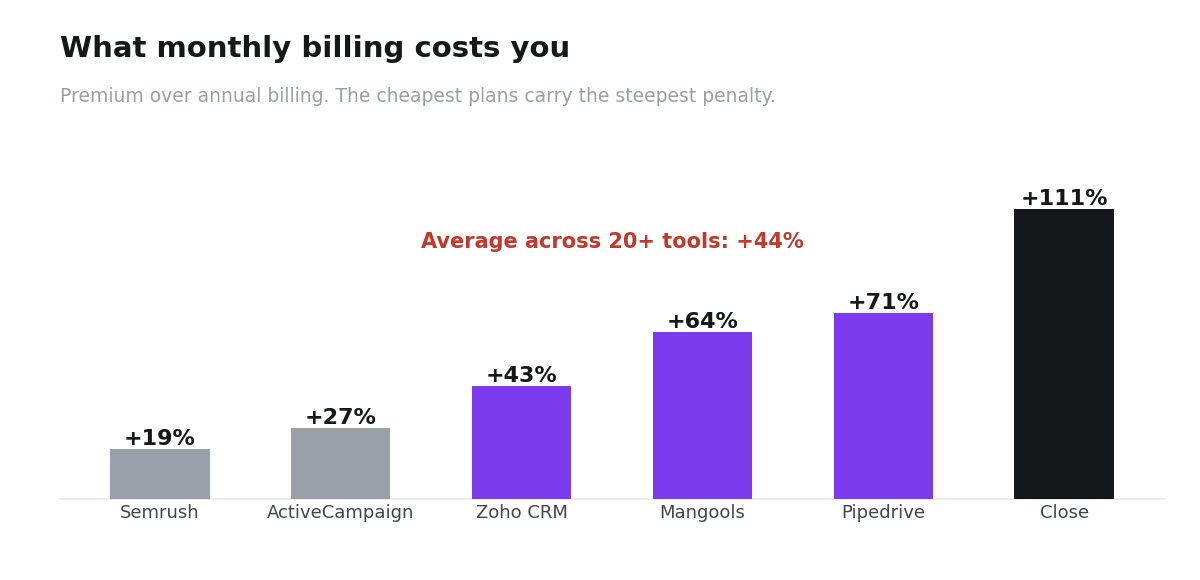
Monthly billing costs 44% more than annual on average. The premium is steepest at the cheap end — the plans small businesses actually buy.
| Tool | Monthly | Annual (per mo) | Premium |
|---|---|---|---|
| Close | $19 | $9 | +111% |
| Pipedrive | $24 | $14 | +71% |
| Mangools | $61 | $37.70 | +62% |
| Zoho CRM | $20 | $14 | +43% |
| ActiveCampaign | $19 | $15 | +27% |
| Semrush | $139 | $117.33 | +18% |
The rule: if you will still be using the tool in four months, annual billing is not a discount — monthly is a penalty. Below four months, keep the flexibility.
2. Seats are the largest variable cost and the easiest to forget
Per-user surcharges reach $100 a month. A three-person team on Semrush Pro+ pays at least $389 rather than the advertised $299 — 30% above the sticker for the same plan.
A dormant Semrush seat costs at least $540 a year and generates nothing. Audit seats quarterly; it is the highest-return recurring task on this page.
3. Know where your next tier boundary sits
Usage-priced tools do not get more expensive smoothly. They step, and the steps are large.
- Klaviyo: 10,000 → 11,500 profiles takes you from $150 to $225 a month. A 15% list increase for a 50% bill increase.
- ClickFunnels: crossing 10,000 contacts moves the annual bill from $970 to $1,970.
- HubSpot: marketing contacts are sold in 5,000-blocks at $135–225 a month each.
Find your ladder, find your position on it, and model eighteen months forward. The boundary you meet next year is the one that matters.
4. Stop paying for records that generate nothing
If your platform bills on contacts stored rather than emails sent, dead records are a monthly charge. Mailchimp counts contacts you have not manually archived and does not deduplicate across audiences. Klaviyo bills on every profile in the account.
Detail and a quarterly routine in our email list hygiene guide.
The quarterly review
- List every subscription with its renewal date and billing cycle. Overspend hides in tools nobody owns.
- Audit seats. Remove dormant users before renewal, not after.
- Check each tool against its ladder. How far from the next boundary?
- Clean stored-record meters. Archive, suppress, deduplicate.
- Switch anything staying past four months to annual.
- Re-price the two most expensive tools against alternatives. Not to switch — to know what the alternative costs when you negotiate.
The mistake to avoid
Cutting tools is the obvious move and usually the wrong first one. A tool that costs $1,200 a year and does its job is not the problem; a tool that costs $1,200 when the same job costs $400 elsewhere is. So is a $249 plan billed monthly at $409 with two dormant seats.
Fix the structure before you cut the stack.
Common questions
How much do companies typically overspend on SaaS?
We cannot speak to industry averages, but we can speak to structure: monthly billing adds 44%, a three-person team on a single-seat plan adds 64%, and the plan buyers land on costs 3.9× the advertised entry price. Those three alone compound quickly.
Is annual billing always better?
Past roughly four months, yes on price. Below that, monthly keeps the exit open, which has its own value on a tool you have evaluated for seven days.
What is the fastest win?
Seat audit. It is the largest variable cost, it takes an afternoon, and dormant seats are pure loss.
Do I need spend management software?
Below roughly twenty subscriptions, a spreadsheet with renewal dates and billing cycles does the job. The discipline matters more than the tool.