 MailerLite
 ActiveCampaign
 Omnisend
 Klaviyo
 SE Ranking
 Mangools
 Semrush
 Ahrefs
 Pipedrive
 Zoho CRM
 Salesforce
 HubSpot
 Systeme.io
 GoHighLevel
 ClickFunnels
 Vendasta
SaaS contract negotiation
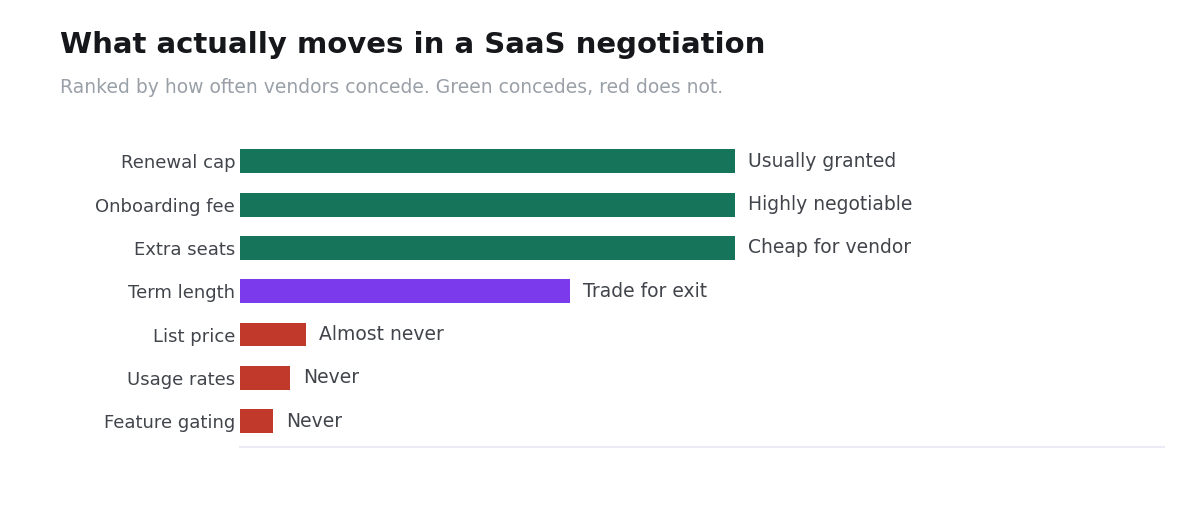
You have more leverage than the pricing page implies, and less than a procurement blog implies. What actually moves is narrow and predictable: term length, seat count, onboarding fees and renewal caps. What almost never moves is the per-seat list price on a self-serve plan.
RealCostLabs is independent and reader-supported. We may earn a commission on purchases made through our links, at no extra cost to you, and our scores are never for sale.
First, know which conversation you are in
| Situation | Leverage | Realistic outcome |
|---|---|---|
| Self-serve, under ~$500/mo | Very low | Annual discount only — the published one |
| Sales-assisted, $500–2,000/mo | Moderate | Onboarding fee, extra seats, term length |
| Enterprise, $2,000+/mo | Real | Price, caps, terms, support tier |
| Renewal after a year of usage data | Highest | Everything above, plus a credible exit |
If you are buying Mangools at $29 a month, there is no negotiation. If you are signing HubSpot Professional with a five-figure onboarding fee, there is.
What actually moves
Onboarding and implementation fees
The most negotiable line in a contract, because it is a services charge rather than a license. HubSpot’s mandatory onboarding starts around $500 and reaches five figures on Professional and Enterprise. Ask for it waived, reduced, or delivered by a partner instead — and ask before you sign, because it is close to immovable afterwards.
Seats
Vendors would rather give you seats than cut the rate, because it protects their published pricing. On tools charging $45–100 per additional user, two free seats is worth $1,080–2,400 a year and costs the vendor almost nothing.
Renewal caps
The clause to ask for, because it compounds. A written cap on year-two and year-three increases — say 5% — costs the vendor nothing in year one, which is why it is the one to push for. Without it your renewal is whatever the list price becomes.
Term length
A two-year commitment buys a better rate than one year. Only take it if the tool is genuinely load-bearing, because you are trading the exit for the discount.
What does not move
- Published self-serve list price. Discounting it undermines every other customer on the page.
- Usage rates. SMS per message, credits per report, contact blocks. These are metered infrastructure and vendors hold the line.
- Feature gating. You cannot buy one Professional feature on a Starter plan. The tier boundary is the product architecture.
The only leverage that reliably works
A specific, priced alternative that you can describe in one sentence.
Not “it seems expensive”. Instead: “SE Ranking covers our rank tracking and audit needs at $1,238 a year against your $2,500, and we have run both.” That is a fact the account manager has to escalate. Vague dissatisfaction is not.
This is why the preparation matters more than the conversation. Price the two closest alternatives at your real usage before you open the discussion.
Timing
- Not at signup on a self-serve plan. No mechanism exists.
- At the first renewal. You now have usage data, they have a churn risk, and both of you know it.
- At the end of the vendor’s quarter, if you are large enough to be a target. Below enterprise this matters less.
- When you genuinely might leave. Leverage you are bluffing about tends to get called.
Five questions to ask before signing anything
- What is the mandatory onboarding or implementation fee, in writing? Put it next to the first-year discount before you sign.
- What does year two cost? Ask for a cap. Get it in the contract.
- What is metered, and at what rate? Seats, sends, contacts, credits — each is a separate meter.
- What happens at the tier boundary? Hard stop, auto-upgrade or overage billing. All three exist and behave very differently on an invoice.
- How do I cancel? Notice period, data export, refund policy. Ask now, when they want your signature.
The uncomfortable truth
For a small business buying marketing software, negotiation is not where the savings are. The savings are in choosing the right tool at the right tier and paying annually — that is the 44% billing-cycle premium and the 3.9× entry-to-working multiple, and neither is negotiable.
Negotiate at the top of your stack, where the numbers are large enough to justify the effort. Everywhere else, pick better instead.
Common questions
Can you negotiate SaaS pricing as a small business?
On self-serve plans, essentially no. Once there is a salesperson involved, yes — on onboarding fees, seats and terms more than on the headline rate.
What discount is realistic?
Published annual discounts run 19–35% and are available to everyone. Beyond that, expect concessions in seats and fees rather than percentage off list.
Should I mention a competitor?
Only with a specific priced comparison you have actually run. A vague threat is worse than none.
What is the single most valuable clause?
A renewal cap. It is rarely refused and it protects you in the years where you have the least leverage.