 MailerLite
 ActiveCampaign
 Omnisend
 Klaviyo
 SE Ranking
 Mangools
 Semrush
 Ahrefs
 Pipedrive
 Zoho CRM
 Salesforce
 HubSpot
 Systeme.io
 GoHighLevel
 ClickFunnels
 Vendasta
Adobe Marketo Engage review
Adobe publishes no prices for any Marketo Engage tier, former employees peg real-world entry near $40,000 a year, and the average contract runs $112,544.
Ratings from G2 (3,149 reviews), Capterra (713) and Trustpilot (6), pricing verified October 11, 2026.
The verdict
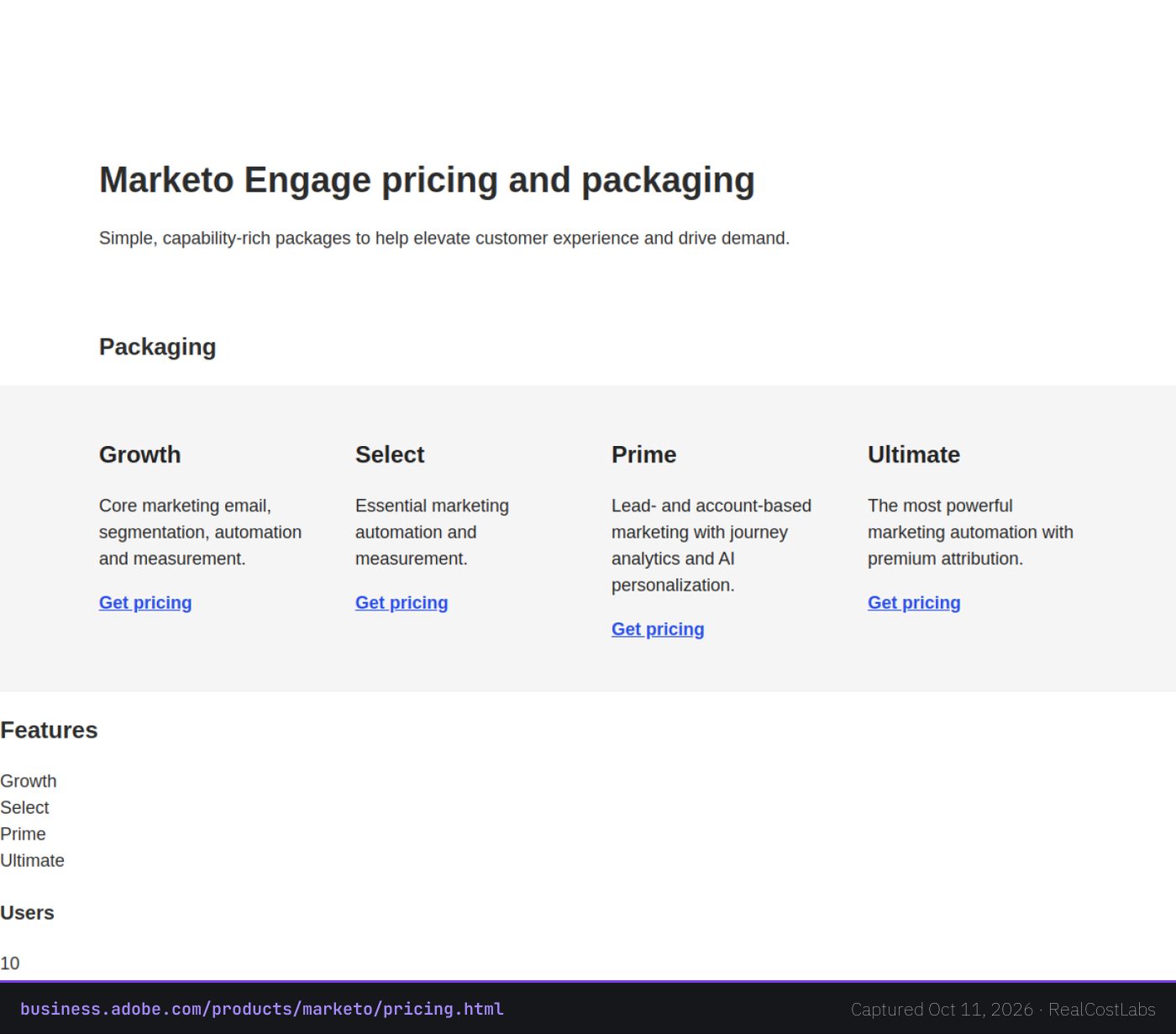
Adobe Marketo Engage sells in four packages — Growth, Select, Prime and Ultimate — and publishes a price for exactly none of them. The live pricing page, which we verified October 11, 2026, shows a feature comparison table, four “Get pricing” buttons and a “Get customized pricing” call to action. That is the entire pricing disclosure from one of the largest software companies on earth. Everything numeric in this review comes from third parties: AutomationAtlas estimates licensing at roughly $895 to $3,195 per month across the four tiers, Vendr contract data cited by Inflection.io puts the average Marketo contract at $112,544 per year across 117 analyzed contracts, and former Marketo employees say real-world costs run from about $40,000 a year for small startups to over $1,000,000 a year for large enterprises.
The product itself has a legitimate claim to the enterprise B2B crown. The automation engine handles complex lead scoring, routing, lifecycle management and multi-step cross-channel nurturing; G2 reviewers’ two most-cited pros are Ease of Use (192 mentions) and Automation (185 mentions). Capterra shows “Comprehensive lead management tools” at 97 percent positive across 220 reviews. Native CRM integrations with Salesforce, Microsoft Dynamics and Veeva are included in every tier per Adobe’s own packaging table, and Adobe promotes its Leader placement in the 2024 Gartner Magic Quadrant for B2B Marketing Automation Platforms. This is not vaporware. It is a serious platform that serious marketing operations teams build careers on.
The problem is everything wrapped around the product. Billing is driven by total lead records in your database, not the contacts you actually email, so a dormant list inflates your bill. Overages accumulate invisibly all year and arrive as a single annual true-up invoice. Attribution worth having (Marketo Measure) is locked behind the top tier. Add-ons like Sales Insight and Web Personalization stack tens of thousands of dollars onto the base license. Add a dedicated admin at $75,000 to $130,000 a year in salary, more than the estimated license at every tier. Capterra’s reviewers score Value for Money at 3.8 out of 5 and list “High and unpredictable pricing” as a top con. That last word — unpredictable — is the theme of this review.
We score Marketo Engage 6.7. Capability and raw automation power are near the top of the category, but our rubric weights price-to-value at 40 percent, and a quote-only product with annual true-ups, inflated first quotes and six-figure realistic budgets cannot score well there. For context, HubSpot scored 7.0 with a similar expensive-but-capable profile and considerably more price transparency, while ActiveCampaign scored 8.7 by delivering most of the automation substance at a published price. Marketo is the right tool for a specific buyer: an enterprise B2B team with a Salesforce-centric stack, a marketing operations function and a budget that does not flinch at $100,000 a year. For everyone else, it is a negotiation exercise with an expensive floor.
What Adobe Marketo Engage really costs at scale
Start with what Adobe will actually tell you: nothing. All four packages are quote-based, every tier requires an annual contract, and pricing scales with database size. The figures in the table below are third-party licensing estimates from AutomationAtlas (July 2026), not Adobe list prices, because Adobe list prices do not publicly exist. Treat them as the opening floor of a negotiation, not a price you can check out at.
| Plan | Monthly | Annual (per mo) | What you get |
|---|---|---|---|
| Growth | Custom quote (est. ~$895) | Quote-based, scales with database size | 10 users, 20k API calls/day, core email marketing, segmentation, automation and measurement, 10 custom data objects / 2M records, 50 predictive content assets |
| Select | Custom quote (est. ~$1,795) | Quote-based, scales with database size | 25 users, 50k API calls/day, “essential marketing automation and measurement”, 10 custom data objects / 2M records |
| Prime | Custom quote (est. ~$2,495) | Quote-based, scales with database size | 25 users, 50k API calls/day, adds lead- and account-based marketing, journey analytics, AI personalization, unlimited interactive webinars |
| Ultimate | Custom quote (est. ~$3,195) | Quote-based, scales with database size | 25 users, 50k API calls/day, adds premium attribution (Marketo Measure) and unlimited interactive webinars with concurrency |
Our standard cost basis for email-capable tools is 10,000 contacts. Because Marketo is quote-only, we triangulate from verified third-party data. VendorBenchmark pegs negotiated contracts for databases up to 100,000 records at $45,000 to $90,000 per year. AutomationAtlas audited a real 15,000-contact Growth deployment that ran about $54,000 per year all-in, license plus services. Against those anchors, a realistic 10,000-contact budget is roughly $15,000 to $45,000 per year for the license alone, before implementation and administration costs — and those two words carry a lot of weight, as the next section shows.
Scale changes the arithmetic but not the shape. VendorBenchmark’s negotiated-price bands run $45,000 to $90,000 per year up to 100,000 records, $150,000 to $280,000 at 250,000 to 500,000 records, and $400,000 to $800,000 or more at 1 million to 5 million records. The Vendr average of $112,544 per year sits comfortably inside that curve. Note what drives the meter: total lead records in the database. Not active contacts, not emails sent. Every stale record you have not purged is billable inventory. If you want to model your own scenario against these bands, our real cost calculator covers the standard tiers.
On trials: there is no free plan, and Adobe’s pricing page offers no self-serve trial — only demo requests. Capterra’s listing marks a free trial as “available”, but Adobe itself advertises neither a trial nor a free version on its own pricing page. Plan on evaluating Marketo through a sales-led demo cycle, not a hands-on sandbox you can spin up on a Tuesday afternoon.
The hidden costs
The license is the visible half of a Marketo budget. Five cost mechanics deserve line items of their own.
Database-size billing punishes hygiene failures. Because cost is driven by total lead records rather than contacts you email, dormant and unwashed lists push you into higher pricing bands. Combined with zero price transparency, this means you cannot know what growth will cost you without a sales call, and every tier requires an annual contract either way.
Annual true-up invoices. Adobe trues up database overage annually rather than monthly. Exceed your contracted record tier in March and nothing happens — until the anniversary, when the accumulated overage lands as one invoice. VendorBenchmark reports premium per-record overage rates can add $20,000 to $100,000 or more to annual costs. This is the single most budget-hostile mechanic in the contract.
Gated capabilities and paid add-ons. Marketo Measure, Adobe’s multi-touch attribution product, is reserved for the Ultimate tier. Below that, add-ons stack on top of the base license: VendorBenchmark estimates Sales Insight at $15,000 to $45,000 per year and Web Personalization at $20,000 to $60,000 per year. Check that the platform you were quoted is the SKU you saw in the demo.
Implementation and staffing. Adobe professional services run $200 to $350 per hour per VendorBenchmark, and multiple sources note that most teams need a dedicated Marketo admin at roughly $75,000 to $130,000 a year in salary — often costing more than the platform itself. The AutomationAtlas audited deployment above illustrates the gap: a Growth-tier license that third parties estimate near $895 a month became $54,000 a year once services were counted.
Inflated quotes and renewal uplifts. VendorBenchmark reports Adobe’s initial proposals typically run 25 to 40 percent above benchmark negotiated prices, with 20 to 35 percent discounts achievable for buyers who push. Renewals frequently include automatic uplifts unless multi-year flat rates are negotiated up front. And the entry tier is tightly capped — Growth allows 10 users and 20,000 API calls per day — so growing teams get squeezed toward Select pricing early. The practical takeaway: never sign the first quote, and negotiate the renewal terms before you sign anything at all.
Features that matter
Strip away the pricing theater and the feature story is genuinely strong. The automation engine is the deepest reason to buy: complex lead scoring, routing, lifecycle management and multi-step nurturing across channels. G2’s 3,149 reviews break down to 1,627 five-star against just 58 one-star, and the most-cited pros are Ease of Use and Automation. For a platform of this complexity, that distribution is a real endorsement of the core workflow.
Lead management is the standout. Capterra reviewers rate “Comprehensive lead management tools” 97 percent positive across 220 reviews, covering nurturing, scoring, segmentation and CRM sync. The CRM story is equally solid: native Salesforce, Microsoft Dynamics and Veeva integrations are included in every tier per Adobe’s packaging table, with 27 verified integrations listed on G2. If your revenue process lives in Salesforce, Marketo speaks its language natively rather than through a connector marketplace.
At the top of the range, the platform scales the way enterprises need it to: sandboxes, workspaces and partitions for multi-team governance, premium multi-touch attribution through Marketo Measure on the Ultimate tier, and contract benchmarks that exist up to 5 million database records. Prime adds account-based marketing, journey analytics and AI personalization, plus unlimited interactive webinars. The analyst recognition matches: a Leader placement in the 2024 Gartner Magic Quadrant for B2B Marketing Automation Platforms and a spot on the Capterra Shortlist for Email Marketing 2026.
The caps are worth reading before the demo. Every tier — including Ultimate — limits custom data objects to 10 objects and 2 million records, and Predictive Content to 50 assets. Growth allows 10 users and 20,000 API calls a day; everything above it allows 25 users and 50,000 calls. If your integration architecture is API-heavy or your data model is wide, those ceilings are contract-negotiation items, not footnotes.
The satisfaction picture has one asterisk: Marketo’s Trustpilot profile is unclaimed, with a 2.4 TrustScore from just 6 reviews. Six reviews is statistically meaningless and we weight it accordingly, but it is notable that nobody at Adobe has bothered to claim the page. The 3.8 Ease of Use sub-score on Capterra is the more meaningful caution — this platform rewards a trained operator and punishes a casual one.
Who should choose Adobe Marketo Engage
Marketo makes sense for enterprise and upper-mid-market B2B teams with a Salesforce, Dynamics or Veeva-centric revenue stack, a genuine marketing operations function, and complex lead lifecycles that simpler tools cannot model. If you run account-based marketing at scale, need multi-touch attribution, and expect to manage hundreds of thousands of records across workspaces and partitions, the platform’s depth justifies the procurement pain. The buyers who do well here budget honestly — license, services at $200 to $350 an hour, and a dedicated admin — and negotiate hard, because 20 to 35 percent discounts off the first quote are documented as achievable. If your realistic all-in budget is $100,000 a year or more and your team can staff the platform, Marketo is one of the few tools that will not run out of headroom.
Who should look elsewhere
If you have 10,000 contacts and a marketing team of three, this is not your platform. The entry tier caps you at 10 users and 20,000 API calls a day, there is no self-serve trial, no public price, and the realistic license floor sits around $15,000 to $45,000 a year before you have implemented anything. ActiveCampaign (our 8.7) delivers serious automation and CRM integration at a published price you can start paying this afternoon, and Brevo (8.4) covers email, automation and SMS with contact-based pricing that does not bill you for records you never touch. Mid-market teams that want an all-in-one suite with more transparency should read our HubSpot review before taking a Marketo demo — HubSpot has its own cost-at-scale problems, but at least it prints its prices. The full field is ranked on our best marketing automation software page.
FAQ
How much does Adobe Marketo Engage cost?
Adobe publishes no prices for any of the four packages — the pricing page shows only “Get pricing” buttons (verified October 11, 2026). Third-party estimates from AutomationAtlas put licensing at roughly $895 (Growth) to $3,195 (Ultimate) per month, former employees peg real-world entry around $40,000 a year for small startups, and Vendr contract data shows an average contract of $112,544 a year across 117 contracts.
Does Marketo Engage have a free plan or free trial?
There is no free plan. Adobe’s pricing page offers no self-serve trial either — only demo and pricing requests. Capterra’s listing marks a free trial as “available”, but Adobe itself advertises neither a trial nor a free version, so expect a sales-led evaluation.
What does Marketo cost for 10,000 contacts?
Roughly $15,000 to $45,000 a year in license fees, based on VendorBenchmark’s $45,000 to $90,000 band for databases up to 100,000 records and an AutomationAtlas-audited 15,000-contact Growth deployment that ran about $54,000 a year all-in with services. Implementation and a dedicated admin (roughly $75,000 to $130,000 a year in salary) come on top.
How does Marketo Engage billing work?
Every tier is an annual, quote-based contract priced on total lead records in your database, not just the contacts you email. Database overage is trued up annually as a single invoice, and VendorBenchmark reports premium per-record overage rates can add $20,000 to $100,000 or more. First quotes typically run 25 to 40 percent above benchmark, and renewals often carry automatic uplifts unless flat multi-year rates are negotiated.
KEEP EXPLORING
See how Adobe Marketo Engage compares
Quote-only enterprise power, measured against tools that publish their prices.
RealCostLabs is independent and reader-supported. We may earn a commission on purchases made through our links, at no extra cost to you, and our scores are never for sale.