 MailerLite
 ActiveCampaign
 Omnisend
 Klaviyo
 SE Ranking
 Mangools
 Semrush
 Ahrefs
 Pipedrive
 Zoho CRM
 Salesforce
 HubSpot
 Systeme.io
 GoHighLevel
 ClickFunnels
 Vendasta
Asana review
The product earns its 27,000 positive reviews; the seat banding, expiring AI credits and Enterprise-gated SSO are where the real bill gets written.
Ratings from G2 (13,263 reviews), Capterra (13,650) and Trustpilot (307), pricing verified October 11, 2026.
The verdict
Asana is one of the most-reviewed work management tools on the market, and the reviews are mostly good: 4.4/5 across 13,263 G2 reviews and 4.5/5 across 13,650 Capterra reviews, with the intuitive interface and easy task tracking cited over and over. The sticker price looks reasonable too. Starter runs $10.99 per user per month on annual billing, which is in line with the category. The problem is that almost nobody pays the sticker price, and the gap between the pricing page and the invoice is wider at Asana than at most competitors we track.
Three mechanisms drive that gap. First, seats above five are sold in bands of five, so a 7-person team buys 10 licenses and a 12-person team buys 15. Second, the AI credits bundled into every paid plan are pooled per billing account, expire at the end of each month, and cost $150/month per extra 100,000-credit block once they run out. Third, the features that mid-market buyers actually need to standardize on the tool, SAML SSO and SCIM provisioning, sit on an Enterprise tier with no published price. None of these are hidden exactly. They are just not what the $10.99 headline suggests.
Then there is the review-site split. Asana scores 4.4 and 4.5 on G2 and Capterra, and 1.5/5 on Trustpilot across 307 reviews, a rating Trustpilot labels “Bad.” We read the split as a decent product attached to a purchasing experience that generates real resentment, and the seat-banding complaints on Asana’s own forum point the same direction.
The Lab Score lands at 6.9, below monday at 7.6. The products are closer than that gap implies. The pricing mechanics are not. If your team size happens to sit just above a five-seat boundary, Asana is one of the more expensive mainstream options per active user, and that is the number that matters at renewal.
What Asana really costs at scale
Asana sells five tiers. The free Personal plan now covers two users for any account created after November 12, 2025, down from ten. Starter and Advanced are the self-serve paid tiers, with a roughly 23% premium for monthly billing over annual. Enterprise and Enterprise+ are quote-only.
| Plan | Monthly | Annual (per mo) | What you get |
|---|---|---|---|
| Personal | $0 | $0 | Up to 2 users (accounts created after Nov 12, 2025); unlimited tasks and projects; list, board and calendar views; 100MB per-file cap |
| Starter | $13.49/user | $10.99/user | Timeline/Gantt views, reporting dashboards, unlimited automations, forms, custom templates, free guests; AI Studio Basic with 50K credits per billing account/month; 2-seat minimum |
| Advanced | $30.49/user | $24.99/user | Unlimited portfolios, goals, workload management, approvals, time tracking, formulas, Salesforce/Tableau/Power BI integrations; 75K AI credits per billing account/month |
| Enterprise | Custom quote | Custom quote | SAML SSO, SCIM provisioning, service accounts, view-only licenses, capacity planning, workflow bundles; 200K AI credits per billing account/month |
| Enterprise+ | Custom quote | Custom quote | Adds SIEM integrations, data residency, audit logs, managed workspaces for security and compliance-heavy orgs |
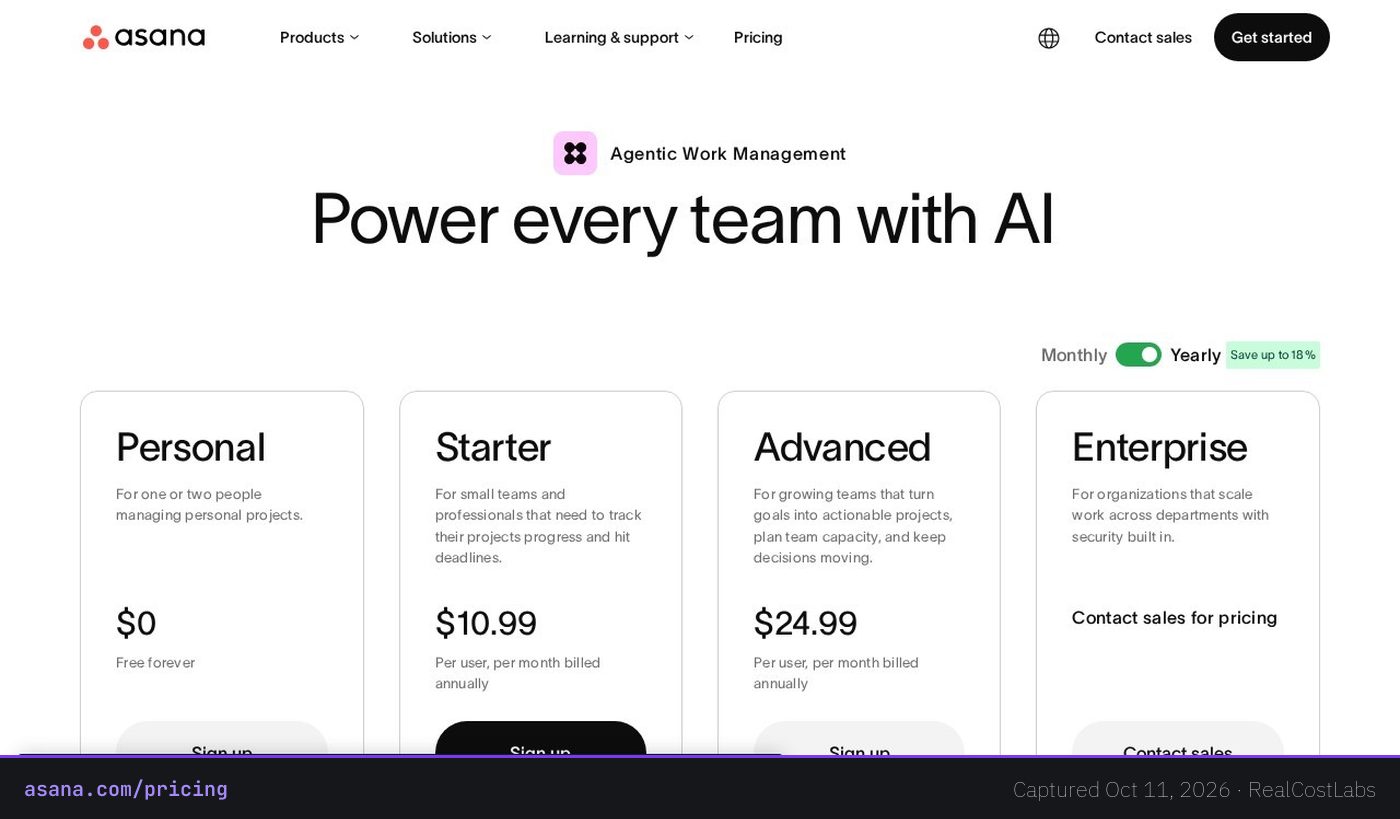
Start with the entry price, because it is not what the pricing page leads with. Starter has a 2-seat minimum, so the real floor is $26.98/month on monthly billing or $263.76/year paid annually. A solo consultant cannot buy one Starter seat.
Now run the numbers at our standard 10-seat basis for work management tools. Starter annual: 10 seats at $10.99 comes to $1,318.80/year. Advanced, the tier with portfolios, workload management and time tracking, runs 10 x $24.99 x 12 = $2,998.80/year, or $304.90/month if you stay on monthly billing.
That is the clean case. The realistic case for a 10-person marketing team adds the Timesheets & Budgets add-on at $5.99/user/month, which is another $718.80/year, and heavier AI usage via AI Studio Plus at $150/month, another $1,800/year. Stack those on Advanced annual and the team is at roughly $5,500/year, not the $2,998.80 the plan page implies and certainly not anything resembling $10.99 a seat. You can run your own team size and add-on mix through our real cost calculator; Asana is a tool where that exercise changes minds.
And that still assumes your headcount divides evenly by five. A 7-person team on Advanced annual pays for 10 seats, the full $2,998.80, which works out to about $35.70 per actual user per month for a plan priced at $24.99. More on that below, because it is the single most consequential line in Asana’s pricing.
The hidden costs
Seat banding above five users
Teams of two to five can buy exact seat counts. Above five, Asana sells licenses in bundles of 5, 10, 15, 20 and so on. A 7-person team pays for 10 seats; an 11-person team pays for 15. At Advanced annual rates, those three phantom seats on a 7-person team cost $899.64/year for nobody. This is not a niche complaint. There is an active thread on Asana’s own forum titled “remove the banding,” which is about as direct as customer feedback gets. If your team is 6, 7, 8, 11, 12 or 13 people, price Asana at the next band up, because that is what you will pay.
The free plan quietly shrank
The Personal plan used to cover 10 users. For accounts created after November 12, 2025, it covers 2. Legacy free accounts keep their grandfathered 10 seats, with a catch: downgrade and later come back, and the 10-seat allowance is gone permanently. The free plan is still genuinely free forever, with unlimited tasks and projects and the core list, board and calendar views, but as a team trial it now only works for pairs. The 100MB per-file cap is the other constraint worth knowing before you rely on it.
The monthly-billing premium
Monthly billing costs $13.49 on Starter versus $10.99 annual, and $30.49 on Advanced versus $24.99. That is roughly 23% more for the flexibility of leaving. Asana markets the same numbers as “save up to 18% with annual billing,” which is the identical arithmetic pointed in a friendlier direction. Budget on the monthly figure until you are certain the tool will stick.
AI credits are pooled and expire
Every paid plan includes AI Studio Basic credits: 50K per month on Starter, 75K on Advanced, 200K on Enterprise. Note the unit: per billing account, not per user. A 10-person Starter team and a 2-person Starter team get the same 50K pool. Credits do not roll over, so a quiet month is simply forfeited. When the pool runs dry, AI Studio Plus sells an extra 100,000 credits for $150/month (about $135/month billed annually), and the top AI Studio Pro tier is annual-only and sales-led. The good news is there is no mandatory per-seat AI fee, which several competitors now charge. The bad news is that AI spend becomes a second, separately metered bill that scales with usage rather than headcount, which makes it harder to forecast.
SSO lives behind a quote
SAML SSO and SCIM user provisioning are Enterprise-only, and Enterprise has no published price. For security-conscious mid-market teams, this is a classic forcing function: the moment IT mandates single sign-on, you leave self-serve pricing entirely and enter a sales conversation with no anchor. If SSO is on your requirements list, get the Enterprise quote before you commit a pilot team, not after.
Time tracking is paid, then paid again
Native time tracking requires Advanced at $24.99/user/month. The fuller Timesheets & Budgets functionality is then a separate $5.99/user/month add-on on top of the plan price. A team that adopted Asana partly for time and budget tracking is looking at effectively $30.98/user/month annual before AI overages.
Features that matter
The pricing critique should not obscure that Asana ships a strong product, particularly for marketing operations. Advanced carries unlimited portfolios, goals, workload and capacity management, approvals, forms with branching, native time tracking, formulas, and direct Salesforce, Tableau and Power BI integrations. That is a credible marketing-ops stack without third-party glue.
Two inclusions stand out as genuinely good value. First, unlimited free guests on Starter and above. Marketing teams that work with clients, freelancers and agencies can bring all of them into projects without buying seats, which quietly offsets some of the seat-banding pain. Second, unlimited automations and forms are included from Starter at $10.99, where many competitors meter automation runs by plan tier and force upgrades on volume alone.
The AI story is similarly mixed-positive. AI Studio Basic is bundled into every paid plan with no per-seat AI SKU, which we count as a strength; the metering and expiry mechanics, covered above, are the cost. For light-to-moderate AI use, the included 50K to 200K monthly credits may simply be enough, and then Asana’s AI is effectively free relative to rivals charging per user for it.
On the core experience, the review volume speaks for itself. Sustaining a 4.4 on G2 and 4.5 on Capterra across more than 26,000 combined reviews is hard to fake, and the consistent theme is that the interface is intuitive and campaign and task tracking are easy to run. The free plan, within its new 2-user limit, still offers unlimited tasks and projects with list, board and calendar views, which remains a real product rather than a demo.
What the score reflects, per our rubric: capability is Asana’s strongest dimension, and third-party satisfaction would be too if Trustpilot were not dragging the average. Price-to-value, weighted at 40%, is where the banding, the billing premium and the add-on stacking pull the number down to 6.9. A team whose headcount lands cleanly on a band boundary and whose AI usage stays inside the bundled credits experiences a meaningfully better deal than the score implies; a 7-person team paying for 10 seats experiences a worse one. Few tools we review have this much variance between the best-case and worst-case buyer at the same list price.
Who should choose Asana
Teams of two to five are the sweet spot. Below the banding threshold you buy exact seat counts, Starter at $10.99/user annual is fairly priced for unlimited automations, forms, Gantt views and dashboards, and free guests cover your external collaborators. A 4-person team pays $527.52/year on Starter annual, and that is the price you actually pay.
Marketing teams of exactly 10, 15 or 20 who need portfolio and workload management are the next best fit. At those headcounts the banding costs you nothing, and Advanced at $2,998.80/year for 10 seats is competitive for the depth you get, including the Salesforce, Tableau and Power BI integrations that usually mark a higher tier elsewhere.
Client-heavy shops, agencies and consultancies get disproportionate value from unlimited free guests, and light AI adopters get bundled credits without a per-seat AI surcharge. If those describe you and your headcount lands on a band boundary, the 6.9 understates your particular deal.
Who should look elsewhere
Teams of six to nine, eleven to fourteen, and so on should price the phantom seats honestly before signing. Paying $2,998.80 for seven active users is a 43% effective markup, and no interface is that intuitive. monday, our current category benchmark at 7.6, and ClickUp, the aggressive value play in the segment, both deserve a quote at those headcounts.
Budget-driven teams that mostly need tasks, docs and automations will find ClickUp’s lower tiers cover more ground per dollar; teams that want deeper customization of the work platform itself should look at monday. Security-conscious mid-market companies with an SSO mandate should be cautious everywhere, but especially here: Asana’s SAML and SCIM sit behind an unpublished Enterprise price, so your total cost is unknowable until sales tells you. And solo operators literally cannot buy one seat; the 2-seat minimum makes the real entry $263.76/year. Our guide to choosing marketing software ranks the full field.
FAQ
How much does Asana really cost for a 10-person team?
On Starter annual, $1,318.80/year. On Advanced annual, the tier with portfolios, workload management and time tracking, $2,998.80/year, or $304.90/month on monthly billing. Add the Timesheets & Budgets add-on ($718.80/year for 10 seats) and AI Studio Plus ($150/month) and a realistic marketing-team total is around $5,500/year.
Is Asana’s free plan still worth it?
For one or two people, yes: unlimited tasks and projects, list, board and calendar views, and a 100MB per-file cap, free forever. But accounts created after November 12, 2025 are capped at 2 users, down from 10, so it no longer works as a small-team plan. Legacy free accounts keep 10 seats unless they downgrade, at which point the grandfathered allowance is permanently lost.
What is Asana’s seat banding and why does it matter?
Above 5 seats, Asana sells licenses only in 5-seat increments: 5, 10, 15, 20 and up. A 7-person team must buy 10 seats, which at Advanced annual rates is $2,998.80/year for seven actual users. Teams of 2-5 can still buy exact counts. If your headcount sits just above a band boundary, this is the largest hidden cost in Asana’s pricing.
Does Asana charge extra for AI?
Every paid plan bundles AI Studio Basic credits at no per-seat fee: 50K/month on Starter, 75K on Advanced, 200K on Enterprise, pooled per billing account. Credits expire monthly and do not roll over. Once exhausted, AI Studio Plus adds 100,000 credits for $150/month (about $135/month billed annually), and the higher AI Studio Pro tier is annual-only through sales.
KEEP EXPLORING
See how Asana compares
Ranked against monday, ClickUp and the rest of the field on real renewal cost, not signup teasers.
RealCostLabs is independent and reader-supported. We may earn a commission on purchases made through our links, at no extra cost to you, and our scores are never for sale.