 MailerLite
 ActiveCampaign
 Omnisend
 Klaviyo
 SE Ranking
 Mangools
 Semrush
 Ahrefs
 Pipedrive
 Zoho CRM
 Salesforce
 HubSpot
 Systeme.io
 GoHighLevel
 ClickFunnels
 Vendasta
Salesforce Marketing Cloud review
The cheapest real Marketing Cloud plan is $18,000 a year, billed upfront, and the included email credits cover about 1.5 sends per contact per month.
Ratings from G2 (4,443 reviews), Capterra (526) and Trustpilot (~644), pricing verified October 11, 2026.
The verdict
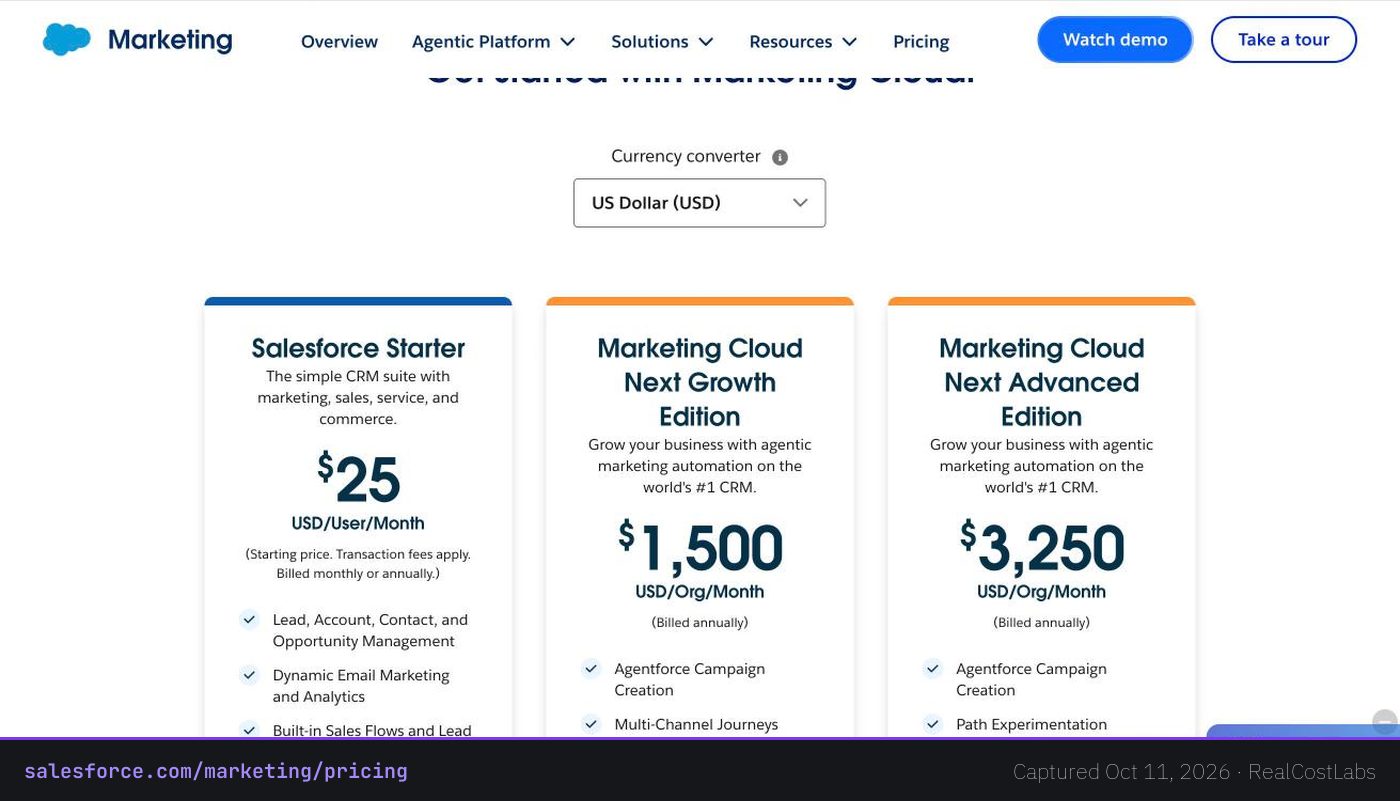
Salesforce Marketing Cloud is in the middle of a rebuild. The product Salesforce now sells to new customers is Marketing Cloud Next, in two editions: Growth at $1,500 per org per month and Advanced at $3,250 per org per month, both billed annually only. That works out to $18,000 or $39,000 per year, paid in advance, before you have sent a single SMS or bought a single add-on. The older Marketing Cloud Engagement product line still exists as an upgrade ladder for existing customers, running from Pro+ at $24,000 a year to Enterprise+ at $360,000 a year. If someone quotes you “Salesforce Marketing Cloud pricing,” the first question to ask is which of these two product families they mean, because the numbers are not interchangeable.
The platform itself is genuinely capable. Marketing Cloud Next runs on the same core platform as Sales and Service Cloud, so customer data flows into marketing without a connector layer, and Agentforce AI handles campaign creation, natural-language segmentation and content generation in both editions. At the top of the Engagement ladder, Salesforce will sell you 150 million email messages, 10 million mobile app messages and 500,000 contacts in one contract. Few vendors can say that. The question this review cares about is not whether the software works, but what it actually costs to run, and there the picture gets less flattering with every line item.
The core issue is metering. Growth includes 180,000 email credits per year, which on a 10,000-contact list is roughly 1.5 emails per contact per month. Send more and you pay $10 per 1,000 extra sends. SMS and WhatsApp credits are not included in any Marketing Cloud Next edition, at any price. Extra Business Units cost $2,500 per month each, Data 360 profiles start at $240 per 1,000, and premium support costs 30% of your net license fees. For context, HubSpot (our Lab Score 7.0) has its own contact-tier pricing problems but at least includes send volume that scales with the tier, and ActiveCampaign (8.7) delivers unmetered core email at a fraction of the entry price.
Third-party sentiment is mixed in an instructive way. G2 reviewers rate it 4.0/5 across 4,443 reviews and Capterra lands at 4.2/5, but Capterra’s sub-scores tell the real story: ease of use scores 3.8 and customer service 3.9, both below the overall number. Salesforce’s company-level Trustpilot score is 1.3/5, though that listing covers all of Salesforce, not Marketing Cloud specifically. Our Lab Score of 6.5 reflects a platform with near-unmatched capability and enterprise scale, dragged down by the worst price-to-value profile in our marketing automation index. If you are not already committed to the Salesforce ecosystem, the entry math is hard to justify.
What Salesforce Marketing Cloud really costs at scale
Start with the structural facts. There is no free plan and no self-serve free trial for Marketing Cloud Growth or Advanced; both are “Contact us” products. Free trials exist only for the Salesforce Starter and Pro CRM suites, which are a different product. Billing is annual only, per org, paid in advance, which Salesforce’s own FAQ confirms is the general rule across its catalog. The $1,500 per month figure on the pricing page is real, but you cannot pay it monthly; the actual invoice is $18,000, once a year.
A note on the cheap-looking option: Salesforce Starter at $25 per user per month appears on the same marketing pricing page, and it is not Marketing Cloud. It is an entry-level CRM suite with dynamic email marketing and analytics bolted on, plus transaction fees. It is fine for a small team that wants basic email inside a starter CRM, but it does not include journeys, scoring models, or any of the Marketing Cloud Next feature set. Treat it as a different product that happens to share a pricing page.
| Plan | Monthly | Annual (per mo) | What you get |
|---|---|---|---|
| Salesforce Starter (CRM suite) | $25/user | $25/user | Entry CRM suite with basic dynamic email marketing and analytics; transaction fees apply; not Marketing Cloud |
| Marketing Cloud Growth | Not offered | $1,500/org ($18,000/yr) | 180,000 email credits/yr, 500 active flows, 1 scoring model, forms and landing pages, Agentforce campaigns, multi-channel journeys; SMS/WhatsApp sold separately |
| Marketing Cloud Advanced | Not offered | $3,250/org ($39,000/yr) | 360,000 email credits/yr, 750 active flows, 2 scoring models, AI predictive scoring, path experimentation, unified two-way SMS/WhatsApp conversations (channel credits still separate) |
| MC Engagement Pro+ | Not offered | $2,000/org ($24,000/yr) | Marketing Cloud Growth features plus 2.5M email messages and 15K contacts |
| MC Engagement Corporate+ | Not offered | $5,500/org ($66,000/yr) | Marketing Cloud Advanced features plus 10M email messages, 1M mobile app messages, 45K contacts |
| MC Engagement Enterprise+ | Not offered | $30,000/org ($360,000/yr) | Marketing Cloud Advanced features plus 150M email messages, 10M mobile app messages, 500K contacts |
Now run a realistic scenario: 10,000 contacts, four marketing emails per contact per month, or 480,000 sends a year. Growth includes 180,000 email credits, so you are 300,000 credits short. At $10 per 1,000 extra sends, that overage costs $3,000, bringing the year to roughly $21,000, or about $1,750 a month. That is before any SMS (an add-on from $10 per 1,000 credits, plus setup and lease-code fees) and before any Data 360 profile charges. Advanced’s 360,000 included credits would cover three emails per contact per month at this list size, but the plan costs $39,000 a year. The odd result is that the legacy Engagement Pro+ path, at $24,000 a year with 2.5 million email sends and 15,000 contacts included, is better email value than either new edition at this volume. If your send volume differs, our real cost calculator will do this arithmetic for your own numbers.
One more forward-looking data point: Salesforce announced an average 6% list-price increase effective August 1, 2025, across Enterprise and Unlimited editions of several clouds, its first broad increase in about seven years. The direction of travel on pricing is up, and annual contracts mean you renegotiate from inside a deployed system.
The hidden costs
Email is metered, and the meter is tight
The allowance is small for the price. Growth’s 180,000 annual credits amount to 1.5 sends per contact per month on a 10,000-contact list; a weekly newsletter alone would blow through the allocation. Overage runs $10 per 1,000 sends, billed as an add-on. Budget for it from day one, because at normal B2C cadences the base allocation is not enough.
SMS and WhatsApp are never included
Salesforce’s own help documentation is direct about this: SMS credits are not included with any Marketing Cloud Next edition. Both SMS and WhatsApp start at $10 per 1,000 credits, and SMS additionally requires paid setup plus a lease or short-code purchase. Advanced includes the two-way conversation tooling, but the messages themselves are always a separate line item. If mobile messaging is central to your program, none of the headline prices apply to you.
Platform add-ons stack quickly
Extra Business Units, which multi-brand setups need, cost $2,500 per month each. Data 360 profiles start at $240 per 1,000 profiles. Agentforce AI actions consume Flex Credits at $500 per 100,000 requests. And the adjacent suites Salesforce will propose during the sales cycle are five-figure monthly items in their own right: Salesforce Personalization at $8,000 per org per month, Marketing Intelligence at $10,000, Loyalty Management at $20,000, Personalization+ at $15,000 and Intelligence+ at $11,000, all billed annually. A “complete” Salesforce marketing stack can cost several multiples of the Marketing Cloud license that anchors it.
Support costs 30% of your bill
Only the self-service Standard success plan is included. The Premier Success Plan, which gets you expedited support, costs 30% of net license fees on top of the licenses themselves. On a $39,000 Advanced contract, that is another $11,700 a year for support. Signature-tier pricing is not published at all; the answer is “contact your account executive.”
The floor is annual and prepaid
There is no monthly billing for Growth or Advanced and no self-serve trial, so the minimum real commitment to find out whether Marketing Cloud Next fits your team is $18,000, paid up front, on a sales-led contract. Existing Sales or Service Enterprise Edition customers can at least get basic marketing capabilities free through Salesforce Foundations before committing, which is the closest thing to a trial that exists here.
Features that matter
Native platform integration
Marketing Cloud Next is built directly on the same platform as Sales, Service and Commerce, with customer data unified through Data 360. There is no connector layer between CRM and marketing, no sync jobs to babysit, and no field-mapping project between sales data and campaign logic. For companies already running Salesforce as the system of record, this is the single strongest argument for the product, and it is a real one.
Agentforce AI in both editions
AI agents handle campaign creation, segmentation via natural-language prompts, content generation for email and SMS, and paid-media optimization. This is included in both Growth and Advanced rather than gated to the top tier, which is more generous than the metering elsewhere in the price book. The caveat is that Agentforce actions consume Flex Credits at $500 per 100,000 requests, so heavy AI usage is itself metered.
Scale that few competitors can match
The Engagement+ ladder tops out at 150 million email messages, 10 million mobile app messages and 500,000 contacts on Enterprise+, with multi-business-unit and multi-brand support along the way. If you are a global enterprise sending at that volume, the shortlist of platforms that can handle it is short, and Salesforce is on it.
Multi-channel orchestration in one builder
Email, SMS, WhatsApp, mobile push, forms and landing pages all run through one journey builder, and Advanced adds unified two-way conversational messaging across SMS and WhatsApp. The orchestration layer is included; only the messages are metered. Growth also ships 500 active flows and one scoring model, with Advanced raising that to 750 flows, two scoring models, and path experimentation for testing journey variants.
Ecosystem depth
AppExchange apps, a certified partner network, and free Trailhead training reduce the staffing risk that usually accompanies enterprise marketing platforms. The plus editions also mean existing Marketing Cloud Engagement customers can add next-generation features without a rip-and-replace migration, which protects prior investment in a way Salesforce has not always managed during product transitions.
Who should choose Salesforce Marketing Cloud
The shortlist is narrower than the marketing suggests.
- Companies already standardized on Salesforce CRM. The native data layer is the product’s core advantage, and it only accrues to teams whose sales and service operations already live on the platform. Existing Enterprise Edition customers can even start free via Salesforce Foundations.
- Enterprises with genuine multi-million-send volume. At Corporate+ and Enterprise+ scale, per-message economics improve dramatically: Enterprise+ includes 150 million emails, which no mid-market tool will sell you at any price.
- Multi-brand organizations. Business Unit support and multi-brand orchestration exist here in a way most competitors cannot replicate, provided you budget $2,500 per month for each additional unit.
- Existing Marketing Cloud Engagement customers. The Pro+, Corporate+ and Enterprise+ paths bundle the new-generation features with large send allocations, and at moderate volumes Pro+ is arguably the best email value in the entire Salesforce price book.
Who should look elsewhere
If you are a small or mid-sized team without an existing Salesforce commitment, the $18,000 annual floor plus metered everything makes this an easy pass. ActiveCampaign remains our top-scored pick at 8.7, delivering automation depth and unmetered core email at a small fraction of the cost. Teams that want an all-in-one CRM and marketing platform with a lower entry point should read our HubSpot review; its 7.0 score reflects its own renewal-price problems, but its entry economics are far friendlier than Salesforce’s. Enterprises comparing dedicated marketing automation suites should also weigh Marketo, the closest enterprise peer, before signing anything. Our full rankings live on the best marketing automation software page.
Also look elsewhere if SMS is your primary channel and you are price-sensitive. Since no Marketing Cloud edition includes SMS credits, and SMS carries setup and lease-code fees on top of per-message costs, the true cost of an SMS-first program here is unknowable from the public price list alone.
FAQ
How much does Salesforce Marketing Cloud cost?
Marketing Cloud Growth costs $1,500 per org per month and Advanced costs $3,250 per org per month, both billed annually only, so the real invoices are $18,000 and $39,000 per year. The legacy Engagement editions run $2,000 to $30,000 per org per month ($24,000 to $360,000 per year). Salesforce Starter at $25 per user per month is a basic CRM suite with email marketing, not Marketing Cloud.
Is there a free trial or free plan?
No. Marketing Cloud Growth and Advanced have no free plan and no self-serve trial; both are sales-led “Contact us” products. Free trials exist only for the Salesforce Starter and Pro CRM suites. The one exception: existing Sales or Service Enterprise Edition customers can get basic marketing capabilities at no extra cost through Salesforce Foundations.
How many emails are included, and what does overage cost?
Growth includes 180,000 email message credits per year and Advanced includes 360,000, per Salesforce’s own allocations documentation. On a 10,000-contact list that is roughly 1.5 and 3 emails per contact per month respectively. Additional sends cost $10 per 1,000 credits. SMS and WhatsApp are separate add-ons from $10 per 1,000 credits, with SMS requiring paid setup and a lease or short-code purchase.
Why is the Trustpilot score so low?
The 1.3/5 Trustpilot score is Salesforce’s company-level listing covering roughly 644 reviews of salesforce.com as a whole; no Marketing Cloud-specific Trustpilot page exists. Product-level review sites are considerably kinder: G2 rates it 4.0/5 across 4,443 reviews and Capterra 4.2/5 across 526, though Capterra’s ease-of-use sub-score of 3.8 hints at the learning curve buyers should expect.
See how Salesforce Marketing Cloud compares
We rank every major platform by what it really costs at renewal, not the signup teaser.
RealCostLabs is independent and reader-supported. We may earn a commission on purchases made through our links, at no extra cost to you, and our scores are never for sale.