 MailerLite
 ActiveCampaign
 Omnisend
 Klaviyo
 SE Ranking
 Mangools
 Semrush
 Ahrefs
 Pipedrive
 Zoho CRM
 Salesforce
 HubSpot
 Systeme.io
 GoHighLevel
 ClickFunnels
 Vendasta
Is Semrush worth it?
Yes, if you run SEO and paid search together and at least two people log in. No, if you are one person who mostly checks rankings — you would be paying for a platform to use a dashboard. Here is the arithmetic behind that split.
RealCostLabs is independent and reader-supported. We may earn a commission on purchases made through our links, at no extra cost to you, and our scores are never for sale.
The short answer
Semrush is the most complete SEO platform you can buy. That is exactly why the value question is hard: you pay for all of it whether you use all of it or not. Plan-by-plan numbers, add-ons and real team bills are in our Semrush pricing 2026 breakdown.
Worth it if
- You run organic and paid search together. The paid-search intelligence is the part competitors genuinely do not match, and it is bundled rather than sold separately.
- You are replacing three or more tools. One login instead of four subscriptions plus manual data-stitching is a real saving in money and hours.
- You are an agency reporting to clients. Breadth of data wins pitches, and the reporting holds up in a meeting.
- You need competitor data specifically, not just your own numbers.
Not worth it if
- You mainly track rankings for one site. That is a $38-a-month job and you would be paying $139.
- You are a solo operator on a tight budget. The entry plan is one seat, and the tier above it costs 43% more.
- You are three people who each need a login. Read the seat section below before you commit — this is where the budget breaks.
- You want to try before you buy properly. Seven days is not long enough to evaluate a platform this large.
What Semrush actually costs
The advertised number is $139 a month. The realistic working plan is $199, the first tier with historical data. Neither figure includes seats.
| Plan | Monthly | Annual (per mo) | Extra seat | Who it is really for |
|---|---|---|---|---|
| SEO | $139 | $117.33 | from $45/mo | One person, one site |
| Starter | $199 | $165.17 | from $45/mo | The realistic working plan: historical data lives here |
| Pro+ | $299 | $248.17 | from $45/mo | Agencies: 15 websites, 1,500 keywords |
| Advanced | $549 | $455.67 | from $45/mo | Large teams and API access |
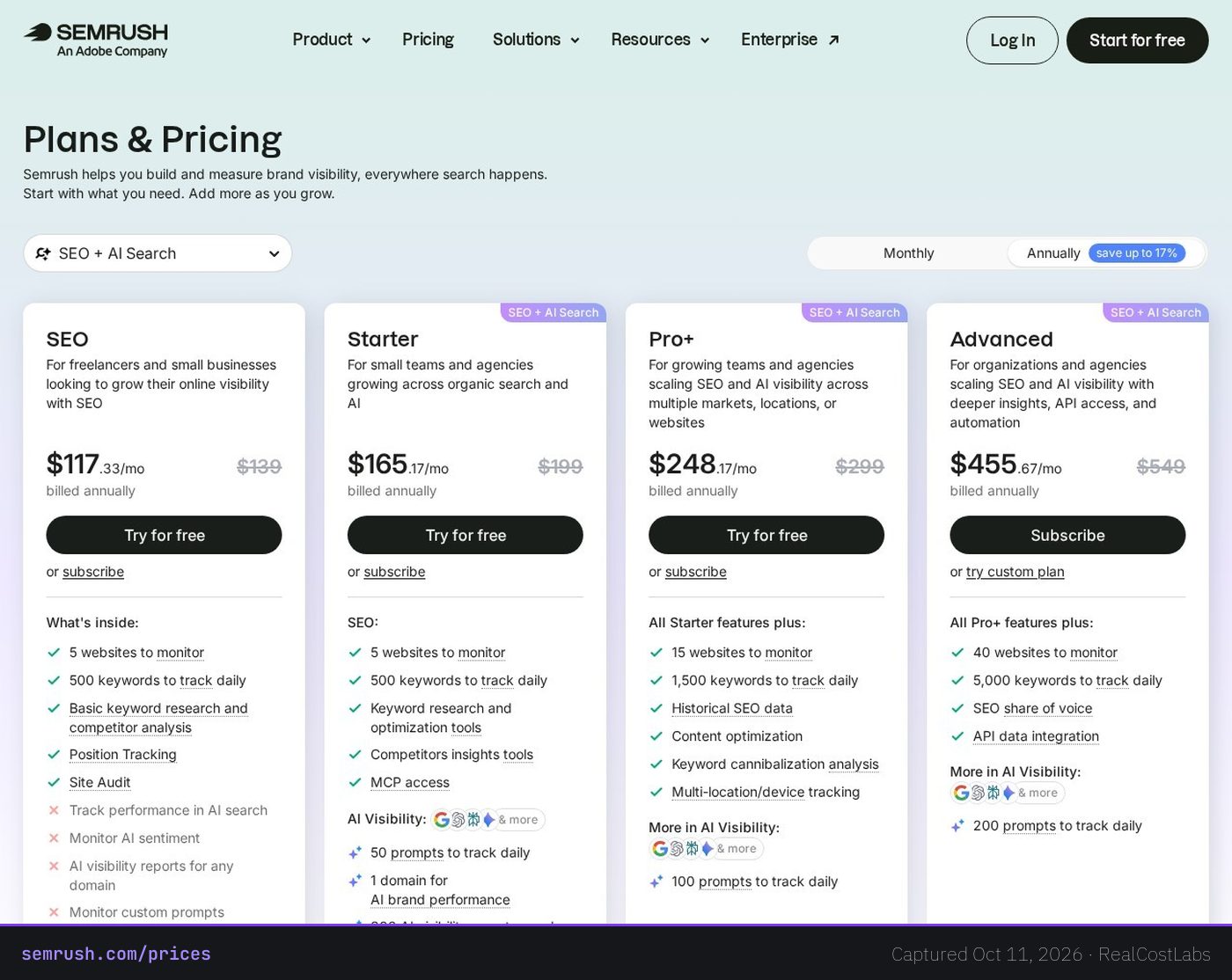
Prices verified against Semrush’s published rate card, June 2026. Every plan ships with a single seat.
Monthly billing carries a 19% premium over annual. That is one of the gentler penalties in the category — Close charges 111%, Pipedrive 71% — but it still means the flexible option costs about $260 a year more on the SEO plan.
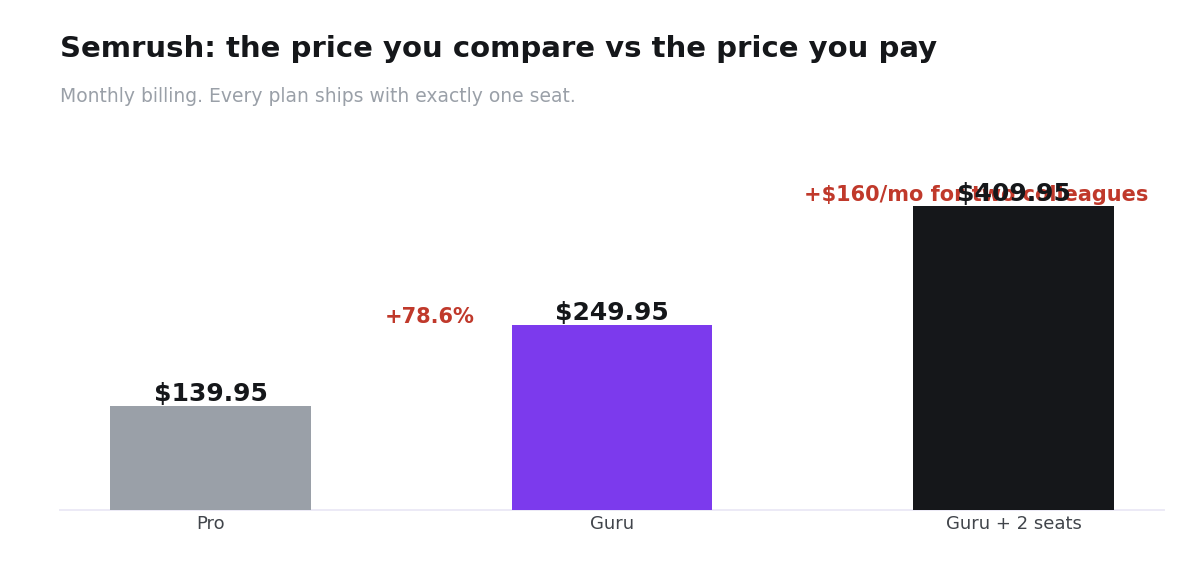
The number that decides it: 43%
The jump from the SEO plan to Starter is a 43% price increase, and Starter to Pro+ adds another 50%. It is one of the steepest ladders in the SEO toolkit category, and it is the single most important figure on this page.
It matters because the SEO plan is deliberately incomplete for professional use. Historical data and content optimization live on Starter, and the 15-website limit agencies need lives on Pro+. So the question is not “is $139 worth it” — it is “is $199 worth it”, because that is where you will be within a quarter if the tool is doing its job.
Price it before you sign, not after
Take the plan you think you need, add one tier, add a seat for every person who will log in, and compare that number against what you pay now. If it still works, Semrush is worth it. If it only works at the entry tier, it is not — because you will not stay there.
Seats are where the budget breaks
Every Semrush plan includes exactly one seat. This is the most common budgeting mistake we see, and it is not small.
A three-person team on Pro+, monthly billing
| Line item | Monthly | Per year |
|---|---|---|
| Pro+ base plan | $299 | $3,588 |
| Second seat | from +$45 | from +$540 |
| Third seat | from +$45 | from +$540 |
| Actual total | from $389 | from $4,668 |
That is at least 30% above the advertised price for the same plan, and the per-seat price rises with the tier, so the real gap is wider. Two colleagues add $1,080 a year at minimum before anyone touches an add-on.
Add-ons for local SEO, lead generation, competitive intelligence and the Agency Growth Kit sit behind their own paywalls and stack on top. None of them appear in the comparison table you used to decide.
What the ratings gap tells you
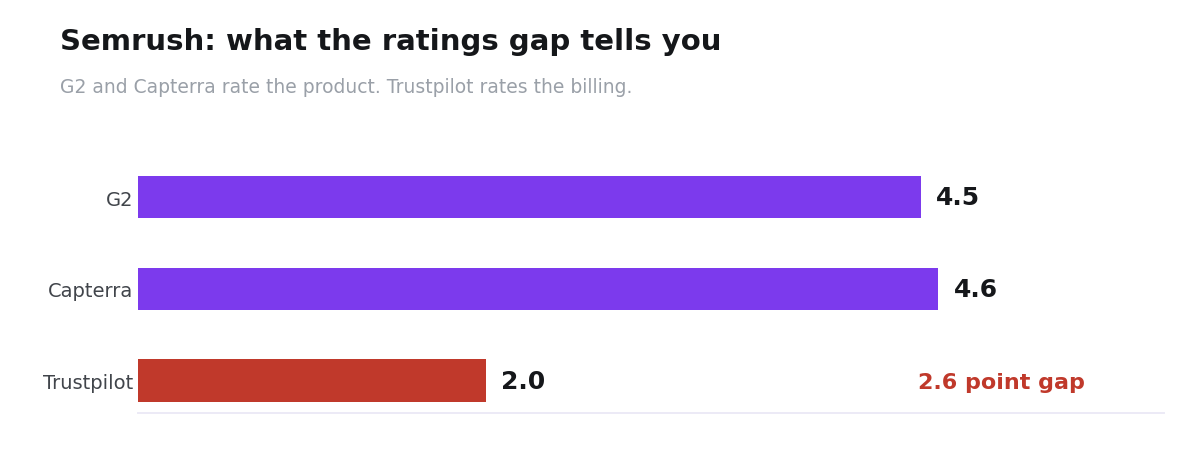
Semrush scores 4.5 on G2 across roughly 3,434 reviews and 4.6 on Capterra across about 2,318. On Trustpilot it sits at 2.0.
| Platform | Score | Who writes there |
|---|---|---|
| G2 | 4.5 / 5 | Professionals evaluating features |
| Capterra | 4.6 / 5 | Buyers comparing products |
| Trustpilot | 2.0 / 5 | People who have been billed |
A 2.5-point gap between review sites is not noise, and it is not really about the product. G2 and Capterra measure whether the tool does the job. Trustpilot is where people go after a billing experience they did not expect.
The specific complaints are consistent: the seven-day trial auto-converts to paid, and cancellation is deliberately awkward. If you start a trial, put a calendar reminder on day six. That single step removes most of what the 2.0 is made of.
Worth it, by who you are
| You are | Realistic annual cost | Verdict |
|---|---|---|
| Solo blogger, one site | $1,408 (SEO annual) | No — Mangools does the job for $452 |
| Freelance SEO, several clients | $1,982 (Starter annual) | Marginal — depends on billable rate |
| In-house running SEO + PPC | $1,982–2,978 | Yes — the paid-search data is the reason |
| Three-person agency | from $4,058 (Pro+ + 2 seats, annual) | Yes, if it wins one client |
| Anyone who just checks rankings | $1,408+ | No — overwhelmingly |
The break-even for an agency is straightforward: at $4,058 a year or more, Semrush pays for itself if it helps win or keep one client worth $340 a month. An agency with one $410-a-month client clears that; a solo operator checking rankings does not.
If the answer is no, what instead
Saying Semrush is not worth it for you is not the same as saying you need nothing. The question is which part of Semrush you actually open.
- Rank tracking only — Mangools at $37.70 a month annual, or $452.40 a year. That is $956 less than the Semrush SEO plan for rank tracking alone.
- Backlink research — Ahrefs has the better index, but costs more and has no free trial. See our Semrush vs Ahrefs breakdown.
- A full replacement — SE Ranking at $103 a month annual covers rank tracking, audit, keywords and backlinks in one subscription, and includes more tracked keywords at entry.
- Client reporting on a budget — Moz at $49 a month (or $79 on the cheapest annual plan, Standard), with the gentlest learning curve in the category.
What you actually lose on the cheap plan
The 43% jump only makes sense if you know what sits on either side of it. This is the part the pricing page compresses into checkmarks.
| Capability | SEO $139 | Starter $199 | Does it matter? |
|---|---|---|---|
| Websites | 5 | 5 | Only Pro+ ($299) raises this, to 15 |
| Tracked keywords | 500 | 1,500 | Yes — 500 runs out fast on multi-site work |
| AI-visibility prompts tracked daily | 10 | 50 | Yes if AI answers already send you traffic |
| Historical data | — | Included | Yes — the item that forces the upgrade |
| Content toolkit | — | Included | Only if you brief writers |
Historical data is the item that forces the upgrade. You do not miss it in week one. You miss it the first time a client asks what happened to their rankings in March, and you cannot answer.
If neither historical data nor the extra tracked keywords matter to you, the SEO plan is genuinely enough — and that is a real outcome, not a consolation prize. The trap is buying the SEO plan while planning to do Starter work.
The three-year number
Software is bought monthly and paid for over years. Here is the same decision at the scale it actually happens.
| Setup | Year 1 | 3 years |
|---|---|---|
| SEO, annual billing, one seat | $1,408 | $4,224 |
| Starter, annual billing, one seat | $1,982 | $5,946 |
| Starter, monthly billing, one seat | $2,388 | $7,164 |
| Pro+ + 2 seats (min.), annual | $4,058 | $12,174 |
| Advanced + 2 seats (min.), annual | $6,548 | $19,644 |
A three-person agency on Pro+ is looking at at least $12,174 over three years. That is a hire’s worth of budget in some markets, which is the right frame for the decision — not “is $299 a lot for software” but “is this worth a third of a junior salary”.
For comparison, the same three people on Mangools Premium would pay about $1,897 over three years. The gap is $10,277. Semrush has to be worth that, not worth $299.
If you do buy, cut the bill first
Four things that are free and reduce what you pay for the same product.
- Pay annually if you are staying past month four. The 19% premium on monthly billing means the break-even is early. Below four months, stay monthly and keep the exit.
- Audit seats every quarter. Seats are the largest variable cost and the easiest to forget. A dormant seat is at least $540 a year.
- Skip the add-ons until something breaks. Local SEO, lead generation and competitive intelligence are separate paywalls. Buy them when a specific job needs them, not at signup.
- Use the trial properly. Seven days is short, so plan it: run your three real workflows on day one, not day six. Then decide with a reminder already set.
The verdict
Semrush is worth it when breadth is the point — when you are consolidating tools, running paid and organic together, or selling SEO to clients who want to see the data. In those cases the $199 Starter plan replaces more than $199 of software and hours.
It is not worth it when you are buying a platform to use one feature. The 43% tier jump and the per-seat model mean Semrush punishes exactly the user who hoped to stay small and cheap. If that is you, the answer is that a $38 tool does your job and Semrush knows it.
We score tools on real value rather than headline features. Semrush earns a Lab Score of 8.2 — excellent capability, priced for someone with a budget line for it.
Common questions
Is the Semrush free trial actually free?
Yes, for seven days, but it requires a card and auto-converts to a paid month if you do not cancel. Set a reminder for day six. This is the source of most of the Trustpilot complaints.
Can I share one Semrush seat with a colleague?
The terms do not permit it and the product enforces session limits. Budget for a seat per person: from $45 per month, rising with the tier.
Is Semrush worth it for a small business that is not an agency?
Usually not at Starter pricing and above. If you have one website and no paid search, you are buying competitor intelligence you will rarely use. Price Mangools or SE Ranking first.
Does Semrush get cheaper if I pay annually?
By about 19%, which is about $260 a year on the SEO plan and $406 on Starter. That is a genuine saving, but it also locks you in for twelve months on a tool you have had seven days to evaluate.
Why is the Trustpilot score so low if the product is good?
Because the two sites measure different things. G2 and Capterra reviewers rate capability. Trustpilot reviewers rate what happened when they tried to stop paying. Both scores are true.
KEEP EXPLORING