 MailerLite
 ActiveCampaign
 Omnisend
 Klaviyo
 SE Ranking
 Mangools
 Semrush
 Ahrefs
 Pipedrive
 Zoho CRM
 Salesforce
 HubSpot
 Systeme.io
 GoHighLevel
 ClickFunnels
 Vendasta
beehiiv review
The free plan is one of the most generous in email; the pricing slider behind it climbs from $49 to $399 a month on yearly billing before you ever reach 100,000 subscribers.
Ratings from G2 (40 reviews), Capterra (16) and Trustpilot (379), pricing verified October 11, 2026.
The verdict
beehiiv sells a simpler deal than most email platforms: you pay by list size, never by send volume, and from the Lite plan up the platform takes 0% of your paid-subscription revenue. The Free plan is the strongest part of that deal. It covers up to 2,500 subscribers with unlimited email sends, custom domains, a hosted website, and API access, at $0 with no credit card required. In a market where free tiers usually cap out well below that and strip out domain features, that is an unusual amount of product for nothing.
The cost story starts after the free tier. The advertised $49/mo price covers the Lite plan on yearly billing at up to 1,000 subscribers only, and the slider moves in large steps from there: on monthly billing Lite runs $59 at 1,000 subscribers, $79 at 2,500, $109 at 5,000, $139 at 10,000, $199 at 25,000, $299 at 50,000, $389 at 75,000 and $469 at 100,000. Pro — the tier you need for branding removal, webhooks and dynamic content — runs $239/mo at 10,000 subscribers and $699/mo at 100,000, and is the only tier that keeps going past that point: $799 at 150,000, $899 at 200,000 and $999 at 250,000. Past 250,000 subscribers you are into custom Enterprise pricing.
There are also billing habits here we flag whenever we find them: automatic prorated charges when you cross a subscriber tier, a free trial whose length the pricing page never states, a 20% fee on the Boosts marketplace, and a user-reported base-price increase from $39 to $49 that subscribers say they discovered on billing statements rather than in an email. None of these is unique to beehiiv, but together they mean the invoice needs watching.
On our rubric — price-to-value 40%, performance 25%, third-party satisfaction 20%, capability 15% — beehiiv scores 8.1. That puts it a tenth under Kit (8.2), its closest competitor, and well under MailerLite (9.2), which remains the cheaper tool for general-purpose email at every list size we test. beehiiv earns its score on the free tier, the 0% take rate on paid subscriptions, and a built-in monetization stack no rival matches at this price. It loses points on slider steepness past 10,000 subscribers and on how its pricing changes have reached customers.
What beehiiv really costs at scale
beehiiv prices on a single variable: active subscribers. Every plan, including the free one, has unlimited sends, so there is no send-volume arithmetic — a real simplification over platforms that meter emails. The trade-off is that the subscriber slider does all the pricing work, and it moves in discrete tiers rather than smoothly. Adding one subscriber past a tier boundary reprices your whole account: going from 1,000 to 1,001 subscribers moves Lite from $49/mo to $69/mo on yearly billing, a 41% increase for one contact.
Yearly billing discounts the slider by roughly 13 to 17% depending on the step, paid upfront. Lite at 1,000 subscribers is $49/mo on yearly billing against $59 month to month; at 10,000 it is $119/mo against $139; at the 100,000-subscriber cap it is $399/mo against $469. Pro on yearly billing runs $95/mo at 1,000 subscribers, $199/mo at 10,000 and $599/mo at 100,000, then $869/mo at its 250,000 ceiling. We verified every figure below by working through beehiiv’s live pricing slider in October 2026.
| Plan | Monthly | Annual (per mo) | What you get |
|---|---|---|---|
| Free | $0 | $0 | Up to 2,500 subscribers, unlimited sends, 1 team member, 1 publication, custom domains, hosted website, API access, 1 guest author, 30-day analytics lookback. No paid subscriptions, automations, or A/B testing. |
| Lite — 1,000 subs | $59 | $49 ($588/yr) | Adds paid subscriptions at a 0% take rate, ad monetization, email automations, A/B testing, audience polls, the beehiiv MCP, 2 team seats, 3 publications, 12-month analytics. |
| Lite — 10,000 subs | $139 | $119 ($1,428/yr) | Same feature set; price tracks list size. |
| Lite — 100,000 subs | $469 | $399 ($4,788/yr) | Same feature set; 100K is the plan ceiling. |
| Pro — 1,000 subs | $109 | $95 ($1,140/yr) | Adds branding removal, webhooks, dynamic content, webinars and coaching, advanced analytics, AI credits, 10 team seats, 10 publications, unlimited guest authors, 24/7 priority support. |
| Pro — 10,000 subs | $239 | $199 ($2,388/yr) | Same feature set; price tracks list size. |
| Pro — 100,000 subs | $699 | $599 ($7,188/yr) | Same feature set; Pro continues to 250,000 subscribers ($999/mo monthly, $869 yearly) before Enterprise. |
| Enterprise | Custom quote | Custom quote | 100K+ subscribers, custom publication limits, dedicated IPs, SSO, dedicated account manager, concierge onboarding, VIP support. |
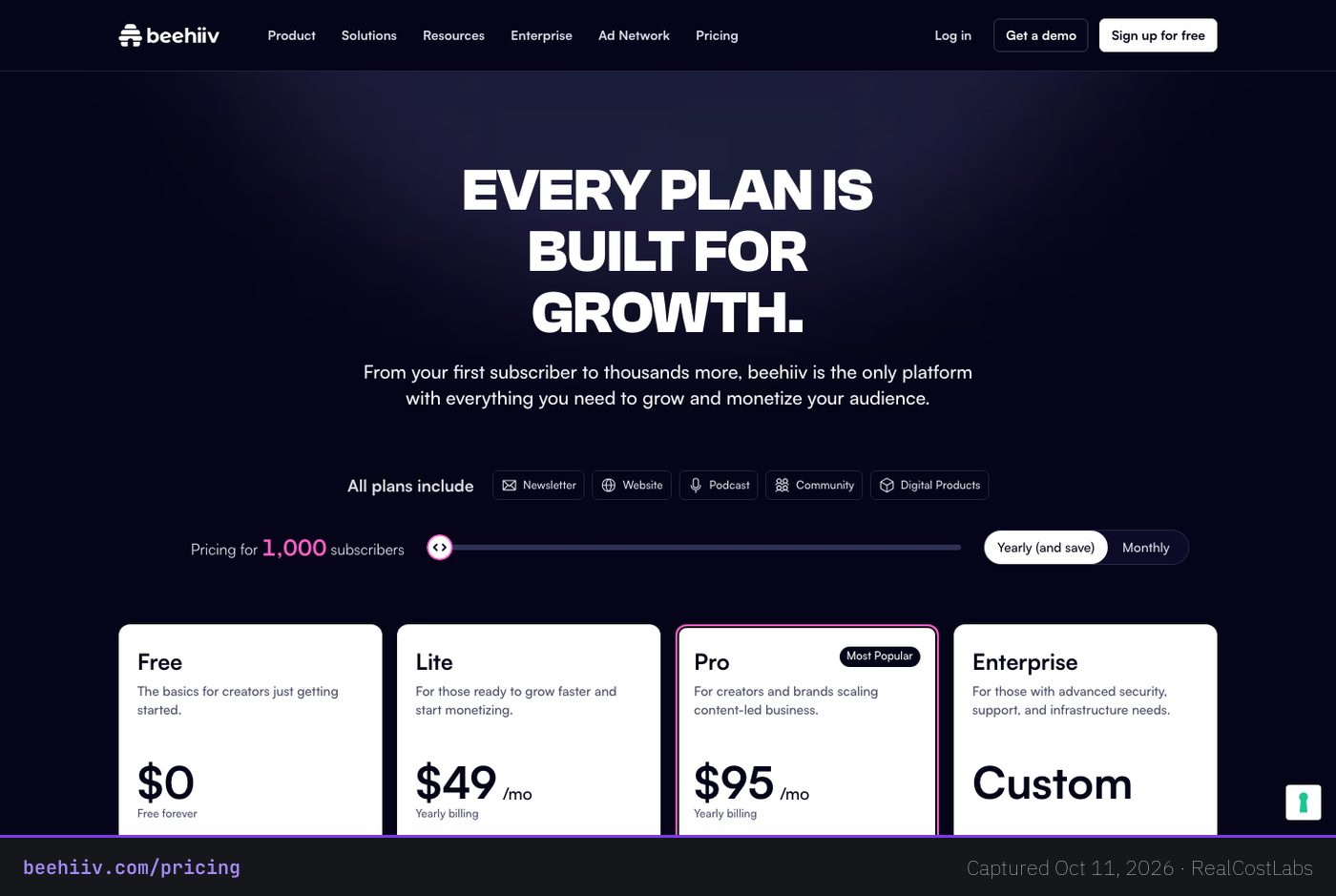
At our standard 10,000-contact benchmark, beehiiv lands at $139/mo month-to-month or $119/mo on yearly billing for Lite, and $239/mo or $199/mo for Pro. That is competitive at the Lite tier and expensive at Pro, given that the main things Pro buys are branding removal and webhooks. To see what your own list costs on beehiiv against its competitors, run the numbers through our real cost calculator.
The hidden costs
The 1,001st subscriber. Tier pricing means growth reprices you in jumps, not increments. Crossing from 1,000 to 1,001 subscribers moves Lite from $49 to $69/mo on yearly billing. Between 1,000 and 100,000 subscribers, Lite’s price climbs through eight steps to $399/mo on yearly billing, $469 month to month. Budget against the tier you will grow into this year, not the one you sign up at.
Automatic tier billing. beehiiv’s own support documentation states that when you pass your subscriber limit you “will automatically be charged a prorated amount for the next tier.” You can opt out of the auto-upgrade, but the same documentation warns that sends to subscribers may then be delayed until you act. In practice that means the choice is between an unplanned charge and a paused newsletter — worth knowing before a viral growth spike, which is exactly when it will happen.
A trial with no stated length. The Lite and Pro cards say “Try for free” and “No credit card required,” but the pricing page does not say how long the trial lasts or which features it includes, so treat it as a look around rather than a dress rehearsal and check the terms in-app before you build on it.
Monetization is not fee-free. The Boosts cross-promotion marketplace takes a 20% cut of earnings — a $2.00-per-subscriber offer nets you $1.60. The “0% take rate” on paid subscriptions is real from Lite up, but Stripe’s 2.9% + $0.30 per transaction still applies, and removing beehiiv’s branding from your emails requires Pro, which runs $50 to $230 a month more than Lite depending on list size.
A reported unannounced price increase. A 2026 third-party intelligence report documents r/beehiiv users finding the entry-plan base price raised from $39 to $49/mo with no direct email or in-app notice — several say they discovered it on billing statements. This is user-reported and not vendor-confirmed, so we weight it accordingly, but it is consistent with our general advice on this platform: read your invoice every month.
Features that matter
beehiiv’s differentiator is the monetization stack, and it is genuinely broad: a sponsored Ad Network, the Boosts cross-promotion marketplace, paid subscriptions with a 0% platform take rate, digital products, and a sponsorship storefront, all built in. No competitor at this price point ships anything comparable. For a publisher whose newsletter is the business rather than a marketing channel for one, this is the strongest argument for beehiiv over a conventional email tool.
The plan gating is worth reading closely. Free has no automations, no A/B testing, no polls, and no paid subscriptions — it is a sending and hosting tier. Lite adds email automations, A/B testing, audience polls, the beehiiv MCP, and the monetization stack: paid subscriptions at a 0% take rate and ad monetization. Pro adds the operational features larger publishers tend to need: webhooks, dynamic content, webinars and coaching, advanced analytics, AI credits, branding removal, 24/7 priority support, 10 team seats, and 10 publications instead of 3.
Third-party sentiment is solid rather than spotless. beehiiv scores 4.5/5 on G2, with 30 of 40 reviews at five stars and “Ease of Use” the most-cited pro at 17 mentions; Capterra sits at 4.4/5 across 16 reviews. Trustpilot is the outlier at 4.0/5 over 379 reviews — a respectable score, but the lowest of the three. The review counts on G2 and Capterra are small, so treat those averages as directional.
What beehiiv does not try to be is a general-purpose marketing platform. There is no ecommerce integration story to speak of, no CRM, and the automation builder is newsletter-shaped rather than lifecycle-shaped. If your email program exists to sell products rather than to be the product, the feature set will feel thin next to conventional email platforms at the same price.
Who should choose beehiiv
beehiiv is the right call for a specific kind of operator:
- Newsletter-first publishers who intend to monetize through ads, cross-promotion, or paid subscriptions. The 0% take rate alone beats the 10% cut competitors like Substack take, and the Ad Network and Boosts have no real equivalent elsewhere at this price.
- Anyone starting from zero. Free to 2,500 subscribers with unlimited sends, custom domains, and a hosted website is the most generous on-ramp in the category. You can build a real publication before paying a dollar.
- High-frequency senders. Because pricing is by list size only, a daily newsletter costs the same as a monthly one. Platforms that meter sends punish exactly this use case.
- Small teams running multiple titles. One publication free, three on Lite, ten on Pro, under one bill.
Who should look elsewhere
If email is a marketing channel for a product business — ecommerce flows, lead nurture, CRM-driven segmentation — MailerLite (Lab Score 9.2) does more of that work for meaningfully less money at every list size, and its pricing curve is far gentler past 10,000 contacts.
Creators who sell courses and digital products, and who want a more mature automation and tagging system around a creator business, should compare Kit (8.2) before committing. Kit’s monetization features are narrower than beehiiv’s, but its automation engine is deeper and its ecosystem of creator integrations is broader.
Publishers already past 100,000 subscribers should note that beehiiv’s published pricing simply stops there; everything beyond is custom Enterprise negotiation. If you want list-price transparency at large scale, check how the alternatives handle six-figure lists in our ranked email marketing guide before you migrate.
FAQ
Is beehiiv actually free?
Yes, within limits. The Free plan runs indefinitely for up to 2,500 subscribers and includes unlimited sends, custom domains, a hosted website, and API access, with no credit card required. It excludes automations, A/B testing, polls, and paid subscriptions. Lite and Pro also offer a free trial with no card required, but the pricing page does not say how long it runs.
How much does beehiiv cost at 10,000 subscribers?
Lite costs $139/mo on monthly billing or $119/mo on yearly billing ($1,428 billed upfront). Pro costs $239/mo monthly or $199/mo yearly ($2,388/yr). We verified both by setting beehiiv’s live pricing slider to the 10K tier in October 2026.
Does beehiiv take a cut of my revenue?
It depends on the revenue stream. Paid subscriptions carry a 0% platform take rate from Lite up — only Stripe’s 2.9% + $0.30 per transaction applies. Boosts marketplace earnings carry a 20% beehiiv fee, so a $2.00-per-subscriber offer nets you $1.60.
What happens when I pass my plan’s subscriber limit?
By default, beehiiv automatically charges you a prorated amount for the next pricing tier. If you opt out of automatic upgrades, beehiiv’s support docs warn that sends may be delayed until you upgrade or trim your list. Note that tiers move in jumps: going from 1,000 to 1,001 subscribers takes Lite from $49/mo to $69/mo on yearly billing ($59 to $79 month to month).
KEEP EXPLORING
See how beehiiv compares
Ranked against the field on renewal pricing, not signup teasers.
Ready to try beehiiv?
Start on the free plan up to 2,500 subscribers — the pricing slider only starts to matter once the list grows.
Try beehiiv free →RealCostLabs is independent and reader-supported. We may earn a commission on purchases made through our links, at no extra cost to you, and our scores are never for sale.