 MailerLite
 ActiveCampaign
 Omnisend
 Klaviyo
 SE Ranking
 Mangools
 Semrush
 Ahrefs
 Pipedrive
 Zoho CRM
 Salesforce
 HubSpot
 Systeme.io
 GoHighLevel
 ClickFunnels
 Vendasta
Mindbody pricing
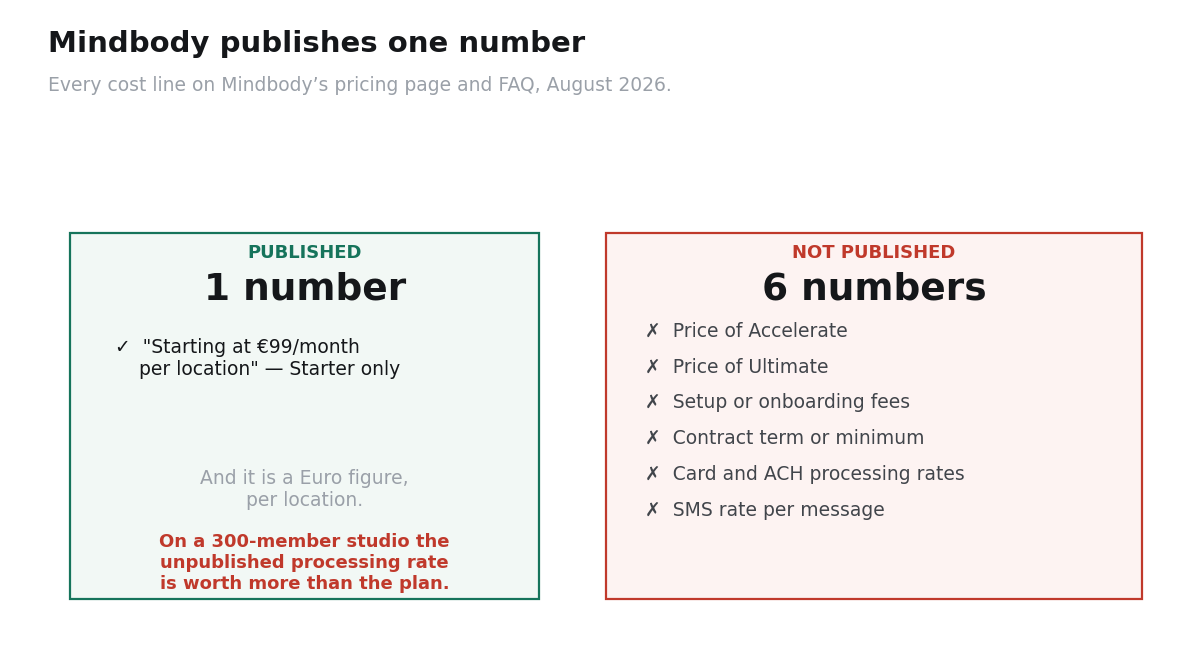
Mindbody publishes exactly one number: “starting at €99 per month per location” — a Euro figure, for the entry tier only. Everything else is a phone call. This page documents precisely what is and is not disclosed, what to ask before the demo, and what its competitors charge for the same job.
RealCostLabs is independent and reader-supported. We earn no commission from Mindbody, PushPress or Zen Planner. Every figure was read from the vendors’ own pages in August 2026.
The short answer
There is no published price for two of the three tiers. Mindbody offers three tiers — Starter, Accelerate and Ultimate — and only the first carries a figure, in Euros, per location.
That is not unusual for enterprise software. It is unusual for a product sold to independent yoga studios and gyms, and it means any comparison of it on price is guessing.
What is actually published
| Item | Status |
|---|---|
| Entry price | “Starting at €99 per month per location” |
| Tier names | Starter, Accelerate, Ultimate |
| Starter contents | Booking, payments, reporting, website tools |
| Accelerate contents | Advanced analytics, room and resource management, promotional tools |
| Ultimate contents | Email and SMS marketing, lead management, advanced analytics |
| Price of Accelerate | Not published — “Let’s talk” |
| Price of Ultimate | Not published |
| Setup or onboarding fees | Not published |
| Contract term or minimum commitment | Not published |
| Payment processing rates | Not published |
| SMS and text message rates | Not published |
Read from Mindbody’s own pricing page and FAQ, August 2026.
Its own FAQ confirms the total cost comprises the base plan, optional add-ons such as a branded app and SMS or email features, and transaction fees for payments, text messages and certain integrations — without attaching a number to any of them.
So four separate cost lines are acknowledged to exist and none is priced.
Why the unpublished rates matter more here than usual
A gym or studio is a recurring-revenue business. The processing rate is not charged when a customer buys once — it is charged on the same member, every month, for as long as they stay.
A studio with 300 members paying $60 a month bills $216,000 a year. At that scale:
| Processing rate | Annual cost on $216,000 |
|---|---|
| 0.79% (a published competitor bank-draft rate) | $2,786 |
| 2.89% (a published competitor card rate) | $7,322 |
| 4.99% (a published competitor free-tier card rate) | $12,204 |
The spread between those rates is $9,400 a year — several times any plausible subscription difference between platforms. Since Mindbody does not publish its rate, you cannot compare it on total cost at all until you have the number.
That single figure is worth more than the tier price you will be quoted.
The four questions to send before the demo
Put these in one email and ask for written answers. If they arrive only verbally in a call, that is information too.
- The monthly price of the tier I need, in my currency. The published €99 is per location and for Starter only.
- The card and ACH processing rates. On a 300-member studio a two-point difference is roughly $4,500 a year.
- The SMS rate per message. Class changes, waitlists and cancellations all go out by text, and the FAQ confirms texts carry transaction fees.
- The minimum contract term and any setup fee. Neither is published.
Ask before the demo rather than after. A quote is much easier to obtain while you are still a prospect.
What competitors publish for the same job
For a benchmark, here is what one competitor discloses in full — which is the comparison Mindbody’s pricing page prevents you from making.
| PushPress plan | Per month | Card | ACH |
|---|---|---|---|
| Free | $0 | 4.99% + $0.30 | 2.89% + $0.30 |
| Pro | $159 | 2.89% + $0.30 | 0.79% + $0.30 |
| Max | $229 | 2.89% + $0.30 | 0.79% + $0.30 |
All PushPress tiers include unlimited members, admins and staff accounts.
Zen Planner sits in the same category and also routes pricing through sales.
This is the practical use of a benchmark: when Mindbody quotes you, you will know whether the number is competitive rather than merely plausible. We work the full arithmetic through in our guide to software for gyms and studios.
One thing worth knowing about the referral programme
Mindbody runs a customer referral programme with a reward equivalent to about US$1,000 for a valid referral — but it is open only to businesses with an active Mindbody account in good standing, and the referred business must subscribe within 90 days.
Mentioned here because a US$1,000 reward per referral is worth knowing about when you read enthusiastic Mindbody recommendations from existing customers. It is disclosed and legitimate, and it is worth factoring into how you read reviews.
For the avoidance of doubt: we are not in that programme and earn nothing from Mindbody.
The verdict
Mindbody is the best-known platform in fitness and wellness, and for multi-location businesses that want its consumer marketplace exposure it is a serious option. But you cannot evaluate it on price from its website, and the numbers it withholds — particularly the processing rate — are larger on a recurring-revenue business than the subscription it does publish.
Get the four figures in writing, then compare against a platform that publishes everything. If Mindbody comes out ahead with the full picture visible, buy it with confidence. If it will not give you the picture, that is the answer.
We earn no commission from Mindbody, PushPress or Zen Planner.
FAQ
How much does Mindbody cost?
The only published figure is “starting at €99 per month per location” for the Starter tier. Accelerate and Ultimate prices are quote-only, as are setup fees, contract terms and processing rates.
Why does Mindbody not publish its pricing?
It uses a quote-based model, with three tiers routed through sales. Its FAQ confirms the total cost includes the base plan, optional add-ons such as a branded app and SMS, and transaction fees for payments, texts and certain integrations.
What should I ask before a Mindbody demo?
Four things in writing: the monthly price of your tier in your currency, the card and ACH processing rates, the SMS rate per message, and the minimum contract term plus any setup fee.
Does Mindbody charge transaction fees?
Yes — its FAQ states that payments, text messages and certain integrations carry transaction fees. No rate is published for any of them.
How does Mindbody compare with PushPress on price?
You cannot compare them from the published information. PushPress discloses everything: free, $159 or $229 a month, with card at 4.99% on the free plan and 2.89% on paid, and ACH at 2.89% and 0.79%. Mindbody publishes one Euro figure.
Is Mindbody worth it for a single-location studio?
Its strongest argument is the consumer marketplace, which matters most where discovery is the constraint. For a single location filling classes through its own community, a platform with published pricing is easier to budget.
What is the Mindbody referral programme?
A customer referral scheme worth roughly US$1,000 for a valid referral, open only to existing Mindbody customers in good standing, with the referred business subscribing within 90 days. It is worth knowing when reading online recommendations.
What does a gym platform actually cost in total?
Subscription plus processing on recurring dues, and on a 300-member studio the second is larger. On a 300-member studio billing $216,000 a year, the difference between a 0.79% and a 4.99% rate is $9,400 — which is why the unpublished rate matters more than the published plan.