 MailerLite
 ActiveCampaign
 Omnisend
 Klaviyo
 SE Ranking
 Mangools
 Semrush
 Ahrefs
 Pipedrive
 Zoho CRM
 Salesforce
 HubSpot
 Systeme.io
 GoHighLevel
 ClickFunnels
 Vendasta
GoHighLevel SaaS Mode, Explained
SaaS mode is the $497/mo feature that turns GoHighLevel into software you sell under your own brand. The math is real — 15 clients at $197/mo is $2,955 in MRR against roughly $650 in costs, a 78 percent gross margin. So are the churn and the support tickets that come with being a software vendor.

Most GoHighLevel features save agencies money. SaaS mode is the one that makes it. It converts a $497/mo subscription into a product you sell at your own price, on your own Stripe account, with your clients’ usage rebilled at a markup you set. This guide covers what the mode actually does, what it costs to unlock, how the rebilling machinery works, and a worked margin example you can stress-test with your own numbers in the SaaS margin calculator.
What SaaS mode actually is
GoHighLevel’s normal model is agency software: you run marketing for clients out of sub-accounts, and the client never touches the platform. SaaS mode inverts that. Instead of selling services powered by GoHighLevel, you sell GoHighLevel itself — rebranded as your product, on your domain, at prices you set. A prospect lands on your pricing page, picks a plan, enters a card, and gets a sub-account that looks and behaves like software you built. GoHighLevel runs the infrastructure invisibly and bills you wholesale.
It is worth separating this from plain white-labeling, which is available one tier down on the $297 Unlimited plan. White-label is cosmetic: your logo, your domain, a branded desktop app. SaaS mode adds the commercial machinery — self-serve signup, automated Stripe billing, plan tiers with feature gates, trial management, and usage rebilling. If all you need is your logo on the login screen, the white-label guide covers that cheaper path.
The price of entry: $497/mo, no way around it
SaaS mode lives exclusively on the SaaS Pro plan. There is no add-on route from the lower tiers.
| Plan | Price | Sub-accounts | SaaS mode |
|---|---|---|---|
| Starter | $97/mo | 3 | No |
| Unlimited | $297/mo | Unlimited, white-label desktop app | No |
| SaaS Pro | $497/mo | Unlimited, full white-label | Rebilling, custom plans, usage markup |
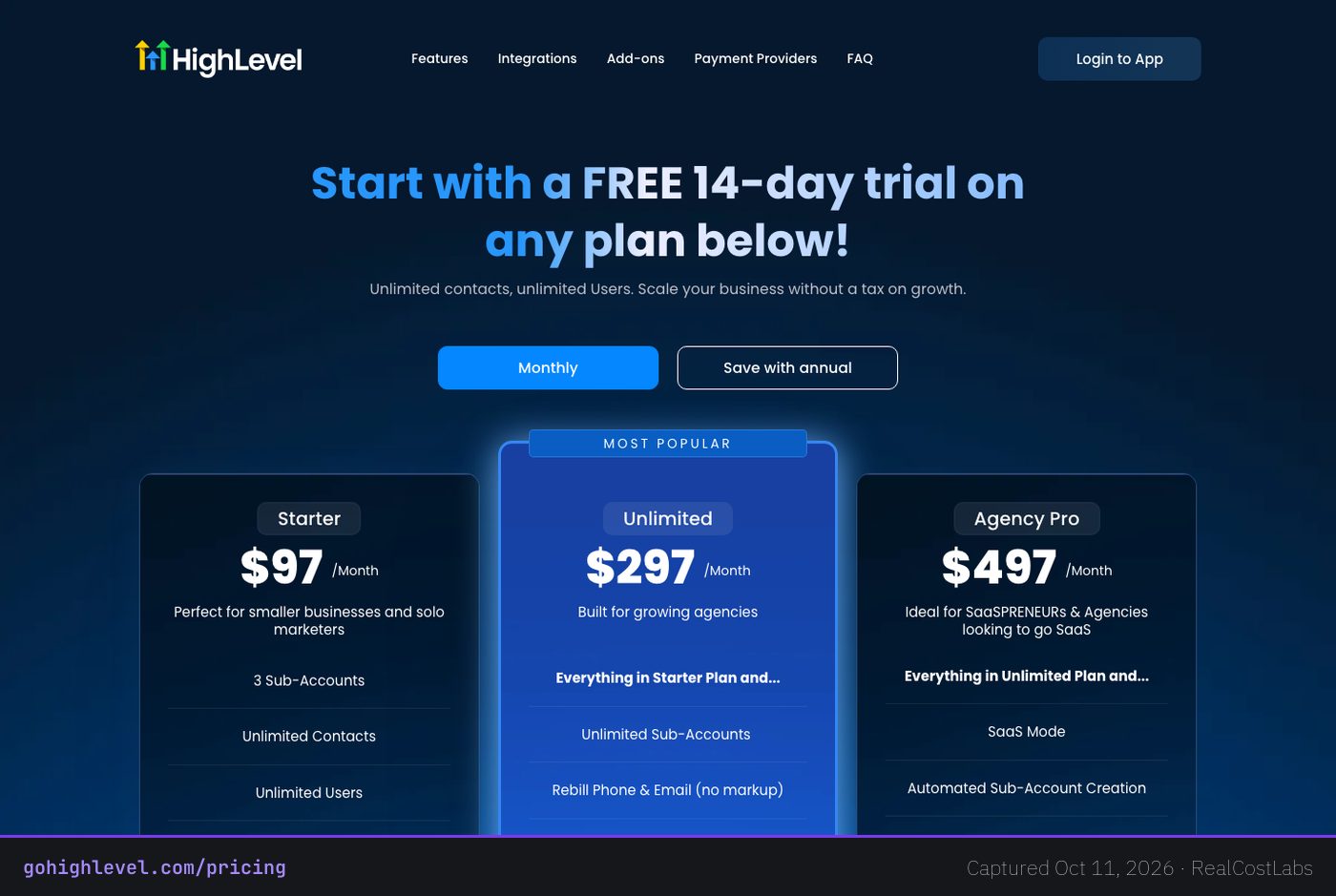
Annual billing takes roughly two months off, which brings SaaS Pro to about $414/mo effective. On top of the plan fee sits the prepaid wallet that meters SMS and email — the same wallet mechanics we break down in the full pricing teardown. The difference in SaaS mode is what happens to those wallet charges next.
How rebilling works
Rebilling runs on Stripe Connect. You link your own Stripe account, GoHighLevel charges your clients through it, and the revenue lands with you. GoHighLevel then charges you separately: the $497 plan fee plus whatever raw usage your clients burned through your wallet.
The margin lever is the markup multiplier. Wholesale rates are small — LC Phone runs about $0.0079 per SMS segment, LC Email about $0.675 per 1,000 sends — and SaaS mode lets you rebill client usage at up to 5x those rates. The client’s card is charged your marked-up price automatically; the wholesale cost hits your wallet; the spread is yours.
Concrete version: a client sends 10,000 SMS segments in a month. Raw cost to you is about $79. At a 3x markup they pay about $237, and you keep roughly $158 — on usage alone, before their subscription fee. Usage stops being a cost line and becomes a second revenue line.
Building your own pricing tiers
The SaaS configurator lets you define your own plans, gate features per tier, and attach a trial. The obvious ladder mirrors GoHighLevel’s own: something like $97, $297, and $497 per month, with CRM and funnels at the bottom and automations, memberships, and API access reserved for the top. The right price depends on niche and how much service is bundled in; the worked example below uses $197.
Three pricing notes. First, offer two or three tiers rather than five. Second, an annual option paid up front is the cheapest churn insurance available. Third, a one-time setup fee — even $199 — filters out the tire-kickers who would otherwise consume a month of onboarding support and cancel in week five.
The margin math, worked
Here is the standard solo-operator case: 15 clients on a single $197/mo plan, moderate usage, markup covering most wallet burn.
| Line item | Monthly |
|---|---|
| 15 clients × $197 | $2,955 MRR |
| SaaS Pro plan | −$497 |
| Wallet usage, net of rebilling offset | −$150 |
| Gross profit | $2,308 · ~78 percent margin |
Two caveats. Stripe takes its cut — about 2.9 percent plus 30 cents per charge, call it $90/mo on this book — which pulls the true margin closer to 75 percent. And the model says nothing about your hours, which is where the real cost hides. Every assumption above is adjustable: plug your own client count, price point, markup, and churn rate into the SaaS margin calculator rather than trusting our example. It models the wallet mechanics for you.
Churn and support: what the margin hides
Plan for churn: at 7 percent a month, a 15-client book loses about one client a month. That means one new signup a month just to stand still.
You are also the vendor now. Password resets, deliverability questions, a client who deleted their own automation and wants it back — all of it lands on you, not on GoHighLevel. Budget support time for each client in the first quarter after signup. The 78 percent gross margin exists to fund exactly this; the binding constraint for a solo operator is hours, not software cost. Agencies weighing SaaS mode against a conventional service model should read the agency playbook first, because hybrid setups — services for anchor clients, SaaS for the long tail — are where the math works best.
Setup checklist
The order matters. A rebilling misconfiguration is the fastest way to lose money in month one.
- Upgrade to SaaS Pro ($497/mo, or ~$414 effective on annual).
- Connect your Stripe account via Stripe Connect.
- Set your white-label domain and branding so signup never shows GoHighLevel’s name.
- Build a snapshot — the pre-loaded funnels, automations, and pipelines every new client account is cloned from. This is your actual product.
- Define two or three plans in the SaaS configurator with feature gates per tier.
- Set the usage markup. Start at 2x or 3x, not the 5x ceiling; you can raise it later without a conversation, but lowering it after complaints is a credibility cost.
- Configure trial length and the failed-payment sequence, including automatic account pause.
- Run one end-to-end test signup with a real card before sending traffic.
Who should buy it — and who should stay at $297
- Recurring software revenue that scales without headcount
- Usage becomes a profit line at up to 5x markup
- A niche snapshot becomes a sellable product, not a service
- The $200/mo jump over Unlimited is covered by one or two clients at $197
- Fewer than five clients and no near-term plan to sell software
- High-touch service model where clients never log in
- No appetite for running a support desk
- Cosmetic white-label is all the branding you need
The break-even is unusually short: the $200/mo difference between Unlimited and SaaS Pro is paid for by the second SaaS client at almost any realistic price point. The harder question is whether you want to run a software company, with the churn and support economics that implies. Our full GoHighLevel review scores the platform as a whole; this feature is the strongest single argument in it.